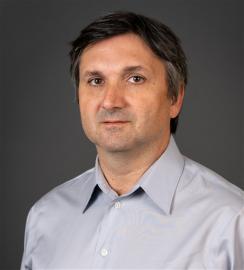
Ioan Bejenaru
· ProfessorUniversity of California, San Diego · Mathematics
Active 2001–2025
About
Ioan Bejenaru received his Ph.D. in Mathematics from the University of California, Berkeley, in 2003. He has held academic positions at UCLA as a Hedrick Assistant Professor from 2004 to 2007, at Texas A&M University as an Assistant Professor from 2007 to 2008, and at the University of Chicago as an Assistant Professor from 2008 to 2012. Since 2012, he has been a faculty member at UC San Diego. His research interests are in the field of Nonlinear Partial Differential Equations and Harmonic Analysis. His work covers a variety of topics including nonlinear Schrödinger equations, systems of dispersive equations, geometric partial differential equations, and the stability of solitons.
Research topics
- Computer Science
- Mathematics
- Pure mathematics
- Mathematical analysis
- Geometry
- Mathematical optimization
Selected publications
Global Well-Posedness and Scattering for the Massive Dirac-Klein-Gordon System in Two Dimensions
Communications in Mathematical Physics · 2025-12-06
article1st authorCorrespondingGlobal well-posedness and scattering for the massive Dirac-Klein-Gordon system in two dimensions
arXiv (Cornell University) · 2025-01-07
preprintOpen access1st authorCorrespondingWe prove global well-posedness and scattering for the massive Dirac-Klein-Gordon system with small and low regularity initial data in dimension two. To achieve this, we impose a non-resonance condition on the masses.
Near soliton evolution for $2$-equivariant Schrödinger Maps in two space dimensions
arXiv (Cornell University) · 2024-08-30
preprintOpen access1st authorCorrespondingWe consider equivariant solutions for the Schrödinger Map equation in $2+1$ dimensions, with values into $\mathbb{S}^2$. Within each equivariance class $m \in \mathbb{Z}$ this admits a lowest energy nontrivial steady state $Q^m$, which extends to a two dimensional family of steady states by scaling and rotation. If $|m| \geq 3$ then these ground states are known to be stable in the energy space $\dot H^1$, whereas instability and even finite time blow-up along the ground state family may occur if $|m| = 1$. In this article we consider the most delicate case $|m| = 2$. Our main result asserts that small $\dot H^1$ perturbations of the ground state $Q^2$ yield global in time solutions, which satisfy global dispersive bounds. Unlike the higher equivariance classes, here we expect solutions to move arbitrarily far along the soliton family; however, we are able to provide a time dependent bound on the growth of the scale modulation parameter. We also show that within the equivariant class the ground state is stable in a slightly stronger topology $X \subset \dot H^1$.
The multilinear restriction estimate: almost optimality and localization
Mathematical Research Letters · 2022 · 5 citations
1st authorCorresponding- Mathematics
- Mathematical optimization
- Pure mathematics
The first result in this paper provides a very general $\epsilon$-removal argument for the multilinear restriction estimate. The second result provides a refinement of the multilinear restriction estimate in the case when some terms have appropriate localization properties; this generalizes a prior result of the author.
International Mathematics Research Notices · 2021 · 4 citations
1st authorCorresponding- Computer Science
- Mathematics
- Pure mathematics
Abstract In this paper, we establish the optimal multilinear restriction estimate for $n-1$ hypersurfaces with some curvature, where $n$ is the dimension of the underlying space. The result is sharp up to the end point and the role of curvature is made precise in terms of the shape operator.
arXiv (Cornell University) · 2020 · 2 citations
1st authorCorresponding- Computer Science
- Mathematics
- Pure mathematics
In this paper we establish the optimal multilinear restriction estimate for n-1 hypersurfaces with some curvature, where $n$ is the dimension of the underlying space. The result is sharp up to the endpoint and the role of curvature is made precise in terms of the shape operator.
arXiv (Cornell University) · 2020-02-27
preprintOpen access1st authorCorrespondingIn this paper we establish the optimal multilinear restriction estimate for\nn-1 hypersurfaces with some curvature, where $n$ is the dimension of the\nunderlying space. The result is sharp up to the endpoint and the role of\ncurvature is made precise in terms of the shape operator.\n
The multilinear restriction estimate: almost optimality and localization
arXiv (Cornell University) · 2019-12-13
preprintOpen access1st authorCorrespondingThe first result in this paper provides a very general $ε$-removal argument for the multilinear restriction estimate. The second result provides a refinement of the multilinear restriction estimate in the case when some terms have appropriate localization properties; this generalizes a prior result of the author.
The multilinear restriction estimate: a short proof and a refinement
Mathematical Research Letters · 2017-01-01 · 2 citations
preprintOpen access1st authorCorrespondingWe provide an alternative and self contained proof of the main result of Bennett, Carbery, Tao regarding the multilinear restriction estimate. The approach is inspired by the recent result of Guth about the Kakeya version of multilinear restriction estimate. At lower levels of multilinearity we provide a refined estimate in the context of small support for one of the terms involved.
Optimal Bilinear Restriction Estimates for General Hypersurfaces and the Role of the Shape Operator
International Mathematics Research Notices · 2016-10-13 · 2 citations
preprintOpen access1st authorCorrespondingIt is known that under some transversality and curvature assumptions on the hypersurfaces involved, the bilinear restriction estimate holds true with better exponents than what would trivially follow from the corresponding linear estimates. This subject was extensively studied for conic and parabolic surfaces with sharp results proved by Wolff and Tao, and with later generalizations by Lee. In this paper we provide a unified theory for general hypersurfaces and clarify the role of curvature in this problem, by making statements in terms of the shape operators of the hypersurfaces involved.
Recent grants
Topics in Dispersive Partial Differential Equations and Harmonic Analysis
NSF · $180k · 2016–2020
Schrodinger Maps and Related Problems
NSF · $57k · 2008–2010
Long Time Behaviour for Dispersive PDEs with Large Initial Data
NSF · $85k · 2012–2013
Frequent coauthors
- 30 shared
Daniel Tataru
- 19 shared
Alexandru D. Ionescu
Princeton University
- 17 shared
Carlos E. Kenig
University of Chicago
- 14 shared
Sebastian Herr
- 5 shared
Daniela De Silva
Columbia University
- 5 shared
Joachim Krieger
École Polytechnique Fédérale de Lausanne
- 3 shared
Zihua Guo
Xiangtan University
- 2 shared
Terence Tao
University of California, Los Angeles
- Resume-aware match score
- Save to shortlist
- AI-drafted outreach
See your match with Ioan Bejenaru
PhdFit ranks faculty by your research interests, methods, and publications — grounded in their actual work, not templates.
- Free to start
- No credit card
- 30-second signup