Resume-aware faculty matching

Find professors who actually fit you

Upload your resume. Four AI agents analyze your background, rank the faculty who fit, inspect their recent research, and help you draft outreach — grounded in their actual work, not templates.

Free to startNo credit cardCancel anytime
Top matches Balanced preset
Dr. Sarah Chen
Stanford · Interpretability · NLP
91
Dr. Marcus Holloway
MIT · Robotics · RL
84
Dr. Aisha Okonkwo
CMU · Fairness · HCI
82
Nova · Professor Researcher · re-ranking top 20…
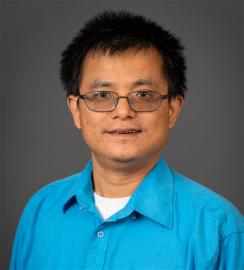
Jiawang Nie

Jiawang Nie

· ProfessorVerified

University of California, San Diego · Mathematics

Active 2000–2026

h-index34
Citations3.4k
Papers18464 last 5y
Funding$1.2M
See your match with Jiawang Nie — sign in to PhdFit.Sign in

About

Jiawang Nie is a professor in the Department of Mathematics at UC San Diego. His research is in the broad area of Numerical Analysis and Scientific Computing, with an emphasis on Polynomial and Semidefinite Optimization, Moment and Tensor Computation, Convex and Real Algebraic Geometry. He has received numerous honors including the Young Researcher Prize, NSF CAREER Award, Tucker Prize Finalist, Hellman Fellowship, SIAG/LA Best Paper Prize, the Kalman Visiting Fellowship, and the Feng Kang Prize in 2021. His educational background includes a Ph.D. in Applied Mathematics from the University of California, Berkeley, obtained in 2006.

Research topics

  • Computer Science
  • Mathematics
  • Pure mathematics
  • Physics
  • Mathematical analysis
  • Quantum mechanics
  • Geometry
  • Mathematical optimization
  • Combinatorics
  • Applied mathematics

Selected publications

  • Robust Completion for Rank-1 Tensors with Noises

    Journal of Scientific Computing · 2026-05-12

    articleOpen access1st author

    Abstract This paper studies the rank-1 tensor completion problem for cubic tensors when there are noises for observed tensor entries. First, we propose a robust biquadratic optimization model for obtaining rank-1 completing tensors. When the observed tensor is sufficiently close to be rank-1, we show that this biquadratic optimization produces an accurate rank-1 tensor completion. Second, we give an efficient convex relaxation for solving the biquadratic optimization. When the optimizer matrix is separable, we show how to get optimizers for the biquadratic optimization and how to compute the rank-1 completing tensor. When that matrix is not separable, we apply its spectral decomposition to obtain an approximate rank-1 completing tensor. The software is applied to solve the resulting large size semidefinite programs. Numerical experiments are given to explore the efficiency of this biquadratic optimization model and the proposed convex relaxation.

  • Lagrange multiplier expressions for matrix polynomial optimization and tight relaxations

    ArXiv.org · 2025-06-14

    preprintOpen access

    This paper studies matrix constrained polynomial optimization. We investigate how to get explicit expressions for Lagrange multiplier matrices from the first order optimality conditions. The existence of these expressions can be shown under the nondegeneracy condition. Using Lagrange multiplier matrix expressions, we propose a strengthened Moment-SOS hierarchy for solving matrix polynomial optimization. Under some general assumptions, we show that this strengthened hierarchy is tight, or equivalently, it has finite convergence. We also study how to detect tightness and how to extract optimizers. Numerical experiments are provided to show the efficiency of the strengthened hierarchy.

  • A Tight SDP Relaxation for the Cubic-Quartic Regularization Problem

    ArXiv.org · 2025-10-31

    preprintOpen access

    This paper studies how to compute global minimizers of the cubic-quartic regularization (CQR) problem \[ \min_{s \in \mathbb{R}^n} \quad f_0+g^Ts+\frac{1}{2}s^THs+\fracβ{6} \| s \|^3+\fracσ{4} \| s \|^4, \] where $f_0$ is a constant, $g$ is an $n$-dimensional vector, $H$ is a $n$-by-$n$ symmetric matrix, and $\| s \|$ denotes the Euclidean norm of $s$. The parameter $σ\ge 0$ while $β$ can have any sign. The CQR problem arises as a critical subproblem for getting efficient regularization methods for solving unconstrained nonlinear optimization. Its properties are recently well studied by Cartis and Zhu [cubic-quartic regularization models for solving polynomial subproblems in third-order tensor methods, Math. Program, 2025]. However, a practical method for computing global minimizers of the CQR problem still remains elusive. To this end, we propose a semidefinite programming (SDP) relaxation method for solving the CQR problem globally. First, we show that our SDP relaxation is tight if and only if $\| s^* \| ( β+ 3 σ\| s^* \|) \ge 0$ holds for a global minimizer $s^*$. In particular, if either $β\ge 0$ or $H$ has a nonpositive eigenvalue, then the SDP relaxation is shown to be tight. Second, we show that all nonzero global minimizers have the same length for the tight case. Third, we give an algorithm to detect tightness and to obtain the set of all global minimizers. Numerical experiments demonstrate that our SDP relaxation method is both effective and computationally efficient, providing the first practical method for globally solving the CQR problem.

  • Finite convergence of the Moment-SOS hierarchy for polynomial matrix optimization

    Mathematical Programming · 2025-02-15 · 2 citations

    articleSenior author
  • Optimization over the weakly Pareto set and multi-task learning

    ArXiv.org · 2025-03-31

    preprintOpen access

    We study the optimization problem over the weakly Pareto set of a convex multiobjective optimization problem given by polynomial functions. Using Lagrange multiplier expressions and the weight vector, we give three types of representations for the weakly Pareto set. Using these representations, we reformulate the optimization problem over the weakly Pareto set as a polynomial optimization problem. We then apply the Moment--SOS hierarchy to solve it and analyze its convergence properties under certain conditions. Numerical experiments are provided to demonstrate the effectiveness of our methods. Applications in multi-task learning are also presented.

  • Preface: Recent advances in polynomial optimization theory and methods

    Numerical Algebra Control and Optimization · 2025-10-23

    articleOpen access
  • A characterization for tightness of the sparse Moment-SOS hierarchy

    Mathematical Programming · 2025-05-02 · 1 citations

    articleOpen access1st authorCorresponding

    Abstract This paper studies the sparse Moment-SOS hierarchy of relaxations for solving sparse polynomial optimization problems. We show that this sparse hierarchy is tight if and only if the objective can be written as a sum of sparse nonnegative polynomials, each of which belongs to the sum of the ideal and quadratic module generated by the corresponding sparse constraints. Based on this characterization, we give several sufficient conditions for the sparse Moment-SOS hierarchy to be tight. In particular, we show that this sparse hierarchy is tight under some assumptions such as convexity, optimality conditions or finiteness of constraining sets.

  • Polynomial optimization relaxations for generalized semi-infinite programs

    Mathematical Programming Computation · 2025-04-18 · 1 citations

    articleOpen accessSenior author

    Abstract This paper studies generalized semi-infinite programs (GSIPs) given by polynomials. We propose a hierarchy of polynomial optimization relaxations to solve them. They are based on Lagrange multiplier expressions and polynomial extensions. Moment-SOS relaxations are applied to solve the polynomial optimization. The convergence of this hierarchy is shown under certain conditions. In particular, the classical semi-infinite programs can be solved as a special case of GSIPs. We also study GSIPs that have convex infinity constraints and show that they can be solved exactly by a single polynomial optimization relaxation. The computational efficiency is demonstrated by extensive numerical results.

  • Moment-SOS relaxations for moment and tensor recovery problems

    Numerical Algebra Control and Optimization · 2025-10-20

    articleOpen access

    This paper studies moment and tensor recovery problems whose decomposing vectors are contained in some given semialgebraic sets. We propose Moment-SOS relaxations with generic objectives for recovering moments and tensors, whose decomposition lengths are expected to be low. The tensor recovery problem is treated as a structured instance of the moment recovery problem. This kind of problems have broad applications in various tensor decomposition questions. Numerical experiments are provided to demonstrate the efficiency of this approach.

  • A Global Approach for Generalized Semi-Infinite Programs with Polyhedral Parameter Sets

    Journal of Optimization Theory and Applications · 2025-08-13

    article

Recent grants

Frequent coauthors

  • Zi Yang

    University at Albany, State University of New York

    19 shared
  • Suhan Zhong

    Texas A&M University

    17 shared
  • Xindong Tang

    Hong Kong Baptist University

    16 shared
  • J. William Helton

    University of California, San Diego

    15 shared
  • Ya-xiang Yuan

    Chinese Academy of Sciences

    13 shared
  • Xinzhen Zhang

    Hunan Agricultural University

    12 shared
  • James Demmel

    12 shared
  • Bernd Sturmfels

    7 shared

Awards & honors

  • Young Researcher Prize
  • NSF CAREER Award
  • Tucker Prize
  • Finalist Hellman Fellowship
  • SIAG/LA Best Paper Prize
  • Resume-aware match score
  • Save to shortlist
  • AI-drafted outreach

See your match with Jiawang Nie

PhdFit ranks faculty by your research interests, methods, and publications — grounded in their actual work, not templates.

  • Free to start
  • No credit card
  • 30-second signup