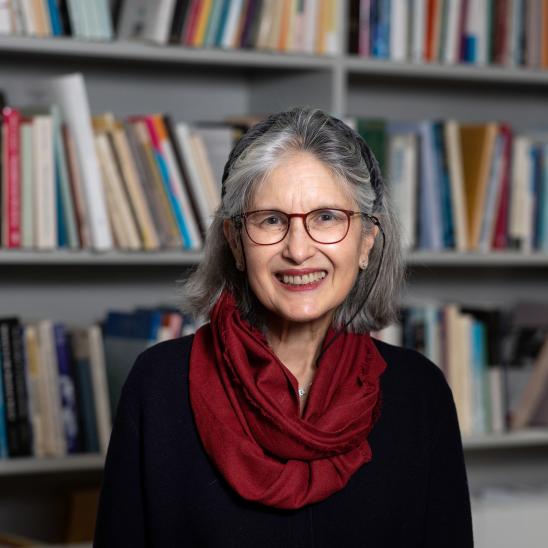
Lorraine Daston
· Visiting Professor, History and Social ThoughtVerifiedUniversity of Chicago · History of Science, Medicine, and Technology
Active 1978–2026
About
Lorraine Daston is a Director at the Max Planck Institute for the History of Science in Berlin and a regular visiting professor in the Committee on Social Thought at the University of Chicago. Her work focuses on the history of rationality, especially but not exclusively scientific rationality. She has written extensively on topics such as the history of wonder, objectivity, observation, the moral authority of nature, probability, Cold War rationality, and scientific modernity. Her current book projects include a history of rules and an inquiry into the relationship between the moral and natural orders.
Research topics
- Political Science
- Sociology
- History
- Law
- Social Science
- Computer Science
- Philosophy
- Art
- Media studies
- Psychology
- Ancient history
- Pedagogy
- Literature
- Economic history
- Geography
- Biology
- Genealogy
- Epistemology
- Ethnology
- Demography
- Virology
- Medicine
Selected publications
« Ian était fier d’être inclassable »
Zilsel · 2026-02-10
article1st authorCorrespondingL’historienne des sciences Lorraine Daston a entretenu, avec Ian Hacking, un long dialogue intellectuel qui a couru des années 1980 aux années 2010. Des premiers questionnements sur la statistique aux réflexions sur une définition opératoire de l’épistémologie historique, en passant par la problématisation de la notion d’objectivité, ce sont de multiples objets et interrogations qui ont nourri leurs échanges. Cette diversité des prises et des enjeux épistémiques ne doit cependant pas cacher qu’une même trame sous-tend les travaux de Lorraine Daston et de Ian Hacking : restituer la profondeur temporelle et analytique de notions d’histoire des sciences telles que celles de probabilité ou d’objectivité) leur profondeur temporelle et analytique. Un seul point (mais d’importance) les sépare : Lorraine Daston ne franchit pas le seuil de la philosophie, domaine natif de Ian Hacking dont il s’est ensuite ingénié à franchir allégrement les frontières. Dans l’entretien que nous avons mené avec l’historienne des sciences, nous sommes donc revenus sur ses lectures des travaux de Hacking et les échanges qu’elle a entretenus avec lui au cours du temps. Il s’est agi de restituer les termes d’un dialogue continu, tonique et (toujours) surprenant.
Co-authorship in Early Modern European Science
2025-12-01
book-chapter1st authorCorresponding2025-09-26 · 2 citations
article1st authorCorrespondingWonders and the Order of Nature 1150–1750
Zone Books · 2025-12-16 · 1 citations
book1st authorCorrespondingLiverpool University Press eBooks · 2025-02-27
book-chapter1st authorCorrespondingAttention and the Values of Nature in the Enlightenment
2024-10-03
book-chapter1st authorCorrespondingIn eighteenth-century Enlightenment natural history, what distinguished genuine naturalists in the eyes of their peers was not professional status, but rather the practice of heroic observation, described as at once a talent, a discipline, and a method. None sufficed without the others. Attentive observation was firmly distinguished from mere seeing, and even from remarking upon. In his letters to the naturalist René Antoine Ferchault de Réaumur, the young Charles Bonnet dismissed his own earlier observations on caterpillars as what “mediocre attention could perceive,” since he “was not yet well instructed in all the precautions required for the exactitude of an observation.” 1 To observe an object attentively meant first and foremost to observe it distinctly, which the naturalists defined as a kind of mental as well as visual dissection. Microscopes and magnifying glasses were standard tools of the trade, and some of the most vaunted feats of observation in nineteenth-century history, such as fellow naturalist Jan Swammerdam's remarkable account of the ovaries of the queen bee, were anatomies of minutiae: the intestines of a caterpillar or the subcutaneous membranes of plants.
THE POWER OF EXEMPLA AND THE EPISTEMOLOGY OF THE HUMANITIES
2024-03-18
book-chapter1st authorCorrespondingInterdisciplinary Science Reviews · 2024-03-01 · 1 citations
article1st authorCorrespondingIan Macdougall Hacking (1936–2023)
Isis · 2024-02-26 · 1 citations
article1st authorCorrespondingAHS volume 78 issue 3 Cover and Front matter
Annales Histoire Sciences Sociales · 2023-09-01
articleOpen accessAn abstract is not available for this content so a preview has been provided. As you have access to this content, a full PDF is available via the ‘Save PDF’ action button.
Frequent coauthors
- 344 shared
Pierre‐François Souyri
University of Cambridge
- 344 shared
André Orléan
- 344 shared
François Hartog
University of Cambridge
- 344 shared
Christian Lamouroux
École des Hautes Études en Santé Publique
- 344 shared
Laurent Thévenot
- 344 shared
Sandro Carocci
University of Rome Tor Vergata
- 344 shared
Jacques Revel
- 344 shared
Jane Burbank
École des hautes études en sciences sociales
- Resume-aware match score
- Save to shortlist
- AI-drafted outreach
See your match with Lorraine Daston
PhdFit ranks faculty by your research interests, methods, and publications — grounded in their actual work, not templates.
- Free to start
- No credit card
- 30-second signup