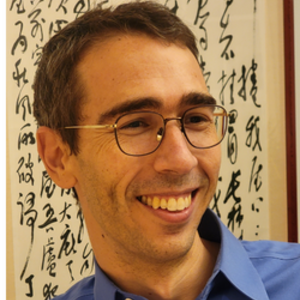
Lucas Bender
· Associate ProfessorYale University · Department of Film and Media Studies
Active 2019–2025
About
Lucas Bender is an Associate Professor in the Department of East Asian Languages and Literatures and the Humanities Program at Yale University. His primary research concerns early and medieval Chinese literature, roughly from 200 BCE to 900 CE, with a focus on its relationship to Chinese intellectual and religious life. He received his Ph.D. in 2016 from Harvard University, where his dissertation argued that the work of the Tang-dynasty poet Du Fu has played a central role in the reimagination of poetry’s relationship with ethics over the last millennium of Chinese history. At Yale, Bender plans to revise his dissertation into a book and is working on a second project examining the split near the end of the Chinese classical period between textual traditions understood as 'literary' and 'philosophical.' He has a longstanding interest in Chinese religions and aims to publish on medieval Daoist and Buddhist poetry and literary theory. His academic interests include comparative religion and philosophy, particularly the relationships between literary works and ethical cultivation in China and the West, as well as the tragic visions of human life explored through literature. He teaches courses in Chinese literature, Chinese thought from the Han dynasty through the Song, comparative topics, and Directed Studies, reflecting his engagement with Chinese intellectual history and literary theory.
Research topics
- Art
- Computer Science
- Literature
- Aesthetics
- Psychoanalysis
- Psychology
- History
Selected publications
The Literary-Critical Use of the Term <i>Duncuo</i> 頓挫
Journal of Chinese Literature and Culture · 2025-04-01
article1st authorCorrespondingAbstract Though apparently a peripheral literary-critical concept, duncuo 頓挫—roughly, “unpredictable variability within a literary text”—illustrates core attitudes and key developmental dynamics of the premodern Chinese critical tradition. This article surveys the term's development from the Han dynasty through the Qing and catalogs the surprisingly wide range of techniques and textual characteristics it came to denote. The author contends that, despite the term's sometime ambiguity, most of these disparate techniques and textual characteristics were united in intimating that the text to which they belonged did not completely account for itself. Duncuo thus involved the text in realities larger, more complex, and more alive than any text could capture completely.
Shi -Poetry as a Venue for Political Thinking: The Case of the Tibetan Border
Tang Studies · 2025-01-01
article1st authorCorrespondingAbstract: This essay considers how medieval poetry could sometimes serve as the venue for shared discussions of difficult political issues and how, in such cases, the genre shaped the discussions it hosted. My example case is the corpus of Middle Tang (roughly 756–840) shi -poetry that survives concerning the Tibetan empire, which during the period conquered and incorporated large areas that had long been under Tang control. Two central arguments are advanced on the basis of this material. First, I demonstrate that understanding the reasons why the poetic form presented a propitious venue for discussing this situation can help us account for the content of this poetry, particularly in its contrast to discussions in other genres. Second, I show that the visions of territory and identity that can be found in this corpus depart from the understandings often thought characteristic of “traditional” China, anticipating in certain respects more “modern” conceptions of the nation. This example thus suggests that medieval thought about China’s place in the world was generically diverse and that poetry specifically may have contributed to the development of new ideas of Chinese identity.
Period Terms and Narrative Thinking
Early Medieval China · 2024-11-14
article1st authorCorrespondingDreaming and Self-Cultivation in China: 300 BCE–800 CE
Early Medieval China · 2024-11-14
article1st authorCorrespondingWhy Poetry for the Middle-Tang “Poet-Monks”?
T oung Pao · 2024-12-10
article1st authorCorrespondingAbstract This essay asks why monks’ literary pursuits came in the Middle Tang period (roughly 755–825) to be particularly associated with the single genre of shi -poetry 詩. Though monks in China had previously engaged extensively in literary writing and had written significant amounts of shi -poetry, no monk before this period had been labeled a “ shi-seng ” 詩僧 (“poet-monk”). This essay suggests that this novel Middle-Tang phenomenon reflects the way discourse about literature in general, and key genres of prose in particular, had begun to connect literary writing with a Confucianism increasingly conceptualized in contradistinction to Buddhism. By comparison, discourse focused on shi -poetry partly resisted this Confucianization and preserved features of an earlier vision of literary composition that made room for Buddhist participation.
Journal of the American Oriental Society · 2024-03-04
article1st authorCorresponding
 
 
 The Tang has often been considered the historical high point of Chinese “cosmopolitanism.” Recent scholarship, however, has been divided on the questions of just how tolerant the era actually was of ethnocultural difference and of whether it represented a turning point in Chinese history toward increasing xenophobia or, on the contrary, toward a less exclusive conception of Chinese identity. This essay suggests that surviving evidence is susceptible to contradictory interpretations on account of its preservation in textual genres characterized by complex motivations that, moreover, changed dramatically over the course of the dynasty. We should not, therefore, uncritically accept statements concerning ethnocultural identity and difference in preserved texts as representative of the thoughts or feelings of even the literati class. A better understanding of the evolution of Chinese attitudes on these questions, instead, will require attention to the ways Tang ideas about texts shaped the attitudes literati felt worthy of expression in them, and how they did so differently in different periods.
 
 
Period Terms and Narrative Thinking
Early Medieval China · 2024-01-01
article1st authorCorrespondingPoetic Omens and Poetic History
Harvard University Asia Center eBooks · 2023-08-30
book-chapter1st authorCorrespondingPoetic Omens and Poetic History
Harvard University Asia Center eBooks · 2023-04-04
book-chapter1st authorCorrespondingTang Studies · 2023-01-01
article1st authorCorrespondingAbstract: This essay argues that many of the compilational projects and scholarly works produced by the court of Tang Emperor Taizong 太宗 (r. 626–649) advance a coherent and novel set of claims about his person and his salvific participation in the realm of cultural forms ( wen 文). These projects intervene in several previously disconnected sixth-century debates and suggest that their proper solutions are all related to one common narrative of the development, more-recent decline, and nascent reinvigoration of Chinese civilization. Although records of the contemporary reception of this narrative outside of the court do not survive, in the decades after Taizong's death it would be echoed, repurposed, and partially inverted by literati arguing the importance and authority of their own interventions in wen . These echoes of Taizong's court projects in literati work show that they had to some degree succeeded in unifying what had recently been a more-fragmented intellectual world.
- Resume-aware match score
- Save to shortlist
- AI-drafted outreach
See your match with Lucas Bender
PhdFit ranks faculty by your research interests, methods, and publications — grounded in their actual work, not templates.
- Free to start
- No credit card
- 30-second signup