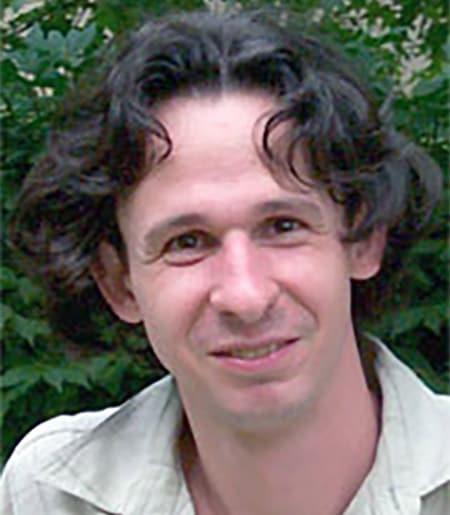
Martin Kassabov
· ProfessorVerifiedCornell University · Mathematics
Active 2002–2026
About
Martin Kassabov is a professor in the Department of Mathematics at Cornell University. He holds an M.Sc. from Sofia University (1998) and a Ph.D. from Yale University (2003). His research interests primarily focus on the representation theory of discrete groups, with particular emphasis on Kazhdan property and property tau, which have numerous applications in combinatorics. A significant part of his work involves properties T and tau, arising from the representation theory, and their applications in combinatorics. Additionally, his research encompasses combinatorial algebra, concentrating on topics such as automorphism groups, Golod-Shafarevich groups, and group rings.
Research topics
- Mathematics
- Artificial Intelligence
- Computer Science
- Algorithm
- Discrete mathematics
- Combinatorics
Selected publications
Examples of finitely presented groups with strong fixed point properties and property (T)
Open MIND · 2026-01-30
preprintSenior authorWe construct a finitely presented group with property (T) which can not act on on reasonable spaces. Such group is constructed using an generalization of Hall embedding theorem, where property (T) is added at the expense of weakening the simplicity requirement.
Examples of finitely presented groups with strong fixed point properties and property (T)
ArXiv.org · 2026-01-30
articleOpen accessSenior authorWe construct a finitely presented group with property (T) which can not act on on reasonable spaces. Such group is constructed using an generalization of Hall embedding theorem, where property (T) is added at the expense of weakening the simplicity requirement.
Expander graphs are globally synchronizing
Advances in Mathematics · 2026-01-19 · 2 citations
preprintOpen accessExpander graphs are globally synchronizing
Advances in Mathematics · 2026-01-19
articleGroups with property (T) and many alternating group quotients
Groups Geometry and Dynamics · 2025-08-01
articleOpen accessSenior authorWe prove that, for the free algebra over a sufficiently rich operad \mathcal{O} , a large subgroup of its group of tame automorphisms has Kazhdan’s property (T). We deduce that there exists a group with property (T) that maps onto large powers of alternating groups.
Detecting null patterns in tensor data
arXiv (Cornell University) · 2024-08-30
preprintOpen accessThis article introduces a class of efficiently computable null patterns for tensor data. The class includes familiar patterns such as block-diagonal decompositions explored in statistics and signal processing, low-rank tensor decompositions, and Tucker decompositions. It also includes a new family of null patterns -- not known to be detectable by current methods -- that can be thought of as continuous decompositions approximating curves and surfaces. We present a general algorithm to detect null patterns in each class using a parameter we call a \textit{chisel} that tunes the search to patterns of a prescribed shape. We also show that the patterns output by the algorithm are essentially unique.
Monotone parameters on Cayley graphs of finitely generated groups
arXiv (Cornell University) · 2024-04-16
preprintOpen access1st authorCorrespondingWe construct a new large family of finitely generated groups with continuum many values of the following monotone parameters: spectral radius, critical percolation, and asymptotic entropy. We also present several open problems on other monotone parameters.
Symmetric Polynomials in Free Associative Algebras—II
Mathematics · 2023-11-29
articleOpen accessSenior authorLet K⟨Xd⟩ be the free associative algebra of rank d≥2 over a field, K. In 1936, Wolf proved that the algebra of symmetric polynomials K⟨Xd⟩Sym(d) is infinitely generated. In 1984 Koryukin equipped the homogeneous component of degree n of K⟨Xd⟩ with the additional action of Sym(n) by permuting the positions of the variables. He proved finite generation with respect to this additional action for the algebra of invariants K⟨Xd⟩G of every reductive group, G. In the first part of the present paper, we established that, over a field of characteristic 0 or of characteristic p>d, the algebra K⟨Xd⟩Sym(d) with the action of Koryukin is generated by (noncommutative version of) the elementary symmetric polynomials. Now we prove that if the field, K, is of positive characteristic at most d then the algebra K⟨Xd⟩Sym(d), taking into account that Koryukin’s action is infinitely generated, describe a minimal generating set.
Transactions of the American Mathematical Society · 2023 · 2 citations
Senior authorCorresponding- Artificial Intelligence
- Computer Science
- Algorithm
We construct new families of groups with property (T) and infinitely many alternating group quotients. One of those consists of subgroups of <inline-formula content-type="math/mathml"> <mml:math xmlns:mml="http://www.w3.org/1998/Math/MathML" alttext="normal upper A normal u normal t left-parenthesis bold upper F Subscript p Baseline left-bracket x 1 comma ellipsis comma x Subscript n Baseline right-bracket right-parenthesis"> <mml:semantics> <mml:mrow> <mml:mrow class="MJX-TeXAtom-ORD"> <mml:mi mathvariant="normal">A</mml:mi> <mml:mi mathvariant="normal">u</mml:mi> <mml:mi mathvariant="normal">t</mml:mi> </mml:mrow> <mml:mo stretchy="false">(</mml:mo> <mml:msub> <mml:mrow class="MJX-TeXAtom-ORD"> <mml:mi mathvariant="bold">F</mml:mi> </mml:mrow> <mml:mrow class="MJX-TeXAtom-ORD"> <mml:mi>p</mml:mi> </mml:mrow> </mml:msub> <mml:mo stretchy="false">[</mml:mo> <mml:msub> <mml:mi>x</mml:mi> <mml:mn>1</mml:mn> </mml:msub> <mml:mo>,</mml:mo> <mml:mo> … </mml:mo> <mml:mo>,</mml:mo> <mml:msub> <mml:mi>x</mml:mi> <mml:mi>n</mml:mi> </mml:msub> <mml:mo stretchy="false">]</mml:mo> <mml:mo stretchy="false">)</mml:mo> </mml:mrow> <mml:annotation encoding="application/x-tex">\mathrm {Aut}(\mathbf {F}_{p}[x_1, \dots , x_n])</mml:annotation> </mml:semantics> </mml:math> </inline-formula> generated by a suitable set of tame automorphisms. Finite quotients are constructed using the natural action of <inline-formula content-type="math/mathml"> <mml:math xmlns:mml="http://www.w3.org/1998/Math/MathML" alttext="normal upper A normal u normal t left-parenthesis bold upper F Subscript p Baseline left-bracket x 1 comma ellipsis comma x Subscript n Baseline right-bracket right-parenthesis"> <mml:semantics> <mml:mrow> <mml:mrow class="MJX-TeXAtom-ORD"> <mml:mi mathvariant="normal">A</mml:mi> <mml:mi mathvariant="normal">u</mml:mi> <mml:mi mathvariant="normal">t</mml:mi> </mml:mrow> <mml:mo stretchy="false">(</mml:mo> <mml:msub> <mml:mrow class="MJX-TeXAtom-ORD"> <mml:mi mathvariant="bold">F</mml:mi> </mml:mrow> <mml:mrow class="MJX-TeXAtom-ORD"> <mml:mi>p</mml:mi> </mml:mrow> </mml:msub> <mml:mo stretchy="false">[</mml:mo> <mml:msub> <mml:mi>x</mml:mi> <mml:mn>1</mml:mn> </mml:msub> <mml:mo>,</mml:mo> <mml:mo> … </mml:mo> <mml:mo>,</mml:mo> <mml:msub> <mml:mi>x</mml:mi> <mml:mi>n</mml:mi> </mml:msub> <mml:mo stretchy="false">]</mml:mo> <mml:mo stretchy="false">)</mml:mo> </mml:mrow> <mml:annotation encoding="application/x-tex">\mathrm {Aut}(\mathbf {F}_{p}[x_1, \dots , x_n])</mml:annotation> </mml:semantics> </mml:math> </inline-formula> on the <inline-formula content-type="math/mathml"> <mml:math xmlns:mml="http://www.w3.org/1998/Math/MathML" alttext="n"> <mml:semantics> <mml:mi>n</mml:mi> <mml:annotation encoding="application/x-tex">n</mml:annotation> </mml:semantics> </mml:math> </inline-formula> -dimensional affine spaces over finite extensions of <inline-formula content-type="math/mathml"> <mml:math xmlns:mml="http://www.w3.org/1998/Math/MathML" alttext="bold upper F Subscript p"> <mml:semantics> <mml:msub> <mml:mrow class="MJX-TeXAtom-ORD"> <mml:mi mathvariant="bold">F</mml:mi> </mml:mrow> <mml:mi>p</mml:mi> </mml:msub> <mml:annotation encoding="application/x-tex">\mathbf {F}_p</mml:annotation> </mml:semantics> </mml:math> </inline-formula> . As a consequence, we obtain explicit presentations of Gromov hyperbolic groups with property (T) and infinitely many alternating group quotients. Our construction also yields an explicit infinite family of expander Cayley graphs of degree <inline-formula content-type="math/mathml"> <mml:math xmlns:mml="http://www.w3.org/1998/Math/MathML" alttext="4"> <mml:semantics> <mml:mn>4</mml:mn> <mml:annotation encoding="application/x-tex">4</mml:annotation> </mml:semantics> </mml:math> </inline-formula> for alternating groups of degree <inline-formula content-type="math/mathml"> <mml:math xmlns:mml="http://www.w3.org/1998/Math/MathML" alttext="p Superscript 7 Baseline minus 1"> <mml:semantics> <mml:mrow> <mml:msup> <mml:mi>p</mml:mi> <mml:mn>7</mml:mn> </mml:msup> <mml:mo> − </mml:mo> <mml:mn>1</mml:mn> </mml:mrow> <mml:annotation encoding="application/x-tex">p^7-1</mml:annotation> </mml:semantics> </mml:math> </inline-formula> for any odd prime <inline-formula content-type="math/mathml"> <mml:math xmlns:mml="http://www.w3.org/1998/Math/MathML" alttext="p"> <mml:semantics> <mml:mi>p</mml:mi> <mml:annotation encoding="application/x-tex">p</mml:annotation> </mml:semantics> </mml:math> </inline-formula> .
Property (T) and Many Quotients
arXiv (Cornell University) · 2023-08-28
preprintOpen accessSenior authorWe prove that, for the free algebra over a sufficiently rich operad, a large subgroup of its group of tame automorphisms has Kazhdan's property (T). We deduce that there exists a group with property (T) that maps onto large powers of alternating groups.
Recent grants
Properties T, Tau and Kazhdan constants
NSF · $105k · 2006–2009
Representation Theory of Groups and Applications
NSF · $194k · 2013–2016
Properties T, Tau and pro-finite groups
NSF · $196k · 2009–2014
Representation Theory of Groups and Applications
NSF · $229k · 2016–2019
Frequent coauthors
- 35 shared
Francesco Matucci
- 21 shared
Collin Bleak
- 18 shared
Andrei Jaikin‐Zapirain
- 15 shared
William M. Kantor
- 12 shared
Nikolay Nikolov
University of Oxford
- 11 shared
Robert M. Guralnick
Walter de Gruyter (Germany)
- 10 shared
Alexander Lubotzky
Courant Institute of Mathematical Sciences
- 9 shared
Tim Riley
Cornell University
Awards & honors
- Twelve new Klarman Fellows to pursue innovative, timely rese…
- Resume-aware match score
- Save to shortlist
- AI-drafted outreach
See your match with Martin Kassabov
PhdFit ranks faculty by your research interests, methods, and publications — grounded in their actual work, not templates.
- Free to start
- No credit card
- 30-second signup