Resume-aware faculty matching

Find professors who actually fit you

Upload your resume. Four AI agents analyze your background, rank the faculty who fit, inspect their recent research, and help you draft outreach — grounded in their actual work, not templates.

Free to startNo credit cardCancel anytime
Top matches Balanced preset
Dr. Sarah Chen
Stanford · Interpretability · NLP
91
Dr. Marcus Holloway
MIT · Robotics · RL
84
Dr. Aisha Okonkwo
CMU · Fairness · HCI
82
Nova · Professor Researcher · re-ranking top 20…
Marvin Joshi

Marvin Joshi

· ProfessorVerified

Georgia Institute of Technology · Electrical and Computer Engineering

Active 2020–2026

h-index3
Citations16
Papers1616 last 5y
Funding
See your match with Marvin Joshi — sign in to PhdFit.Sign in

About

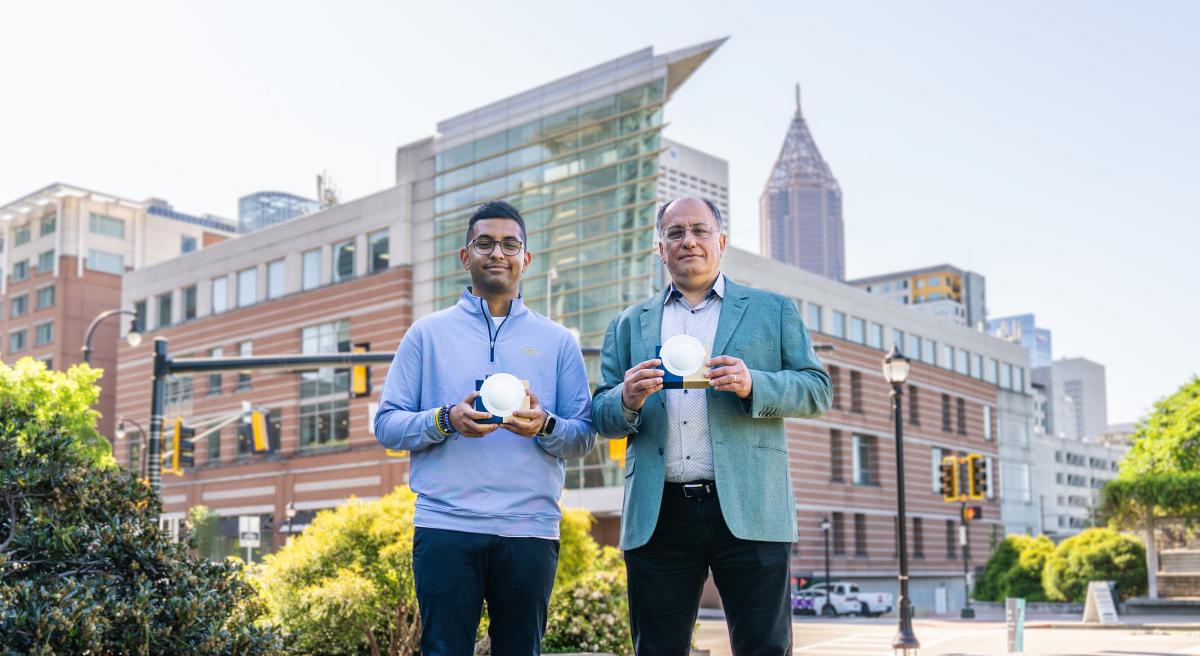
Professor Emmanouil 'Manos' Tentzeris is the Ed and Pat Joy Chair Professor in the School of Electrical and Computer Engineering at Georgia Tech. His research focuses on high-performance electromagnetic applications, particularly in the development of innovative wireless communication systems. Alongside Ph.D. candidate Marvin Joshi, he has contributed to the creation of a lens-enabled backscatter system capable of multi-gigabit data rates, reaching up to 4 Gbps while operating with minimal power consumption. This system leverages a dielectric lens to focus millimeter-wave energy onto tiny antenna elements, enabling high-speed, energy-efficient wireless communication without traditional transmitters. Professor Tentzeris's work demonstrates how advanced lens technology can overcome limitations of conventional backscatter systems, allowing for high data rates over wide angular coverage and distances up to 20 meters. His research aims to enable battery-free sensors and devices that can be deployed at scale in smart city infrastructure, disaster response, and other applications, providing fiber-like performance in a wireless, energy-efficient manner. His ongoing efforts include moving from proof-of-concept to real-world deployment, integrating these systems into mobile platforms and infrastructure, and exploring AI-based optimization to enhance system performance.

Research topics

  • Artificial Intelligence
  • Computer Science
  • Computer vision
  • Telecommunications
  • Real-time computing
  • Electronic engineering
  • Algorithm
  • Engineering

Selected publications

  • Enabling Ultra-Long Range Compact Sensors: A Broadband Multi-Beam Fresnel Lens-Enabled mmID for Next-Generation IoT Applications

    IEEE Antennas and Wireless Propagation Letters · 2026-01-01

    article1st authorCorresponding

    As scalable millimeter-wave sensing and identification technologies continue to expand, there is increasing interest in lens-integrated devices capable of maintaining strong detectability over large solid-angle coverage under arbitrary orientation. This work presents a Fresnel-lens-enabled semi-passive millimeter-wave identification (mmID) architecture that achieves a peak differential radar cross section (RCS) of -12.7 dBsm and total solid-angle coverage of 3.14 sr across 25-29GHz. The design integrates a cross-polarized aperture-coupled stacked patch pixel array with a low-profile Fresnel lens that concentrates incident energy onto multiple pixels, enabling multi-beam retrodirective behavior. Each pixel incorporates a low-power field-effect transistor (FET) switch that provides broadband backscatter modulation while preserving energy-efficient semipassive operation. Outdoor ranging experiments demonstrate reliable detection beyond 200m at both boresight and 60<inline-formula xmlns:mml="http://www.w3.org/1998/Math/MathML" xmlns:xlink="http://www.w3.org/1999/xlink"><tex-math notation="LaTeX">$^\circ$</tex-math></inline-formula> incidence, with projected maximum ranges exceeding 12km under 75dBm equivalent isotropic radiated power (EIRP). These results demonstrate that compact Fresnel-lens-assisted mmID platforms, enabled through reduced lens thickness, can support long-range wireless identification and sensing in dense nextgeneration Internet-of-Things (IoT) environments.

  • Flexible Focalization: An Addititively Manufactured, Conformal, Low-Profile Multilayer Transmitarray for Space-Based 5G/MM Wave Applications

    2025-06-15 · 1 citations

    article

    For the first time, a 28 GHz additively manufactured multilayer flexible transmitarray (TA) system is introduced, utilizing inkjet printing on thin, flexible Polyethylene Terephthalate (PET) substrates. The <tex xmlns:mml="http://www.w3.org/1998/Math/MathML" xmlns:xlink="http://www.w3.org/1999/xlink">$5.4 \times 5.4 ~\text{cm}$</tex> TA achieves <tex xmlns:mml="http://www.w3.org/1998/Math/MathML" xmlns:xlink="http://www.w3.org/1999/xlink">$\pm 28^{\circ}$</tex> 3 dB angular coverage in two axes, a solid angular coverage of 0.45 sr, and a peak gain of 15.3 dBi, all within a compact 2.6 cm thickness. Flexibility tests under varying bend radii demonstrate robust performance for conformal applications. This scalable, low-cost design sets the stage for large-area, inkjet printed flexible RF/mmWave modules. By leveraging additive manufacturing, this lightweight, ultra-low form factor TA system represents a crucial innovation in integration of TAs with space-based 5 G communication architectures.

  • Toward 5G Wireless Power Harvesting: A Promising Broadbeam Equiconvex Lens-Integrated mmWave Harvester for Smart City Environments

    IEEE Microwave and Wireless Technology Letters · 2025-05-28 · 4 citations

    article1st authorCorresponding

    For the first time, the authors propose a 3-D lens-enabled, broadbeam energy harvester capable of mW-level of harvested power across a wide angular coverage. The design incorporates a 25-rectenna “pixel” array, each featuring a circularly polarized antenna with a highly sensitive half-wave rectifier, and an equiconvex 3-D dielectric lens to enhance power capture and angular coverage. In a proof-of-concept testing, the harvester achieved a peak power capture of 6.5 mW and maintained mW level of harvested power, at incident power densities as low as 0.1 mW/cm<sup xmlns:mml="http://www.w3.org/1998/Math/MathML" xmlns:xlink="http://www.w3.org/1999/xlink">2</sup>, across a broad solid angle of 2.68sr, representing the highest combined harvested power across angular coverage among mmWave harvesters. With 5G/mm-Wave EIRP of <inline-formula xmlns:mml="http://www.w3.org/1998/Math/MathML" xmlns:xlink="http://www.w3.org/1999/xlink"> <tex-math notation="LaTeX">$\mathrm {75~dBm}$</tex-math> </inline-formula>, the harvester can theoretically capture 6.5 mW at 40 m and sustain 1 mW out to 80 m. With broadbeam coverage and efficient energy harvesting, this system enables advanced smart city applications while reducing reliance on traditional power sources.

  • An SLS-Printed Luneburg Lens Spherical mmID for 5G Cyberphysical Systems

    2025-04-22

    article

    This work demonstrates a first of its kind selective laser sintering (SLS) -printed Luneburg lens mmID system with greater than state of the art angular coverage. A novel SLS-enabled hole unit cell is leveraged to create a smoother dielectric gradient Luneburg lens than traditional multilayered discrete shell methods, enhancing lens focalization. Inkjet printed, conformal, cross-polarized mmID patches are flexed at the bend radius of the lens to maintain consistent realized gain and enable the extreme coverage in solid angle. The mmID system demonstrates an unprecedented solid angle coverage of 4.62 sr and can be detected up to 30 m at an operating frequency of 28 GHz. This approach enables integration of mmID systems with applications in sensor swarms in smart cities, floating sensing platforms, and wide view cyberphysical systems.

  • Wireless Lab-On-Chip: Inkjet Printed Flexible mm-Wave RFID Module with Integrated Embedded Fluidic Sensors for Salinity Monitoring

    2025-09-23

    article

    This work presents the first fully inkjet-printed, flexible millimeter-wave (mm-Wave) RFID system integrated with a lab-on-chip (LOC) salinity sensor. Both the RFID module and LOC sensor are fabricated using inkjet printing, while soft lithography was employed to create embedded fluidic sensors. This platform highlights the potential of inkjet-printed RFID technology for developing wireless, low-cost LOC devices that enable high data rates and low-latency communication. The salinity sensor demonstrates sensitivity across the full range of normal human sweat electrolyte concentrations (<tex xmlns:mml="http://www.w3.org/1998/Math/MathML" xmlns:xlink="http://www.w3.org/1999/xlink">$\mathbf{4 0 - 8 0 ~ m M}$</tex>). Furthermore, frequency modulation of the 28 GHz center frequency by the sensor enables backscattering of salinity measurement data from distances up to 32 meters - establishing a new state-of-the-art for RFID-LOC systems. These advancements represent a significant step toward flexible, high-performance wearable LOC sensing, electrochemical sensors, and fluidic monitoring applications.

  • Scalable lens-enhanced broadbeam mmWave harvester delivering tens of milliwatts for wireless power transfer in next-generation smart city environments

    Scientific Reports · 2025-12-16

    articleOpen access1st authorCorresponding

    As smart cities and next-generation connected environments continue to grow in scale and complexity, the need for sustainable, maintenance-free energy solutions becomes increasingly urgent. The widespread reliance on batteries to power billions of IoT devices poses significant challenges, including frequent maintenance requirements and substantial environmental impact. A compelling alternative involves harnessing 5G networks, which not only enhance communication capabilities but also enable efficient wireless energy harvesting. In this paper, the authors propose a scalable, broadband, dielectric lens-based mmWave energy harvester with wide total solid angular coverage and mW-level harvesting capabilities. The proposed system features a 'pixel' array of rectennas, each incorporating a circularly polarized aperture-coupled stacked patch antenna and a broadband, high-sensitivity rectifier, enhanced by a biconvex dielectric lens to achieve a wide solid angle coverage of 2.68 sr. The single unit cell, using a single transmitter setup, demonstrated a peak captured power of up to 20 mW. By scaling the design to a 2×2 structure, the proof-of-concept (PoC) harvester achieved up to 82 mW using a two-transmitter setup with incident power density of 0.25[Formula: see text]. When utilizing the full 75 dBm EIRP available at 5G/mmWave, the PoC 2×2 harvester can theoretically capture a peak power up to 105 mW in addition to harvesting mW levels of power at ranges extending up to 120 m. By combining high harvested power with broad-angle coverage, the proposed system outperforms existing state-of-the-art mmWave energy harvesters. With its broadbeam coverage and high efficiency, this architecture presents a compelling pathway to support next-generation smart city applications while minimizing dependence on conventional power infrastructure.

  • Novel Low-Loss Shielded Interconnects for D-Band/Sub-THz Applications Using Microscale Metal Printing Technologies

    IEEE Microwave and Wireless Technology Letters · 2025-03-31 · 3 citations

    article

    This work presents the first demonstration of a shielded interconnect geometry enabled by a novel metal microadditive manufacturing (<inline-formula xmlns:mml="http://www.w3.org/1998/Math/MathML" xmlns:xlink="http://www.w3.org/1999/xlink"> <tex-math notation="LaTeX">$\mu $ </tex-math></inline-formula>AM) process. The printed interconnect operates at the D band (110–170 GHz) and features an innovative helical-shaped geometry that resembles the ideal transmission performance of a microscale coaxial cable, significantly reducing the impedance mismatch losses that are typically observed in conventional wirebonding interconnects when utilized beyond 100 GHz. The measurements demonstrate superior and reliable performance at least up to 155 GHz with an insertion loss (IL) below 1.5 dB and an RL greater than 10 dB. The proposed <inline-formula xmlns:mml="http://www.w3.org/1998/Math/MathML" xmlns:xlink="http://www.w3.org/1999/xlink"> <tex-math notation="LaTeX">$\mu $ </tex-math></inline-formula>AM-enabled interconnect has the potential to pave the way for the next generation of heterogeneous packaging solutions targeted for sub-terahertz (THz) applications that require robust and broadband performance.

  • Enhancing Long-Range Battery-Free Communication: A Passive Lens-Enabled Broadbeam Harmonic mmID for Emerging IoT Systems

    2025-06-15 · 2 citations

    article1st authorCorresponding

    For the first time, the authors propose a novel 3D lens-enabled, fully-passive harmonic retrodirective mmID with wide spherical angular coverage and ultra-long-range capabilities. The mmID features a bi-convex dielectric lens for high gain and solid angular coverage, paired with an RF front-end comprised of 25 capacitive-coupled dual-polarized 'pixel' antennas and a fully-passive frequency-doubling circuit. The proposed system achieves a solid angle coverage of 2.68 sr and a peak RCS of -31.9 dBsm, representing the highest detectability across solid angles among harmonic RFIDs. The mmID was tested up to 150 m at incident angles of 0° and 55°, to demonstrate its ultra-long range capabilities even at highly oblique angles. With <tex xmlns:mml="http://www.w3.org/1998/Math/MathML" xmlns:xlink="http://www.w3.org/1999/xlink">$5 \mathrm{G} / \text{mm}$</tex>-Wave EIRP of 75 dBm, the mmID is projected to reach ranges of 2.7 km at boresight and 1.6 km at 55°. With its fully-passive design and high detectability, this mmID offers a transformative solution for next-generation ultra-long-range <tex xmlns:mml="http://www.w3.org/1998/Math/MathML" xmlns:xlink="http://www.w3.org/1999/xlink">$\mathbf{5 G} / \mathbf{m m W a v e ~ I o T ~ a p p l i c a t i o n s. ~}$</tex>

  • Additively Manufactured FHE-Enabled Antennas and Reconfigurable/Phased Antenna Arrays for Communications, Sensing, and Energy Harvesting

    IEEE Transactions on Antennas and Propagation · 2025-04-30 · 2 citations

    article

    Recent advances in Additive Manufacturing (AM) are transforming the development of flexible and reconfigurable RF electronics, driving innovation in applications such as the Internet of Things (IoT), smart agriculture, Industry 4.0, and smart cities. This review covers a decade of progress in AM for RF applications spanning MHz to sub-THz frequencies, with a focus on antennas, phased arrays, and RF modules designed to meet the demands of 5G/mm-wave and beyond. Key AM techniques, including inkjet and 3D printing, enable the creation of complex multilayer circuits and conformal, reconfigurable components on a wide variety of substrates. Additionally, origami-inspired RF structures, packaging solutions, and energy harvesting and sensing modules are explored, demonstrating AM’s potential for scalable, cost-effective, and multifunctional RF systems. The paper concludes with an outlook on the future of AM in RF electronics, envisioning continued advancements toward sustainable and adaptive communication ecosystems. Through this review, AM is highlighted as a critical enabler of next-generation, multifunctional, and energy-autonomous systems capable of supporting communication and sensing in a low-cost, adaptable, and environmentally sustainable manner.

  • Advancing Self-Sustainable Ultralong-Range Microlocalization: A Fully Passive Multibeam Harmonic mmID With Extended Angular Coverage for Next-Generation IoT Infrastructures

    IEEE Transactions on Microwave Theory and Techniques · 2025-10-01 · 2 citations

    article1st authorCorresponding

    The rapid expansion of next-generation Internet-of-Things (IoT) infrastructures demands scalable, battery-free sensing systems capable of accurate long-range detection, motivating the shift from battery-powered devices to fully passive architectures. This work presents a lens-enabled, fully passive harmonic millimeter-wave identification (mmID) system that unites wide-area coverage with precise localization. The design integrates a cross-polarized dual-band antenna, a zero-bias frequency doubler, and a low-loss polytetrafluoroethylene (PTFE) dielectric lens, with lens geometry synthesized through ray tracing at fundamental and harmonic frequencies to ensure focal stability for incidence angles up to <inline-formula xmlns:mml="http://www.w3.org/1998/Math/MathML" xmlns:xlink="http://www.w3.org/1999/xlink"> <tex-math notation="LaTeX">$\pm {\mathrm {55~\!{^{\circ}}}}$</tex-math> </inline-formula>. The Schottky diode frequency doubler was rigorously modeled through current–voltage (<italic xmlns:mml="http://www.w3.org/1998/Math/MathML" xmlns:xlink="http://www.w3.org/1999/xlink">I</i>–<italic xmlns:mml="http://www.w3.org/1998/Math/MathML" xmlns:xlink="http://www.w3.org/1999/xlink">V</i>) fitting and through–reflect–line (TRL) deembedding to extract an accurate equivalent circuit. The complete mmID achieves a peak harmonic radar cross section (RCS) of <inline-formula xmlns:mml="http://www.w3.org/1998/Math/MathML" xmlns:xlink="http://www.w3.org/1999/xlink"> <tex-math notation="LaTeX">$\mathrm {-29.1~\text{dBsm} }$</tex-math> </inline-formula> and −10 dB angular coverage across <inline-formula xmlns:mml="http://www.w3.org/1998/Math/MathML" xmlns:xlink="http://www.w3.org/1999/xlink"> <tex-math notation="LaTeX">$\pm {\mathrm {55~ {^{\circ}}}}$</tex-math> </inline-formula>, corresponding to a 2.679-sr solid angle. In localization tests with a proof-of-concept (PoC) reader, the retrodirective harmonic mmID delivered mean ranging errors below 4 cm up to 82.5 m and submillimeter accuracy using phase-based tracking within 25 m, while link budget analysis projects maximum ranges of 1.5 km at boresight and 1.2 km at <inline-formula xmlns:mml="http://www.w3.org/1998/Math/MathML" xmlns:xlink="http://www.w3.org/1999/xlink"> <tex-math notation="LaTeX">$\pm {\mathrm {55~ {^{\circ}}}}$</tex-math> </inline-formula>. By combining passive operation, wide angular coverage, and long-range precision, the proposed harmonic mmID provides a scalable, low-maintenance platform for emerging 5G/millimeter-wave (mmWave) cyber-physical systems (CPS) and IoT environments.

Frequent coauthors

  • Manos M. Tentzeris

    Georgia Institute of Technology

    11 shared
  • Genaro Soto-Valle

    Georgia Institute of Technology

    8 shared
  • Charles A. Lynch

    Georgia Institute of Technology

    7 shared
  • Kexin Hu

    Georgia Institute of Technology

    7 shared
  • Abdel-Kareem Moadi

    Knoxville College

    4 shared
  • Aly E. Fathy

    University of Tennessee at Knoxville

    4 shared
  • H. Jamal

    Georgia Institute of Technology

    4 shared
  • Bing Zhang

    Sichuan University

    2 shared

Labs

  • ATHENA LabPI

  • Resume-aware match score
  • Save to shortlist
  • AI-drafted outreach

See your match with Marvin Joshi

PhdFit ranks faculty by your research interests, methods, and publications — grounded in their actual work, not templates.

  • Free to start
  • No credit card
  • 30-second signup