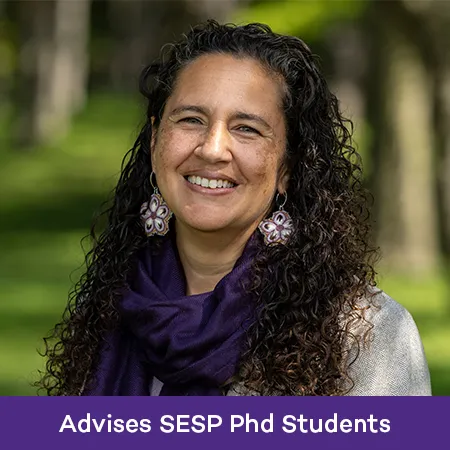
Megan Bang
· James E. Johnson Professor of Learning SciencesVerifiedNorthwestern University · Computer Science and Public Policy
Active 2006–2026
About
Megan Bang is a professor of learning sciences and the director of Northwestern University's Center for Native American and Indigenous Research. She is of Ojibwe and Italian descent and works closely with Indigenous communities. Her research broadly explores the dynamics of culture, learning, and development, with a specific focus on navigating multiple-meaning systems to create more effective and just learning environments in science, technology, engineering, arts, and mathematics education. Bang examines reasoning and decision-making about complex socio-ecological systems, intersecting with themes of culture, power, and historicity. Her work emphasizes the importance of identity, equity, and community engagement, and she conducts research in both school and informal settings across the life course. Additionally, she is involved in initiatives that foster community engagement and Indigenous research, contributing to the understanding of how cultural and social factors influence learning and development.
Research topics
- Political Science
- Sociology
- Computer Science
- Law
- Environmental ethics
- Social Science
- Ecology
- Epistemology
- Engineering ethics
- Mathematics education
- Engineering
- Pedagogy
- Psychology
- Knowledge management
- Biology
- Medical education
- Gender studies
- Multimedia
- Environmental science
- Medicine
- Environmental resource management
- Philosophy
Selected publications
Science and Children · 2026-03-04
articleScience and Children · 2026-01-02 · 1 citations
article1st authorCorrespondingToward a Collective Understanding of Designing STEM Learning for Equity and Justice
Proceedings. · 2025-06-10
articleOpen accessDue to assumptions of "cultural neutrality," STEM education has neglected designing for equity and justice, especially in higher education.This study investigates how a group of learning scientists, STEM faculty, and a computer scientist engaged in collective knowledge building to develop a common understanding of designing for equity and justice in STEM.Findings demonstrate how critical readings and discussions supported building a common foundation of what designing for equity and justice means across STEM disciplines.
Indigenous Science Education and STEM-related Education
2025-01-07
reference-entryEducation broadly conceived includes the when, where, why, and how of teaching, learning, and maturation. From this perspective education takes shape and evolves across many contexts, including familial and kin relations; informal settings such as community-based organizations, museums, and libraries; and school settings from early childhood to post-secondary. Science, like education, is concerned with the how and why of things. Indigenous science education is grounded in the philosophical, intellectual, emotional, and spiritual traditions and practices of Indigenous knowledge systems (IKS). IKS is holistic, relational, and informed by experience in and with the natural world. Although IKS are tribally specific, there are commonalities and shared practices across communities. Indigenous knowledge systems ground much of Indigenous science education. While some principles of IKS and Indigenous science education that we discuss will apply to Indigenous peoples globally, there are also important differences to hold across geopolitical contexts. Rather than collapsing the vast heterogeneity of global indigeneity into a single category, we found it important to limit our scope. Furthermore, it may be inappropriate for the authors—Indigenous people from nations who largely reside within the borders of what is currently considered the United States and Canada—to reach beyond this scope. At the same time, we would be remiss if we did not acknowledge that there is important research within the field of comparative Indigenous education that speaks to connections between the local and the global. In addition, Indigenous peoples globally have traded, collaborated, and exchanged knowledge since time immemorial, and they continue to do so. IKS has taught us, the authors, to view reading and writing as activities that carry with them responsibilities for being in a relation with knowledge. Thus, this article is structured to provide relevant studies, reports, and resources on Indigenous science education and STEM-related education contextualized within what is currently known as the United States and Canada. And in this context, the authors use both Native and Indigenous interchangeably throughout this bibliography. The article is organized around four main sections: (1) Paradigms for Indigenous Science Education, (2) Indigenous Science Education across the Life-Span, (3) Curriculum and Assessments within Indigenous Science Education, and (4) Professional Organizations, Key Reports, and Books.
Designing for Expansive Forms of STEAM Disciplinary Engagement
Proceedings. · 2025-06-10
articleOpen accessIncreasingly, calls from within the natural and computational sciences are recognizing the need for more expansive forms of disciplinary theory building and practice to connect social theories in the study of natural systems.Within science education and science teacher education, there is an increasing recognition of the need for expansive forms science teaching that connect sociopolitical contexts of science with both the professional learning of teachers and the science taught in K12 classrooms.In this symposium, we explore designs for expansive STEAM disciplinary engagement across classroom, professional learning, and informal Indigenous STEAM settings to understand the ways in which work at the edges of disciplines can transform STEAM teaching and learning for educators and students. Rationale and contribution:Understanding STEAM disciplines, learning and learning environments as always deeply connected to sociopolitical contexts (McKinney deRoysten & Sengupta-Irving 2019) allows us to engage with the "ethical entanglements" (Krishnamoorthy & Tolbert, 2022) inherent in doing, being, and learning in STEAM.Yet the forms of disciplinary engagement often present in STEM and STEAM learning environments often represent settled knowledge that mutes the dynamic, heterogeneous, anti-colonial commitments driving STEM and STEAM disciplinary work at the edges of the disciplines.Within science education and science teacher education, there is an increasing recognition of the need for expansive forms science teaching that connect sociopolitical contexts of science with both the professional learning of teachers (Madkins & McKinney de Royston, 2019) and the science taught in K12 classrooms (Davis & Schaeffer, 2019;Jones, 2024).Increasingly, calls from within the natural and computational sciences are recognizing the need for more expansive forms of disciplinary theory building and practice to connect social theories in the study of natural systems (Schell, et al, 2020;Duncan, et al, 2024).For example, Schell, et al's review (2020) argued that understanding key socio-ecological factors related to, for example, urban heat islands, tree canopy cover and biodiversity, and speciation needs to be critically tied to histories of places that include redlining and racial and class segregation (Schell, et al, 2020).Ongoing debates within ecology around the inadequacy of Darwin's sexual selection theory to account for the abundance of same-sex behavior in the natural world have highlighted need for more expansive forms of studying and teaching about gender/sex in the natural world that move the field towards multiplicities and fluidities of gender and biological sex (Roughgarden, 2013).In the midst of disinformation campaigns, policing of black and brown bodies using surveillance technologies, and proliferation of digital tools for anything from voice recognition to hiring to grocery delivery, scholars working in AI and design of technology and computing systems are increasingly foregrounding the connection between societal structures that uphold white supremacy and settler colonialism and the algorithms that affect our daily lives (Benjamin, 2019).At the same time, a new report from the National Academies of Sciences, Engineering, and Medicine (NASEM): Equity in K-12 STEM Education: Framing Decisions for the Future (NASEM, 2024), calls for a clearer articulation of the kinds of powered decision-making that work towards particular purposes for equitable STEM education.The report presents the field with five "equity frames", or "conceptions of equity that can be and are used as rationale for decision-making" (p.133).These are: (1) reducing gaps between groups, (2)
Cultivating Wellbeing in Learning Environments: Storywork, Kinship and Affect With Lands and Waters
Proceedings. · 2025-06-10
articleOpen access1st authorCorrespondingThere is a pressing need to reimagine education for social and ecological well-being.Persistent inequalities and underimagined forms of education not only prevent these developments, but continue to erode human well-being and creativity.Substantive changes require paradigm shifts in foundational conceptualizations of educational challenges and possibilities, including transformative understandings of students' sense making and holistic cultural and intellectual lives.This symposium brings together scholarship focused on storywork, relationality or kinship and affect in the design of learning environments.Further the studies in this symposium are specifically focused on these dimensions of learning tied to field based or land and water based learning environments. Rationale and contribution:There is a pressing need to reimagine education for social and ecological well-being.Persistent inequalities and underimagined forms of education not only prevent these developments, but continue to erode human well-being and creativity (Graves Jr. et.al., 2022).Substantive changes require paradigm shifts in foundational conceptualizations of educational challenges and possibilities, including transformative understandings of students' sense making and holistic cultural and intellectual lives.Further, educational environments need to reflect and engage the intellectual heterogeneity of knowledge systems and the affective landscapes that support transformative possibilities.This symposium brings together scholarship focused on storywork, relationality or kinship and affect in the design of learning environments.Further the studies in this symposium are specifically focused on these dimensions of learning tied to field based or land and water based learning environments.Stories and storywork, even if framed in different terms, is fundamental to the ways human beings live and learn ( Hymes, 1996).As elaborated by Archibald's (2008) work on Indigenous storywork, storywork engages complexity, holistically "educates the heart, mind, body and spirit" (p.x), calls for engaged and felt listening, entails practicing values of respect, reverence, responsibility and reciprocity, offers teachings to "those who know how to ask and how to learn" (Cajete, 1994, p. 41).Indeed storywork is also radical, at once creating worlds, creating communities, and creating selves (Alim, 2009; Morrison, 1993), and insurgent in asserting dignity and solidarity under conditions of domination (Espinoza et al., 2020; Scott, 1990).Indeed we are in times in which broader socio-political movements are recognize the radical possibilities of stories and narrative -increasingly moving to restrict narrative rights-that is who is allowed to tell what stories under which conditions.While narrative right have never been equally distributed in our schools (Hymes, 1996) ,functionally limiting the development of diverse ways of being and knowing (Anzalda, 1987), narrowing disciplinary ideas and practices (Warren et al., 2020), and enacting cultural and linguistic violence through settler colonialism (Battiste, 2000).The presence and quality of social relationships has a significant impact on learning and development (Cantor et.al., 2020; Darling Hammond et.al., 2019; Osher et.al., 2020; Roffey, 2012), and that social relationships are historically infused and reflect broader societal contexts (Bang & Vossoughi, 2016; Nasir, et.al., 2006).Increasingly research is also finding that affective states, like awe or wonder have significant impacts on both processes of learning but also on the nature of what is learned.Indeed increasingly scholars are exploring the ways in which awe and wonder are tied to wellbeing and arguing that our capacities for wonder and awe are requisite for imagining and enacting more just and sustainable worlds (Sherry-Wagner, 2023; Escobar, 2018).And yet, awe and wonder have had little place in the design of learning environments, positioned as something that children should have access and rights to experience in childhood or that is articulated as having pedagogically
Science and Children · 2025-09-03 · 2 citations
articleTowards Consequential Arts: Educators’ Conceptions of the Arts’ Roles in Learning and Change Making
Proceedings. · 2025-06-10
articleOpen accessSenior authorThe arts have great potential to contribute to learning and change making.However, many educational environments have not meaningfully invested in supporting consequential art.In exploring the potential of arts in both disciplinary and transdisciplinary learning, it is essential to consider educators' conceptions of the arts and how these conceptions might be shaped by sociocultural factors.This study analyzed 51 interviews with educators and found that 90.1% articulated views about the arts' roles in learning and change making, which can be grouped into 20 conceptions, 5 of which were especially prominent.
World‐Making Through a Feminist Abolitionist Lens in a <scp>STEAM</scp> Middle School Program
Reading Research Quarterly · 2024-04-03 · 1 citations
articleABSTRACT The maker movement propagated throughout educational spaces alongside promises that technological and design literacies could be harnessed to shape equitable social futures. However, researchers have highlighted the ways makerspaces can reinforce hierarchies of race, gender, and class. This paper builds on research that seeks to support girls' making through broader sociopolitical and ethical commitments. We consider what an everyday pedagogy of feminist abolition looked like in a makerspace, with a focus on how educators responded to emergent social needs within and across gender lines. Our data sources (extensive field notes, audio–video recordings, photographs, and student interviews) are drawn from Hubspace, a 6‐week summer program serving Black, Latine/x, and South Asian middle school youth and grounded in expansive forms of storytelling, coding, engineering, music, writing, and art. In closely analyzing routine forms of educator reflection alongside the design decisions, pedagogical moves and forms of student sense‐making they supported, we found that student and educator sociopolitical learning emerged together to build what became possible in the culture of the space over time. Across three cases, we show how such pedagogies offered lived models and creative languages for practicing restorative and just social relationships. Each of the cases tell the story of different moments when gender became important to the ways participants were working to recognize and desettle received terms of thought and generate alternate forms of thinking, living, and relating, or the making of new stories and worlds.
To heal, grow, and thrive: Engaging Indigenous paradigms and perspectives in developmental science
Child Development · 2024-11-01 · 4 citations
articleOpen accessA focus on positive child development among Indigenous children has largely been absent from developmental science. In this special section of Child Development, we sought to address continuing inequity in representation and valuing Indigenous knowledge and voices by soliciting articles that identified cultural and strengths-based factors Indigenous children, youth, and families cultivate and leverage to promote positive development. In this introduction to the special section, we provide an overview of the four empirical articles included, with attention to the ways these articles advance Indigenous paradigms and methodologies by focusing on the unique histories and strengths of four distinct Indigenous communities. We end with a discussion of how to promote continued growth and inclusiveness in developmental science with Indigenous communities.
Recent grants
Collaborative Research: Research Culturally Based Citizen Science: Rebuilding Relationships to Place
NSF · $542k · 2011–2015
Collaborative Research: Research Culturally Based Citizen Science: Rebuilding Relationships to Place
NSF · $182k · 2011–2012
NSF · $464k · 2011–2015
Collaborative Research: The Cultural Context of Learning: Native-American Science Education
NSF · $395k · 2008–2011
NSF · $550k · 2017–2019
Frequent coauthors
- 39 shared
Douglas L. Medin
Northwestern University
- 28 shared
Ananda Marin
- 18 shared
Carrie Tzou
University of Washington Bothell
- 13 shared
Na’ilah Suad Nasir
Spencer Foundation
- 12 shared
Philip Bell
University of Washington
- 9 shared
Shirin Vossoughi
- 9 shared
Sandra R. Waxman
Northwestern University
- 8 shared
bethany ojalehto
Northwestern University
Education
- 2005
Ph.D., Education
University of California, Berkeley
- 2000
M.A., Education
University of California, Berkeley
- 1997
B.A., Psychology
University of California, Los Angeles
Awards & honors
- 2024-25 One Book One Northwestern program co-chair
- Resume-aware match score
- Save to shortlist
- AI-drafted outreach
See your match with Megan Bang
PhdFit ranks faculty by your research interests, methods, and publications — grounded in their actual work, not templates.
- Free to start
- No credit card
- 30-second signup