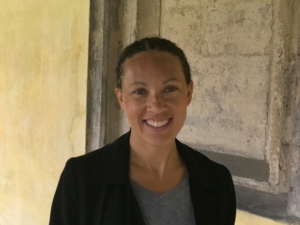
Minayo Nasiali
VerifiedUniversity of California, Los Angeles · History
Active 2012–2023
About
Minayo Nasiali is an Associate Professor in the UCLA Department of History with a field of study focused on Modern Europe. Her academic office is located in 5274 Bunche Hall, and she can be contacted via email at mnasiali@history.ucla.edu. The page text does not provide additional details about her research interests, background, or key contributions beyond her specialization in Modern European history.
Research topics
- Political Science
- Sociology
- History
- Humanities
- Law
- Geography
- Art
- Economics
- Engineering
- Art history
- Economic history
- Economy
- Ancient history
Selected publications
International Journal of Maritime History · 2023
1st authorCorresponding- Political Science
- Economy
- Economic history
During the first half of the twentieth century, the labour of sailors from colonial Africa was essential to the European shipping industry. These seafarers laboured mostly as firemen and coal trimmers (in French, they were called chauffeurs and soutiers), shovelling coal and stoking fires in the engine rooms of the steamships that transported the world's people and goods. To secure this work, African sailors sometimes adopted aliases. They commodified their names and identities as part of an alternative, extralegal economy that also benefitted the broader ‘legitimate’ shipping industry. Their identities, however, were deeply suspected by the empires that claimed them – France and Great Britain. Significantly, black sailors adopted aliases to engage with and circumvent the economic and political regimes that employed and policed them.
The Journal of Modern History · 2021-12-01
article1st authorCorrespondingModern & Contemporary France · 2021
1st authorCorresponding- Political Science
- Geography
- Political Science
French Politics Culture & Society · 2020
- Sociology
- Humanities
- Political Science
Nicholas Hewitt, Montmartre: A Cultural History (Liverpool: Liverpool University Press, 2017). David Spector, La Gauche, la droite, et le marché: Histoire d’une idée controversée (XIXe–XXIe siècle) (Paris: Odile Jacob, 2017) Graham M. Jones, Magic’s Reason: An Anthropology of Analogy (Chicago: University of Chicago Press, 2017). Minayo Nasiali, Native to the Republic: Empire, Social Citizenship, and Everyday Life in Marseille since 1945 (Ithaca: Cornell University Press, 2016). Joseph Bohling, The Sober Revolution: Appellation Wine and the Transformation of France (Ithaca and London: Cornell University Press, 2018). Venus Bivar, Organic Resistance: The Struggle over Industrial Farming in Postwar France (Chapel Hill: University of North Carolina Press, 2018). Todd Shepard, Sex, France, and Arab Men, 1962–1979 (Chicago: University of Chicago Press, 2017). Donald Reid, Opening the Gates: The Lip Affair, 1968–1981 (London: Verso, 2018). Bruno Perreau, Queer Theory: The French Response (Stanford, CA: Stanford University Press, 2016). Oana Sabo, The Migrant Canon in Twenty-First-Century France (Lincoln: University of Nebraska Press, 2018).
French Politics Culture & Society · 2019-03-01 · 3 citations
article1st authorCorrespondingIn the 1950s, French shipping companies began to replace their old fleet of steamships with new diesel ships. They also began to lay off sailors from French Africa, claiming that the changing technology rendered their labor obsolete. The industry asserted that African sailors did not have the aptitude to do other, more skilled jobs aboard diesel vessels. But unemployed colonial sailors argued differently, claiming that they were both able and skilled. This article explores how unemployed sailors from French Africa cast themselves as experts, capable of producing technological knowledge about shipping. In so doing, they shaped racialized and gendered notions about labor and skill within the French empire. The arguments they made were inconvenient, I argue, because colonial sailors called into question hegemonic ideas about who could be modern and who had the right to participate in discourse about expertise.
Decolonizing Christianity: Religion and the End of Empire in France and Algeria
French History · 2018-04-25
article1st authorCorrespondingIn 1996, seven Trappist monks were kidnapped from their monastery in Tibhirine, Algeria and murdered by a faction of the Groupe islamique armé. Rather than characterize their deaths in terms of a fundamental clash of civilizations, in Decolonizing Christianity: Religion and the End of Empire in France and Algeria, Darcie Fontaine instead insists on contextualizing their lives, by exploring how these monks dwelt and worked—as Christians—in Algeria. This comprehensively researched, nuanced study explores Christians’ shifting beliefs about the relationship between religion, imperialism and politics and argues that the Algerian war of independence played a key role in shaping postcolonial Christian institutions and ideologies. Significantly, this ‘social history of theology,’ as Fontaine puts it, asserts that there was no single ‘unified Christian discourse’ about Algeria. Instead, she describes how various protestant and catholic Christians mobilized religious ideologies to serve a variety of ends. While many Euro-Algerians and members of the military utilized Christianity to justify France’s presence in Algeria, other more ‘liberal’ or ‘progressivist’ Christians questioned the continued viability of Algerie Française. Importantly, the changing views of these leftist Christians were shaped by their involvement with the Algerian community. As Fontaine argues, ‘[I]t was through this engagement in social projects at the grass roots that they also came to realize that the institutions and practices of Christianity in Algeria would also have to be decolonized’.
Contemporary French Civilization · 2018-04-01
articleeScholarship (California Digital Library) · 2017-01-01 · 1 citations
articleOpen accessSenior authorWorking paper
Cornell University Press eBooks · 2016-12-06
book-chapter1st authorCorrespondingCornell University Press eBooks · 2016-12-06
book-chapter1st authorCorresponding
Frequent coauthors
- 2 shared
Swanie Potot
- 2 shared
Patricia M. E. Lorcin
Twin Cities Orthopedics
- 2 shared
Alexis Spire
- 1 shared
Aaron Freundschuh
Queens College, CUNY
- 1 shared
Nafisa Essop-Sheik
University of Michigan–Ann Arbor
- 1 shared
Malick W. Ghachem
- 1 shared
Tal Zalmanovich
University of Haifa
- 1 shared
Laurie Wood
Centre d’histoire de Sciences Po
- Resume-aware match score
- Save to shortlist
- AI-drafted outreach
See your match with Minayo Nasiali
PhdFit ranks faculty by your research interests, methods, and publications — grounded in their actual work, not templates.
- Free to start
- No credit card
- 30-second signup