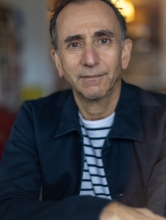
Nicholas Mirzoeff
· ProfessorVerifiedNew York University · Martin Scorsese Department of Cinema Studies
Active 1992–2025
Research topics
- Art
- Sociology
- Social Science
- Aesthetics
- Computer Science
- Visual arts
- Law
- Political Science
- Archaeology
- Genealogy
- Art history
- History
- Medicine
Selected publications
<b>Mirar en la oscuridad. Palestina y el activismo visual desde el 7 de octubre</b>
post(s) · 2025-06-13
articleOpen access1st authorCorrespondingEn esta traducción presentamos la introducción y el primer capítulo de To See In the Dark. Palestine and VisualActivism Since October 7, de Nicholas Mirzoeff. El libro fue publicado en 2025 por Pluto Press. Agradecemosprofundamente al autor y a la editorial por permitirnos hacer esta traducción.
Roundtable on Decolonial Jewish Practice in Art and Visual Culture ‘after Gaza’
Journal of Visual Culture · 2025-04-01
articleHistoire(s) de l’art : autonomie d’une discipline ?
Perspective · 2024-01-01
articleOpen accessSenior authorUn débat entre Carlo A. Célius, Anne Creissels et Nicholas Mirzoeff, mené par Émilie Goudal \n \n« Autonomie » et « discipline » : voilà les termes à partir desquels ce débat a été convoqué. Le seul fait d’associer ces deux notions en apparence antinomiques relevait du défi autant que d’un paradoxe a priori insoluble. L’autonomie est synonyme d’indépendance face à l’autorité que la discipline suggère. C’est au cours du processus de constitution de cette dernière que surgissent et se fixent les règles communes : en ce qui nous concerne, celles d’un champ savant identifié en tant qu’histoire de l’art. Que peut-on dire, à l’intersection d’une liberté que l’on se donne, d’une émancipation proclamée et d’un espace méthodologiquement normé pour fédérer un domaine de la science ?
Visual Culture in Britain · 2024-09-02
article1st authorCorresponding2023-05-02
book-chapter1st authorCorrespondingRacial capitalism claims immunity, both biological and legal, for its actions, even as those actions have now become autoimmune. That is to say, under certain conditions, the immune system turns against itself, often with fatal consequences. Against the violence of racial capitalism, and the global dissemination of a zoonotic virus by means of its “just-in-time” supply chain and compulsory, not to say compulsive, travel, it became possible to see through the portal of the pandemic toward “a decolonial feminist politics of protection”. It would be a portal to a life which goes beyond the modern practices of what philosopher Michel Foucault called “biopolitics.” This biopolitics is governance as the ordering of life as such. A conjuncture is the set of connections between politics, culture, media, and economics that make up the way it is now. In the 1980s, “the market” became the dominant force in creating a new conjuncture, ending a 40-year belief in state intervention to promote biopolitical gains.
Perspective, Visuality, and the Way of Seeing
2023-05-02
book-chapter1st authorCorrespondingOne night in 1972, 50 years ago as the author write this, the art critic John Berger hosted the first of four television programs on BBC2. In a time when there were only three television stations available in the United Kingdom, BBC2 was the serious, artsy channel. Its audiences were small, but it was then considered part of the public broadcasting mission of the British Broadcasting Corporation to cater to minority tastes. Berger himself never used the term “visual culture.” He was mostly interested in what he called the “tradition of European painting,” which he saw as beginning in 1400 and coming to an end in 1900. Berger then argued that perspective was the hallmark of the European painting tradition. He described how it channeled “appearances” into the eye, creating the illusion of a three-dimensional space that the viewer “sees,” as it were, through the window created by the picture frame.
2023-05-02
book-chapter1st authorCorrespondingSlavery shaped modernity, forming modern Western racial capitalism. As the Caribbean historian and politician Eric Williams argued in his classic 1944 account Capitalism and Slavery, the forces that drove modern capitalism into being were those set in motion by slavery. Unless otherwise cited, the examples that follow are taken from his text. There were vast profits to be made from slavery, both for elite families like the Beckfords of Fonthill and a wide range of British gentry. University College London’s “Legacies of British Slavery” project has shown how the reparations paid to slave owners in 1838 funded the British Industrial Revolution and provided the foundation for the wealth of many modern British establishment figures, including former prime minister David Cameron. The momentum generated by slavery’s creation of spectacular profit also created modern ways of seeing.
2023-05-02
book-chapter1st authorCorrespondingIn September 2016, Colin Kaepernick and his allies began to “take a knee” during the performance of the National Anthem at National Football League games in the United States, rather than stand with their hands on their hearts, as US schoolchildren are taught to do. It was a public appearance of dissent, designed to be seen by many, live, and via media. It was intended and received as an affirmation of the statement “Black Lives Matter.” Whether consciously or not – for both performer and viewer – taking a knee invokes and awakens the cultural genealogy of this form. “Taking a knee” cuts the white emancipator from the frame and creates something new: an abolition image. Abolition images depict subjects, who are no longer the object of the rule of others but have subjectivity and are “levelly human,” as the Combahee River Collective put it in their 1977 statement.
The Decisive Moment and the Limits of Looking
2023-05-02
book-chapter1st authorCorrespondingThe classic documentary photograph was always colonial and tied to the militaristic concept of what French photographer Henri Cartier Bresson called “the decisive moment.” This was a moment of action, of intervention, of visualizing, of war. Cartier Bresson was himself a pilot and he worked in colonial Cote d’Ivoire for the French administration. He was inspired by the Jewish Hungarian Martin Munkacsi’s colonial photography, and one photograph in particular, entitled Children Playing on Lake Taganyika/Enfants jouant sur le lac Tanganyika. What this title does not tell us is which of the four countries that border the vast lake is seen. Indeed, the Metropolitan Museum uses the alternative title “Liberia” and dates it to 1931. In that case, it is the Atlantic Ocean into which the young men are running.
2023-05-02
book-chapter1st authorCorrespondingWithin a decade, earth scientists began to realize that the human effects on the planet were nonetheless so devastating as to constitute a clear and present danger to ourselves and to all life. While climate heating caused by the burning of fossil fuels is among the most acute of these threats, the Sixth Mass Extinction of other-than-human life is no less significant. Human pollution by plastics, fertilizers, radiation, and other toxic byproducts of advanced capitalism are making life unlivable, creating dead zones and plastic gyres in the ocean, alongside widespread radioactive contamination. If there is no space outside the biosphere crisis, it has equally transformed time. Humans have become geological agents, effecting geosphere change in the time of individual lives that used to take millennia. The biosphere crisis cannot be solved or even understood within the frameworks of the neoliberalism that has shaped racial capitalism into Autoimmune Climate-Changing Capitalism Syndrome for the past 50 years.
Frequent coauthors
- 3 shared
Terry Smith
University of St Andrews
- 2 shared
Carlo A. Célius
Institut des Mondes Africains
- 2 shared
Dan Hicks
- 2 shared
Anne Creissels
Université Paris 8
- 2 shared
Alexander Mendiburu
- 1 shared
R. J. B. Bosworth
- 1 shared
Aidan McGarry
- 1 shared
Dan Mercea
City, University of London
- Resume-aware match score
- Save to shortlist
- AI-drafted outreach
See your match with Nicholas Mirzoeff
PhdFit ranks faculty by your research interests, methods, and publications — grounded in their actual work, not templates.
- Free to start
- No credit card
- 30-second signup