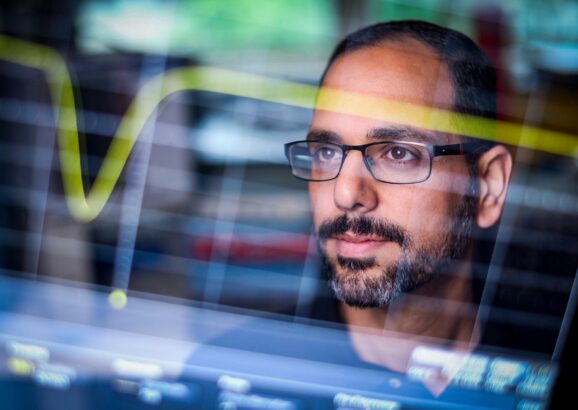
Or Hen
VerifiedMassachusetts Institute of Technology · Physics
Active 2011–2025
About
Or Hen is an Associate Professor of Physics at MIT who focuses on studies of Quantum Chromodynamics (QCD) effects in the nuclear medium and the interplay between partonic and nucleonic degrees of freedom in nuclei. His research involves utilizing high-energy scattering of electrons, neutrinos, photons, protons, and ions off atomic nuclei to study nuclear Short-Range Correlations (SRCs), which are temporal fluctuations of high-density, high-momentum nucleon clusters in nuclei. These SRC pairs, due to their overlapping quark distributions and strong interactions, serve as a bridge between low-energy nuclear structure, high-density nuclear matter, and high-energy quark distributions, with significant implications for strong-interaction physics, hadronic structure, and astrophysics. Hen has conducted experiments at major laboratories such as Thomas-Jefferson and Fermi National Accelerator Laboratories, examining the structure and characteristics of SRC pairs and their effects across nuclear, particle, atomic, and astrophysics domains. Looking ahead, he is engaged in frontier QCD research at the Electron-Ion Collider, co-leading the ECCE consortium that produced the reference design for the EIC's main detector and co-founding the ePIC collaboration. He currently serves on the chair-line of the EIC Users Group and collaborates with ePIC to construct the EIC.
Research topics
- Physics
- Particle physics
- Nuclear physics
- Optics
- Atomic physics
- Computer Science
- Artificial Intelligence
- Systems engineering
- Engineering
- Astronomy
- Statistics
- Environmental science
- Engineering physics
- Mathematics
- Classical mechanics
- Astrophysics
Selected publications
Physical review. D/Physical review. D. · 2025-09-23
articleOpen accessCharged-current neutrino interactions with final states containing zero mesons and at least one proton are of high interest for current and future accelerator-based neutrino oscillation experiments. Using the Booster Neutrino Beam and the MicroBooNE detector at Fermi National Accelerator Laboratory, we have obtained the first double-differential cross-section measurements of this channel for muon neutrino scattering on an argon target with a leading proton momentum threshold of <a:math xmlns:a="http://www.w3.org/1998/Math/MathML" display="inline"> <a:mrow> <a:mn>0.25</a:mn> <a:mtext> </a:mtext> <a:mtext> </a:mtext> <a:mi>GeV</a:mi> <a:mo>/</a:mo> <a:mrow> <a:mi>c</a:mi> </a:mrow> </a:mrow> </a:math> . We also report a flux-averaged total cross section of <c:math xmlns:c="http://www.w3.org/1998/Math/MathML" display="inline"> <c:mrow> <c:mi>σ</c:mi> <c:mo>=</c:mo> <c:mo stretchy="false">(</c:mo> <c:mn>11.8</c:mn> <c:mo>±</c:mo> <c:mn>1.2</c:mn> <c:mo stretchy="false">)</c:mo> <c:mo>×</c:mo> <c:msup> <c:mrow> <c:mn>10</c:mn> </c:mrow> <c:mrow> <c:mo>−</c:mo> <c:mn>38</c:mn> </c:mrow> </c:msup> <c:mtext> </c:mtext> <c:mtext> </c:mtext> <c:msup> <c:mrow> <c:mi>cm</c:mi> </c:mrow> <c:mrow> <c:mn>2</c:mn> </c:mrow> </c:msup> <c:mo>/</c:mo> <c:mi>Ar</c:mi> </c:mrow> </c:math> and several single-differential measurements which extend and improve upon previous results. Statistical and systematic uncertainties are quantified with a full treatment of correlations across 359 kinematic bins, including correlations between distributions describing different observables. The resulting dataset provides the most detailed information obtained to date for testing models of mesonless neutrino-argon scattering.
Search for light sterile neutrinos with two neutrino beams at MicroBooNE
Nature · 2025-12-03 · 5 citations
articleOpen accessAbstract The existence of three distinct neutrino flavours, ν e , ν μ and ν τ , is a central tenet of the Standard Model of particle physics 1,2 . Quantum-mechanical interference can allow a neutrino of one initial flavour to be detected sometime later as a different flavour, a process called neutrino oscillation. Several anomalous observations inconsistent with this three-flavour picture have motivated the hypothesis that an additional neutrino state exists, which does not interact directly with matter, termed as ‘sterile’ neutrino, ν s (refs. 3–9 ). This includes anomalous observations from the Liquid Scintillator Neutrino Detector (LSND) 3 experiment and Mini-Booster Neutrino Experiment (MiniBooNE) 4,5 , consistent with ν μ → ν e transitions at a distance inconsistent with the three-neutrino picture. Here we use data obtained from the MicroBooNE liquid-argon time projection chamber 10 in two accelerator neutrino beams to exclude the single light sterile neutrino interpretation of the LSND and MiniBooNE anomalies at the 95% confidence level (CL). Moreover, we rule out a notable portion of the parameter space that could explain the gallium anomaly 6–8 . This is one of the first measurements to use two accelerator neutrino beams to break a degeneracy between ν e appearance and disappearance, which would otherwise weaken the sensitivity to the sterile neutrino hypothesis. We find no evidence for either ν μ → ν e flavour transitions or ν e disappearance that would indicate non-standard flavour oscillations. Our results indicate that previous anomalous observations consistent with ν μ → ν e transitions cannot be explained by introducing a single sterile neutrino state.
Physics Letters B · 2025-12-08
articleOpen accessMeasurement of Positronium Decays at 7 T with NeuroSphere PET Modules
2025-11-01
articleOne pathway for positron-electron interaction, rather than direct annihilation, is to form the intermediate quasi-stable bound state of positronium before decaying to photons. The orthopositronium lifetime and decay kinematics change in a medium, as well as under an applied magnetic field, and can serve as a probe of material properties (such as differentiating porosity or tissue pathology) and fundamental physics (such as testing quantum electrodynamic theory and constraining fundamental symmetry violation). In this work, we demonstrate the capability of the NeuroSphere MR-compatible PET modules to detect o-Ps decays under an applied 7-T field and present a measurement of the long o-Ps lifetime component in polyvinyltoluene (PVT), finding a clear resonance and long o-Ps lifetime component of 48.3 ns. We also provide a proof-of-concept measurement for constraining charge conjugation and parity symmetry (CP) violation by measuring asymmetry in the kinematics of ortho-positronium (o-Ps) decay to three photons (3g) under the reversal of a magnetic field.
Physics Letters B · 2025-10-12 · 2 citations
articleOpen accessWe report the measurement of the triple-differential cross section d 3 σ / d E vis d cos ( θ μ ) d P μ for inclusive muon-neutrino charged-current scattering on argon. This measurement utilizes data from 6.4 × 10 20 protons on target of exposure collected using the MicroBooNE liquid argon time projection chamber located along the Fermilab Booster Neutrino Beam with a mean neutrino energy of approximately 0.8 GeV. The mapping from reconstructed kinematics to truth quantities is validated within uncertainties by comparing the distribution of reconstructed hadronic energy in data to that of the model prediction in different muon scattering angle bins after applying a conditional constraint from the muon momentum distribution in data. The success of this validation provides confidence that the energy transfer in the MicroBooNE detector is well-modeled within simulation uncertainties, enabling a reliable unfolding to a triple-differential cross section defined at the nominal neutrino flux over muon momentum, muon scattering angle, and visible neutrino energy. This validation not only supports accurate cross-section extraction, but also establishes a critical foundation for tuning interaction models used in future neutrino oscillation measurements. The unfolded measurement covers an extensive phase space, providing a wealth of information useful for future liquid argon time projection chamber experiments measuring neutrino oscillations. Comparisons against a number of commonly used model predictions are included and their performance in different parts of the available phase-space is discussed.
First Search for Neutral Current Coherent Single-Photon Production in MicroBooNE
ArXiv.org · 2025-02-10 · 2 citations
preprintOpen accessThis article presents the first search for neutrino-induced neutral current coherent single-photon production (NC coherent 1$γ$). The search makes use of data from the MicroBooNE 85-tonne active volume liquid argon time projection chamber detector, situated in the Fermilab Booster Neutrino Beam (BNB), with an average neutrino energy of $\langle E_ν\rangle \sim 0.8$ GeV. A targeted selection of candidate neutrino interactions with a single photon-like electromagnetic shower in the final state and no visible vertex activity was developed to search for the NC coherent 1$γ$ process, along with two auxiliary selections used to constrain the dominant background from NC$π^0$ production. With an integrated exposure of $6.87 \times 10^{20}$ protons on target delivered by the BNB, we set the world's first limit for this rare process, corresponding to an upper limit on the flux-averaged cross section of $σ<1.49 \times 10^{-41}\text{cm}^2$ at 90\% C.L.
Threshold $J/ψ$ Photoproduction as a Probe of Nuclear Gluon Structure
ArXiv.org · 2025-10-24
articleOpen accessInternational audience
First study of neutrino angle reconstruction using quasielasticlike interactions in MicroBooNE
Physical review. D/Physical review. D. · 2025-06-06 · 2 citations
articleOpen accessWe investigate the expected precision of the reconstructed neutrino direction using a <a:math xmlns:a="http://www.w3.org/1998/Math/MathML" display="inline"><a:mrow><a:msub><a:mrow><a:mi>ν</a:mi></a:mrow><a:mrow><a:mi>μ</a:mi></a:mrow></a:msub></a:mrow></a:math>-argon quasielasticlike event topology with one muon and one proton in the final state and the reconstruction capabilities of the MicroBooNE liquid argon time projection chamber. This direction is of importance in the context of DUNE sub-GeV atmospheric oscillation studies. MicroBooNE allows for a data-driven quantification of this resolution by investigating the deviation of the reconstructed muon-proton system orientation with respect to the well-known direction of neutrinos originating from the Booster Neutrino Beam with an exposure of <c:math xmlns:c="http://www.w3.org/1998/Math/MathML" display="inline"><c:mn>1.3</c:mn><c:mo>×</c:mo><c:msup><c:mn>10</c:mn><c:mn>21</c:mn></c:msup></c:math> protons on target. Using simulation studies, we derive the expected sub-GeV DUNE atmospheric-neutrino reconstructed simulated spectrum by developing a reweighting scheme as a function of the true neutrino energy. We further report flux-integrated single- and double-differential cross section measurements of charged-current <e:math xmlns:e="http://www.w3.org/1998/Math/MathML" display="inline"><e:msub><e:mi>ν</e:mi><e:mi>μ</e:mi></e:msub></e:math> quasielasticlike scattering on argon as a function of the muon-proton system angle using the full MicroBooNE data sets. We also demonstrate the sensitivity of these results to nuclear effects and final state hadronic reinteraction modeling.
Physical Review Letters · 2025-07-17 · 6 citations
articleOpen accessUnderstanding electron neutrino interactions is crucial for measurements of neutrino oscillations and searches for new physics in neutrino experiments. We present the first measurement of the flux-averaged ν_{e}+ν[over ¯]_{e} charged-current single charged-pion production cross section on argon using the MicroBooNE detector and data from the NuMI neutrino beam. The total cross section is measured to be [0.93±0.13(stat)±0.27(syst)]×10^{-39} cm^{2}/nucleon at a mean ν_{e}+ν[over ¯]_{e} energy of 730 MeV. Differential cross sections are also reported in electron energy, electron and pion angles, and electron-pion opening angle.
2025-01-07 · 2 citations
articleOpen accessThis R&D project, initiated by the DOE Nuclear Physics AI-Machine Learning initiative in 2022, leverages AI to address data processing challenges in high-energy nuclear experiments (RHIC, LHC, and future EIC). Our focus is on developing a demonstrator for real-time processing of high-rate data streams from sPHENIX experiment tracking detectors. The limitations of a 15 kHz maximum trigger rate imposed by the calorimeters can be negated by intelligent use of streaming technology in the tracking system. The approach efficiently identifies low momentum rare heavy flavor events in high-rate p+p collisions (3MHz), using Graph Neural Network (GNN) and High Level Synthesis for Machine Learning (hls4ml). Success at sPHENIX promises immediate benefits, minimizing resources and accelerating the heavy-flavor measurements. The approach is transferable to other fields. For the EIC, we develop a DIS-electron tagger using Artificial Intelligence - Machine Learning (AI-ML) algorithms for real-time identification, showcasing the transformative potential of AI and FPGA technologies in high-energy nuclear and particle experiments real-time data processing pipelines.
Frequent coauthors
- 163 shared
S. Gollapinni
Los Alamos National Laboratory
- 151 shared
X. Qian
- 148 shared
A. Ereditato
University of Chicago
- 146 shared
S. Söldner‐Rembold
University of Manchester
- 145 shared
J. Spitz
University of Michigan–Ann Arbor
- 143 shared
M. Mooney
Colorado State University
- 143 shared
J. I. Crespo-Anadón
Centro de Investigaciones Energéticas, Medioambientales y Tecnológicas
- 142 shared
M. Söderberg
Syracuse University
Labs
Hen LabPI
Education
- 2015
Ph.D., Physics
Tel Aviv University
- 2010
B.A., Physics
Hebrew University of Jerusalem
- 2010
B.Sc., Computer Engineering
Hebrew University of Jerusalem
Awards & honors
- 2022 // American Physical Society (APS) Fellow "For using eA…
- 2021 // Appointed Class of 1956 Career Development Associate…
- 2020 // Sloan Research Fellowship
- 2019 // Stuart Jay Freedman Award in Experimental Nuclear Ph…
- 2019 // Early Career Research Program Award, U.S. Department…
- Resume-aware match score
- Save to shortlist
- AI-drafted outreach
See your match with Or Hen
PhdFit ranks faculty by your research interests, methods, and publications — grounded in their actual work, not templates.
- Free to start
- No credit card
- 30-second signup