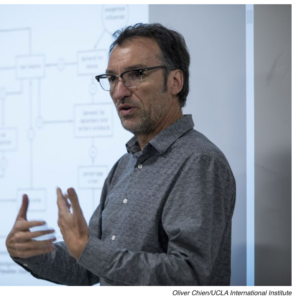
Patrick Heuveline
· ProfessorVerifiedUniversity of California, Los Angeles · Sociology
Active 1992–2024
About
Patrick Heuveline is a professor in the UCLA Sociology Department. His research interests center on how childhood family structures affect child wellbeing and the transition to adulthood. He has conducted comparative, secondary data analyses on single parenting and cohabitation in Western nations, and has an ongoing project in Cambodia studying family change since the Khmer-Rouge period (1975-79). Methodologically, he develops and estimates models focused on population dynamics to represent phenomena intertwined with demographic processes, with applications including the HIV/AIDS epidemic in Eastern Africa and the death toll of the Khmer Rouge regime. Heuveline holds a Ph.D. from the University of Pennsylvania. His work includes a book titled 'Demography: Measuring and Modeling Population Processes' and numerous publications in peer-reviewed journals. His research has been supported by grants from institutions such as the Eunice Kennedy Shriver National Institute of Child Health and Human Development. He is actively engaged in advancing demographic research and policy analysis related to family structures, population health, and historical population dynamics.
Research topics
- Sociology
- Geography
- Medicine
- Demography
- Demographic economics
- Socioeconomics
- Political Science
- Economics
- Gerontology
- Social psychology
- Law
- Development economics
- Psychology
- Gender studies
- Developmental psychology
- Environmental health
Selected publications
Parental Loss and Mental Health in Post-Khmer-Rouge Cambodia
Population Research and Policy Review · 2024-06-25 · 2 citations
articleOpen access1st authorCorrespondingAdverse childhood events (ACE) may have lasting consequences throughout the life course. We focus on one particular type of ACE, parental loss in Cambodia-a country that lost nearly 25% of its population during the 1975-79 Khmer-Rouge regime-and on mental health disorders, one of the potential mechanisms through which ACE may have long-term consequences. Self-reports of symptoms that map on to the Diagnostic and Statistical Manual of Mental Health Disorders (DSM) criteria for anxiety, depression, and post-traumatic stress disorder (PTSD) were collected from 4,405 adults aged 20 and over. We first assess exposure to traumatic events and the prevalence of anxiety, depression, and PTSD using the DSM and alternative criteria. Based on the DSM criteria and previously validated Likert-scale thresholds, we find a high prevalence of anxiety (56.0%), depression (42.8%), and PTSD (2.3%), and even higher levels even among KRR survivors. We then use logit models to analyze the effect of parental loss before age 20 on the likelihood of having experienced traumatic events and experiencing mental health disorders. We find the loss of one parent increases the likelihood of full-PTSD symptoms, but the loss of both parents does not. These findings may result from positive selection into better-off households for orphans whose parents have both died but may also reflect the grief-related difficulties faced by the surviving parent of paternal or maternal orphans. While alternative thresholds for PTSD produced higher prevalence estimates, these measures did not perform better for assessing the effect of parental loss on mental health.
Contemporary Marriage in Cambodia
Journal of Family Issues · 2023-03-10 · 5 citations
articleOpen access1st authorCorrespondingPrevious work has suggested that the drastic Khmer-Rouge-era changes to the family institution have not endured. Potentially more influential in the long term were the rapid socio-economic changes Cambodia underwent starting in the 1990s. We use four waves of the Cambodian Demographic and Health Surveys from 2000 to 2014 to document contemporary trends in marriage formation and dissolution. We find little change in the centrality of marriage, as both cohabitation and sex between unmarried partners remain quite rare. Marriage also continues to be nearly universal and early for women, but we find that the transition to self-arranged "love" marriages occurred earlier and faster than previously documented. A sign that parental endorsement may still matter though, marriage dissolution continues to be associated with spousal characteristics deemed undesirable by past generations. While higher among recent marriage cohorts, especially in the first year after marriage, levels of marriage dissolution remain comparatively low overall.
Interpreting changes in life expectancy during temporary mortality shocks
Demographic Research · 2023-01-05 · 22 citations
articleOpen access1st authorCorrespondingBACKGROUND: Life expectancy is a pure measure of the mortality conditions faced by a population, unaffected by that population's age structure. The numerical value of life expectancy also has an intuitive interpretation, conditional on some assumptions, as the expected age at death of an average newborn. This intuitive interpretation gives life expectancy a broad appeal. Changes in life expectancy are also routinely used to assess mortality trends. Interpreting these changes is not straightforward as the assumptions underpinning the intuitive interpretation of life expectancy are no longer valid. This is particularly problematic during mortality 'shocks,' such as during wars or pandemics, when mortality changes may be sudden, temporary, and contrary to secular trends. OBJECTIVE: This study aims to provide an alternative perspective on what changes in life expectancy measure that remains applicable during mortality shocks. CONCLUSIONS: Returning to two different models that the period life table may represent, I show that a difference in life expectancy is typically interpreted from the synthetic cohort model as the difference in mean longevity between different birth cohorts. However, it can also be interpreted from the stationary population model as a measure of premature mortality in a death cohort. The latter, less common interpretation makes more sense for temporary declines in life expectancy induced by mortality shocks. The absolute change in life expectancy is then an age-standardized value of the average lifespan reduction for people dying during the mortality shock. CONTRIBUTION: To clarify what a decline in life expectancy measures during mortality shocks is important, especially as demographers often assess the mortality impact of those shocks using this metric, which gets widely reported beyond demographers' inner circle.
2023-06-13
preprint1st authorCorrespondingSAGE Publications, Inc. eBooks · 2023
- Sociology
- Political Science
- Psychology
PLoS ONE · 2023-03-29 · 11 citations
articleOpen access1st authorCorrespondingThe mortality gap between the United States and other high-income nations substantially expanded during the first two decades of the 21st century. International comparisons of Covid-19 mortality suggest this gap might have grown during the Covid-19 pandemic. Applying population-weighted average mortality rates of the five largest West European countries to the US population reveals that this mortality gap increased the number of US deaths by 34.8% in 2021, causing 892,491 "excess deaths" that year. Controlling for population size, the annual number of excess deaths has nearly doubled between 2019 and 2021 (+84.9%). Diverging trends in Covid-19 mortality contributed to this increase in excess deaths, especially towards the end of 2021 as US vaccination rates plateaued at lower levels than in European countries. In 2021, the number of excess deaths involving Covid-19 in the United States reached 223,266 deaths, representing 25.0% of all excess deaths that year. However, 45.5% of the population-standardized increase in excess deaths between 2019 and 2021 is due to other causes of deaths. While the contribution of Covid-19 to excess mortality might be transient, divergent trends in mortality from other causes persistently separates the United States from West European countries. Excess mortality is particularly high between ages 15 and 64. In 2021, nearly half of all US deaths in this age range are excess deaths (48.0%).
Physical intimate partner violence in India: how much does childhood socialisation matter?
Asian Population Studies · 2022-02-11 · 8 citations
articleOpen accessSenior authorWhile a large number of studies assumed gendered socialisation leads to partner abuse, little evidence exists for India. We bridge this crucial gap by exploring the pathways between childhood socialisation and intimate partner violence, using data 'Youth in India: Situation and Need Study (2006-2007)' for 5573 young married men (15-29 years). Nearly 17 per cent of men inflicted physical IPV in the past 12 months. Seventy-seven per cent recognized the experience of gender discrimination in their family and reported exposure to violence in two ways-one-third witnessed fathers abusing their mothers and 48 per cent were beaten by their parents. Adverse childhood experiences were associated with IPV perpetration. The structural equation model indicated significant pathways between IPV and childhood socialisation in the forms of experienced violence and gender discrimination. Findings underscore the importance of a violence-free, gender-neutral family environment for young generations and call for a comprehensive policy to ameliorate the impacts of IPV.
Global and National Declines in Life Expectancy: An End-of-2021 Assessment
medRxiv · 2022-01-14 · 4 citations
preprintOpen access1st authorCorrespondingAbstract Timely, high-quality mortality data have allowed for assessments of the impact of Covid-19 on life expectancies in upper-middle- and high-income countries. Extant data, though imperfect, suggest that the bulk of the pandemic-induced mortality might have occurred elsewhere. This article reports on changes in life expectancies around the world as far as they can be estimated from the evidence available at the end of 2021. The global life expectancy appears to have declined by .92 years between 2019 and 2020 and by another .72 years between 2020 and 2021, but the decline seems to have ended during the last quarter of 2021. Uncertainty about its exact size aside, this represents the first decline in global life expectancy since 1950, the first year for which a global estimate is available from the United Nations. Annual declines in life expectancy (from a 12-month period to the next) appear to have exceeded two years at some point before the end of 2021 in at least 50 countries. Since 1950, annual declines of that magnitude had only been observed in rare occasions, such as Cambodia in the 1970s, Rwanda in the 1990s, and possibly some sub-Saharan African nations at the peak of the HIV/AIDS pandemic.
medRxiv · 2022-03-22 · 2 citations
preprintOpen access1st authorCorrespondingAbstract A mortality gap between the United States and other high-income nations emerged before the pandemic. International comparisons of Covid-19 mortality suggest this gap might have increased during the pandemic. Applying average mortality rates of the five largest West European countries to the US population shows that the number of “excess deaths” attributable to this mortality gap continues to increase year after year in the United States. The annual number of such excess deaths has doubled between 2017 and 2021, with most of the increase occurring during the pandemic (+89.1% between 2019 and 2021). In 2021, excess mortality in the United States relative to its European peers contributed 892,491 excess deaths, amounting to 25.8% of all US deaths that year, up from 15.7% in 2017. Of the 450,224 excess deaths added between 2017 and 2021, 42,317 are attributable to population change (9.4%), 230,672 to differential rates of Covid-19 mortality (51.2%), and the remaining 177,235 to differential rates of mortality from other causes (39.4%, possibly including misclassified deaths due to Covid-19). The contribution of Covid-19 mortality to excess mortality in the United States (relative to its European peers) grew between 2020 and 2021 due to diverging trends in Covid-19 mortality, especially towards the end of 2021 as US vaccination rates plateaued at lower levels than in European countries. While this contribution might be transient, divergent trends in mortality from other causes persistently separates the United States from West European countries. Excess mortality is particularly high between ages 15 and 64. In 2021, nearly half of all US deaths in this age range are excess deaths (48.0%).
Journal of Adolescent Health · 2022-04-15 · 11 citations
articleOpen accessPURPOSE: There is concern that adolescents experience worse quality of health care than older women. We compare quality of reproductive health services (family planning and antenatal care) for adolescents (<20 years) versus adult women (≥25 years), in four sub-Saharan African countries. METHODS: In total, 2,342 family planning visits and 8,600 antenatal care visits were analyzed from Democratic Republic of the Congo, Malawi, Senegal, and Tanzania. Service Provision Assessment surveys include observation of care and client exit interviews. We compare visit content and care satisfaction for adolescents versus adult women aged ≥25. All models are multilevel, weighted to reflect survey design, and include client, provider, and facility covariates (pooled models also include survey fixed effects). RESULTS: Adolescents receive more overall family planning care activities compared to adult women (2.31 activities in adjusted generalized linear models, standard error [SE] 1.29, p < .1), and 3.76 more discussion activities (e.g., counseling) on average (SE 1.94, p < .1), but significantly fewer discussion activities during antenatal care (-3.10 activities, SE .97, p < .01). However, adolescents' satisfaction with both care types was not significantly different than adult women. These relationships largely persist in country-stratified models, using different model specifications, and when comparing adolescents to women aged ≥20. CONCLUSIONS: Adolescents' family planning visits are similar to, or even slightly more comprehensive than, adult women-but their antenatal visits include fewer recommended care components, with particular gaps for activities requiring provider-client dialog. This suggests opportunities for strengthening communication between providers and young women, and improving care across the reproductive health continuum.
Recent grants
NIH · $1.5M · 2014
California Center for Population Research (CCPR) at UCLA
NIH · $2.2M · 2001–2027
NIH · $152k · 2005
Frequent coauthors
- 6 shared
Michael Tzen
University of California, Los Angeles
- 5 shared
Noreen Goldman
Princeton University
- 5 shared
Bunnak Poch
Ministry of Health
- 5 shared
J. Baxter
- 5 shared
Jeffrey M. Timberlake
University of Cincinnati
- 4 shared
Gail B. Slap
Children's Hospital of Philadelphia
- 4 shared
Michel Guillot
University of Pennsylvania
- 3 shared
T. Tai
Providence University
Awards & honors
- Chair (Président), Comité d’évaluation des personnels cherch…
- Senior Fellow, Center for Khmer Studies (2015-2016)
- Elected: Nomination Committee, Population Association of Ame…
- Elected, Board of Directors, Population Association of Ameri…
- Fellow, the Center for Advanced Study in the Behavioral Scie…
- Resume-aware match score
- Save to shortlist
- AI-drafted outreach
See your match with Patrick Heuveline
PhdFit ranks faculty by your research interests, methods, and publications — grounded in their actual work, not templates.
- Free to start
- No credit card
- 30-second signup