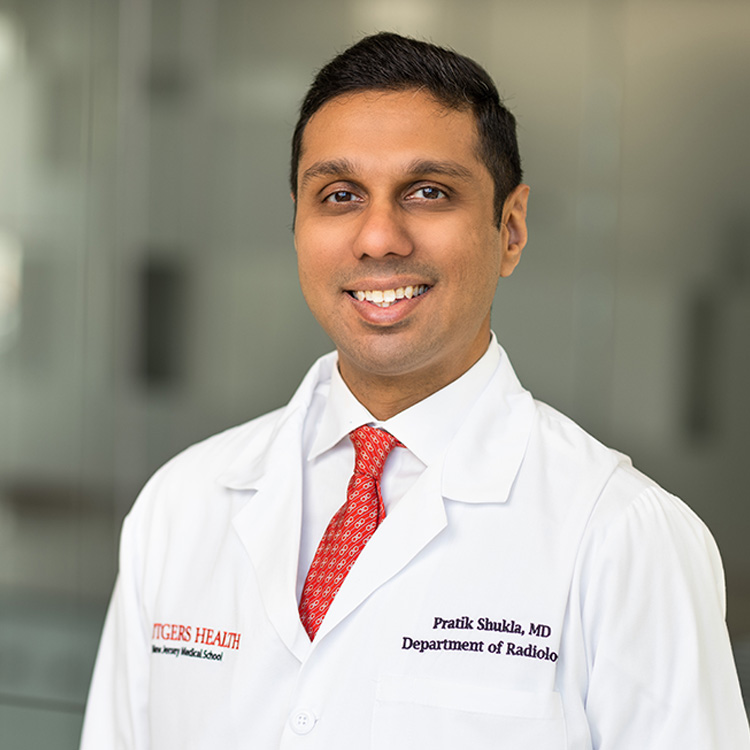
Pratik A Shukla
· Co-Director of Quality Assurance, Associate ProfessorVerifiedRutgers University · Radiology
Active 1980–2026
About
Pratik A. Shukla, MD, is an Associate Professor in the Department of Radiology at Rutgers New Jersey Medical School. He completed his MD in 2012 and his BA in 2008 at Rutgers, The State University. His professional licensure is in New Jersey. The information provided does not include specific details about his research focus, key contributions, or additional biographical information beyond his educational background and current academic appointment.
Research topics
- Medicine
- Internal medicine
- Surgery
- Radiology
- Family medicine
- Urology
- Medical physics
Selected publications
Journal of Vascular and Interventional Radiology · 2026-03-23
articleOpen accessSenior authorJournal of Vascular and Interventional Radiology · 2026-03-23
articleSenior authorInsurance-Based Differences in Treatment Patterns for Uterine Fibroids
Journal of the American College of Radiology · 2025-02-19 · 2 citations
article1st authorCorrespondingAbstract No. 524 Analysis of Leadership Positions and H-index in Academic Interventional Radiology
Journal of Vascular and Interventional Radiology · 2025-02-19
articleSenior authorAbstract No. 215 Nephrology Tube Dislodgements Are Not Associated with Ambulatory Status or BMI
Journal of Vascular and Interventional Radiology · 2025-02-19
articleOpen accessJournal of Vascular and Interventional Radiology · 2025-02-19
articleOpen accessSenior authorCardioVascular and Interventional Radiology · 2025-03-19 · 2 citations
articleOpen accessPURPOSE: To assess the safety and efficacy of Obsidio™ conformable embolic (CE) for embolization in the peripheral vasculature. MATERIALS AND METHODS: A retrospective review of the first 21 patients treated with CE was performed. Eighteen (85.7%) patients were male, and median age was 61.5 years (range, 12-89 years). Technical success was defined as stasis as assessed by a static contrast column for at least 5 heartbeats on post-embolization angiography. For procedures of peripheral vascular hemorrhage, clinical success was defined as hemorrhage resolution without reintervention within 30-day follow-up. RESULTS: Indications for embolization were peripheral arterial hemorrhage (n = 13), preoperative tumor embolization (n = 4), preoperative embolization of renal cell carcinoma prior to cryoablation (n = 2), redistribution of flow prior to Yttrium-90 radioembolization to prevent nontarget radiation delivery (n = 1), and parastomal variceal embolization (n = 1). Embolization was performed via 2.4 or 2.8 French microcatheters flushed with saline prior to embolization. Most procedures (20/21) utilized < 1 cc of embolic, with the quantity used ranging between 0.1 and 1.4 cc. The amount of embolic injected was determined by the embolization endpoint, i.e., filling of the vessel intended for embolization. CE was used in combination with coils placed prior to CE in 4 procedures. Follow-up was a median of 57 days (range 0-244 days). Complete stasis was achieved in 100% (n = 21/21) of procedures. There were no post-procedure adverse events or rebleeding. CONCLUSION: CE resulted in reliable vessel occlusion with no cases of rebleeding or reintervention and with no procedure-related adverse events in this series. LEVEL OF EVIDENCE: Level 4, Case Series.
Clinical Imaging · 2025-11-01
reviewSenior authorThe IR Match: A Bibliometric Analysis of 457 First-Year Residents
Journal of Vascular and Interventional Radiology · 2025-08-05
letterSenior authorModelling and Simulation in Materials Science and Engineering · 2025-07-04
articleAbstract The durability and long-term survival of medical implants are major concerns for patients and surgeons. The laser shock peening (LSP) process can enhance the implant’s in-vivo lifespan through the compressive residual stress introduced on the implant’s surface. In the current research, a novel hybrid machine learning (ML) prediction tool was developed to calculate LSP induced residual stresses. Laser energies of 3 J, 5 J, 7 J with three overlapping levels of 33%, 50% and 67% with a constant laser spot diameter were introduced to a Ti-6Al-7Nb titanium hip implant material. A three-dimensional finite element model was developed incorporating an explicit dynamic analysis to capture the dynamic material response during the LSP process. Furthermore, The random forest ML algorithm was adapted so that the laser energy and overlapping were set as input parameters, while the associated residual stresses were set as output parameters. The mean squared error (MSE), root MSE and coefficient of determination for testing data sets concerning residual stress were 112.9%, 10.6% and 97%, respectively. The FEM and ML results both show a good agreement with the experimental data. The new proposed approach allows development of ML models even with a limited experimental data. The accuracy and performance of each model are discussed and the limitations are addressed. The approach carried out in this paper enables subsequent predictions of surface treatment techniques of implants through residual stress fields and can be applied to a wide range of applications.
Frequent coauthors
- 173 shared
Abhishek Kumar
- 66 shared
S. Shanmugasundaram
SRM Dental College
- 62 shared
Antony Sare
Yale University
- 59 shared
Sohail Contractor
University of Louisville
- 56 shared
M. Kolber
The University of Texas Southwestern Medical Center
- 44 shared
Vishnu Chandra
University of Virginia
- 42 shared
Jean Anderson Eloy
Neurological Surgery
- 36 shared
Ethan Wajswol
Icahn School of Medicine at Mount Sinai
Education
- 2012
M.D.
Rutgers, The State University
- 2008
B.A.
Rutgers, The State University
- Resume-aware match score
- Save to shortlist
- AI-drafted outreach
See your match with Pratik A Shukla
PhdFit ranks faculty by your research interests, methods, and publications — grounded in their actual work, not templates.
- Free to start
- No credit card
- 30-second signup