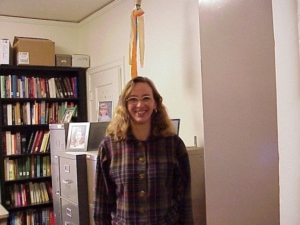
Rebecca Jean Emigh
· ProfessorVerifiedUniversity of California, Los Angeles · Sociology
Active 1989–2026
About
Rebecca Jean Emigh is a Professor in the UCLA Sociology Department with a focus on long-term processes of social change. Her research explores how cultural, economic, and demographic factors intersect to influence social transformations, utilizing historical perspectives and mixed methods to analyze social phenomena both in the past and present. Emigh is particularly interested in a 'view from below,' examining how ordinary people impact social relations and shape history. Her academic background includes a Ph.D. in Sociology from the University of Chicago, an M.A. in Statistics from the same institution, an M.A. in Sociology from Columbia University, and a B.A. in Sociology from Barnard College, Columbia University. Her work encompasses studies on transitions to capitalism, forms of information gathering, and the social implications of census practices. Emigh has contributed to the understanding of official information gathering, racial categorization, and social change, and has co-authored significant volumes on how societies and states count and classify populations. Her scholarship has been recognized through awards such as the ASA Section on the History of Sociology and Social Thought Article Prize and the SSHA Founder's Prize.
Research topics
- Sociology
- Computer Science
- Artificial Intelligence
- Anthropology
- Genealogy
- Economics
- Ethnology
- Data science
- Management science
- History
- Geography
Selected publications
Critical Sociology · 2026-04-05
article1st authorCorrespondingCritical Sociology · 2026-05-03
articleOpen accessSenior authorThe Sociology of Sociological Interventions: Do Sociologists Make a Social Difference?
2025-01-01
article1st authorCorrespondingDo sociologists actually change the world they study, or are they just documenting its problems from the sidelines?
Introduction: Relational Power Theory: Elites and Nonelites
2024-11-28 · 1 citations
book-chapter1st authorCorrespondingAbstract In this chapter, we review the historical development of elite theory, and then we propose a way forward beyond it. Elite theory emerged as a critique of democracy in the late 19th century. Although it used historical materials illustratively, it tended to be ahistorical theoretically because its primary aim was to demonstrate the perdurance of elites even in conditions of mass suffrage. Lachmann was the first scholar to develop elite theory as a truly historical and explanatory framework by combining it with elements of Marxism. Even Lachmann's theory, however, remained inadequate because it did not rest on a fully articulated theory of power. In this introduction, we suggest a “relational power theory” as a remedy to this situation, and we use it to formulate a general heuristic for the study of elites, nonelites, and their interrelationships. To illustrate its utility, we show how it can illuminate the chapters in this volume (though they were not necessarily written for these purposes).
Virtual Issue: Race in the United States in <i>Social Science History</i>
Social Science History · 2024-01-01 · 1 citations
articleSenior authorCorrespondingAn abstract is not available for this content so a preview has been provided. Please use the Get access link above for information on how to access this content.
The Sociology of Sociological Interventions: Do Sociologists Make a Social Difference?
2024-01-01
book-chapterHistorical Trajectories of Official Information Gathering in India
2024-11-14
book-chapterAbstract A “state-driven” approach suggests that colonists use census categories to rule. However, a “society-driven” approach suggests that this state-driven perspective confers too much power upon states. A third approach views census-taking and official categorization as a product of state–society interaction that depends upon: (a) the population's lay categories, (b) information intellectuals' ability to take up and transform these lay categories, and (c) the balance of power between social and state actors. We evaluate the above positions by analyzing official records, key texts, travelogues, and statistical memoirs from three key periods in India: Indus Valley civilization through classical Gupta rule (ca. 3300 BCE–700 CE), the “medieval” period (ca. 700–1700 CE), and East India Company (EIC) rule (1757–1857 CE), using historical narrative. We show that information gathering early in the first period was society driven; however, over time, a strong interactive pattern emerged. Scribes (information intellectuals) increased their social status and power (thus, shifting the balance of power) by drawing on caste categories (lay categories) and incorporating them into official information gathering. This intensification of interactive information gathering allowed the Mughals, the EIC, and finally British direct rule officials to collect large quantities of information. Our evidence thus suggests that the intensification of state–society interactions over time laid the groundwork for the success of the direct rule British censuses. It also suggests that any transformative effect of these censuses lay in this interactive pattern, not in the strength of the British colonial state.
Annual Review of Sociology · 2024-05-09 · 1 citations
articleOpen access1st authorCorrespondingOrality, literacy, and digitality are forms of knowledge and communication based on speech, reading and writing, and electronic technologies using binary formats, respectively. This article reviews four possible relationships between them: Is literacy (and by extension digitality) the superior form, is orality superior, are all three mostly interchangeable, or do they all change each other as they emerge historically? These different positions imply different histories: linear, contingent, and epochal. This article considers the future of digitality by reviewing these relationships, past and present. These four intellectual positions did not arise neutrally. In fact, the superiority of literacy is rooted in Eurocentric views of technological progress and colonial power. Because this positionality is crucial to understanding the historical relationship among them, the article draws on the philosophy of science of dialectical realism to look for the similarities and differences between the positions, as well as the contradictions. It is a bold call for the comparative historical sociology of digitality (and everything else).
12. The Dialectical Comparative Methodology
Columbia University Press eBooks · 2024-04-25 · 5 citations
book-chapter1st authorCorrespondingIEEE Annals of the History of Computing · 2022-10-01 · 2 citations
article1st authorCorrespondingResearch relies on the survival of materials about activities of everyday life. However, what remains in the present, available for research, are not the activities themselves but documents (materials saved intentionally) and traces (materials saved unintentionally) about them. Furthermore, only some documents and traces survive. This article outlines a sociotechnological framework for the social life course of research materials, through capturing, saving, and retrieving and then applies this approach to understand the survival rates of historical demographic materials, censuses and census-like surveys. This approach emphasizes that research materials survive not only because of (or in spite of) technical elements but also because of interconnected sociotechnological processes. These processes are shaped by the power and interests of social and state actors and institutions.
Recent grants
Frequent coauthors
- 47 shared
Patricia Ahmed
- 43 shared
Dylan Riley
- 7 shared
Cynthia Feliciano
Washington University in St. Louis
- 4 shared
Iván Szelényi
Yale University
- 4 shared
Parveen Ahmed
- 2 shared
Dylan Riley
- 2 shared
Éva Fodor
- 2 shared
Mary Jo Maynes
Twin Cities Orthopedics
Awards & honors
- SSHA 2015 Founder's Prize (2016)
- Outstanding Marxist Sociology Article Award, Marxist Sociolo…
- Article Prize from the ASA Section on the History of Sociolo…
- Honorable Mention, Barrington Moore Prize for Best Book, Com…
- Resume-aware match score
- Save to shortlist
- AI-drafted outreach
See your match with Rebecca Jean Emigh
PhdFit ranks faculty by your research interests, methods, and publications — grounded in their actual work, not templates.
- Free to start
- No credit card
- 30-second signup