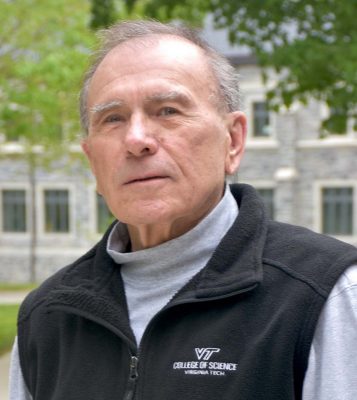
Robert J. Bodnar
· University Distinguished Professor and C.C. Garvin Professor of GeochemistryVerifiedVirginia Tech · Geosciences
Active 1978–2026
About
Robert J. Bodnar is a University Distinguished Professor and the C. C. Garvin Professor of Geochemistry at Virginia Tech in the Department of Geosciences. He holds a Ph.D. in Geochemistry and Mineralogy from Penn State University, obtained in 1985, and has a background in geology and chemistry from the University of Arizona and the University of Pittsburgh. His research focuses on fluid inclusion studies, experimental geochemistry, and mineralogy, contributing significantly to understanding hydrothermal fluid characteristics, fluid inclusion techniques, and water-rock interactions. Bodnar has authored numerous publications in these fields and has been recognized with various honors and awards for his contributions to geosciences.
Research topics
- Geochemistry
- Geology
- Chemistry
- Mineralogy
- Petrology
- Seismology
- Paleontology
- Astrobiology
- Oceanography
- Physics
- Geotechnical engineering
- Soil science
- Earth science
Selected publications
Geoscience Frontiers · 2026-01-18
articleSynthetic fluid inclusions: A novel technique for experimental water-rock studies
2026-02-20 · 1 citations
article1st authorCorrespondingSynthetic fluid inclusions have been used to determine volumetric and phase equilibrium properties of fluids over a wide range of pressure-temperature-composition conditions. The technique is particularly useful in the study of immiscible fluid systems and for systems which become saturated in one or more solid or fluid phases during cooling and decompression from experimental to ambient conditions. When used in conjunction with conventional experimental techniques, synthetic fluid inclusions permit determination and quantification of physical properties of fluid systems over the complete range of PTX conditions of interest to geochemists studying crustal geochemical processes.
2025-01-01
article1st authorCorrespondingFLUID PULSES DURING SUBDUCTION AND THEIR IMPACTS ON FLUID COMPOSITION, ROCK VOLUME, AND METASOMATISM
Abstracts with programs - Geological Society of America · 2025-01-01
articleSenior authorAbstracts with programs - Geological Society of America · 2025-01-01
articleNew insights into the evolution of boron isotope composition of seawater from evaporites
2025-01-01
articleReview: The hydrogeology of critical mineral resources relevant to the energy transition
Hydrogeology Journal · 2025-05-31 · 3 citations
articleOpen accessAbstract Attaining the goals of the international treaty on climate change (the Paris Agreement) will greatly increase the demand for the critical minerals required to implement clean-energy technologies. This poses both challenges and opportunities to the hydrogeologic community from several perspectives. Here, important insights that the hydrogeological sciences have to offer for mineral exploration, mineral production, and addressing environmental issues related to mining and mine decommissioning are summarized. This study focuses on copper, cobalt, lithium, and rare earths to represent the broad spectrum of critical minerals and illustrate their relevance by referring to projected demands and production rates. The current understanding of the hydrogeologic processes that form major deposits of these minerals are then summarized. Ore is defined as the naturally occurring material from which minerals of economic value can be extracted, where most ore deposits are the products of complex hydrogeologic couplings between fluid flow, heat transport, solute transport, chemical reactions, and mechanical deformation. Exploration models for the discovery of deeper, hidden deposits are potentially informed by hydrogeologic theory and hydrogeochemical processes. Hydrogeologic understanding and methods are also essential to production and recovery. Longstanding challenges are mine dewatering and (conversely) mine water supply, as well as mineral-extraction practices such as spoil heap leaching and in situ mining. New challenges arise from element extraction from subsurface brines. Finally, the quantity of water use and potential environmental impacts of mining on water quality are at the core of ‘social license’: the approval and acceptance of society to mining activities.
Science Advances · 2025-06-25 · 17 citations
articleOpen accessPorphyry copper deposits (PCDs) are the main source of copper globally, with the metals transported in and deposited from aqueous magmatic fluids. Processes that define the volume of magma and concentration of copper in the magma required to form PCDs, however, are not well understood. Here, we present the results of quantitative modeling of the behavior of Cu and Cl during magma evolution in the upper crust. We show that fractional crystallization is the most important process promoting efficient Cu extraction, and that high concentrations of Cu in the ore-forming hydrothermal fluids can be reached with moderate Cl concentrations. Unusually high concentrations of Cl and Cu in the magma and large magma volumes are not required. Arc magmas of modest volume (<10 3 km 3 ) and modest initial Cu and Cl concentrations can generate large PCDs, if a sufficient mass of magmatic fluid is exsolved at an advanced stage of crystallization.
Earth and Planetary Science Letters · 2025-06-05 · 2 citations
articleOpen accessSenior author• Melt inclusions contain up to 1.3 wt% CO₂, and primary melts are estimated to have contained 4.4–6.0 wt% CO₂. • Primitive melts crystallized over a range of depths, with maximum values of 10–18 km, whereas more evolved melts crystallized at depths <5 km. • Sources of alkalic magmas are lithospheric mantle metasomes containing amphibole, clinopyroxene, phlogopite, and carbonate. • Degassing models predict CO₂-rich gas compositions that match surficial plume measurements from summit lava lakes. Nyiragongo and Nyamulagira are two of the most active volcanoes in the East African Rift System, producing some of the highest fluxes of volcanic CO₂ and SO₂ on Earth, yet pre-eruptive volatile constraints at these volcanoes remain sparse. Here, we report the geochemistry of melt inclusions (MI) from Mg-rich tephra erupted from flank cones of Nyamulagira and Nyiragongo. In our sample suite, CO₂ concentrations in bubble-corrected melt inclusions reach ∼1.3 and 0.9 wt% for Nyiragongo and Nyamulagira, respectively. Water concentrations are 0.8–1.6 wt% for primitive compositions and 0.2–0.4 wt% for more evolved compositions. Sulfur concentrations reach up to 3100 ppm at Nyiragongo and 2500 ppm at Nyamulagira. Major element ‘fingerprinting’ of MI shows that some tephra samples have MI with both Nyamulagira and Nyiragongo-type compositions, requiring mixing of olivine originally crystallized from multiple distinct magma types. Volatile solubility modeling yields a wide range of crystallization depths for more primitive magmas, with maximum values of ∼10–18 km, compared to <5 km for more evolved magmas erupted at the Nyamulagira summit. Estimated CO₂ concentrations for primary melts based on final equilibration with a lherzolite residue at mantle depths are 6.0 ± 2.5 wt% for Nyiragongo and 4.4 ± 2.5 wt% for Nyamulagira. Major element and volatile data are consistent with magma generation in metasomatized lithospheric mantle domains (metasomes) of amphibole+clinopyroxene+lesser phlogopite, with high initial CO₂ sourced from carbonate phase(s). Degassing models of CO₂, H₂O, and S show that gas compositions at the two volcanoes can be explained by evolved magmas feeding summit lava lakes by a process of conduit convection and degassing.
2024-01-01
articleOpen access
Recent grants
Experimental Study of Water Leakage from Melt Inclusions in Quartz During Laboratory Heating
NSF · $226k · 2004–2007
NSF · $378k · 2007–2010
NSF · $478k · 2016–2019
NSF · $78k · 2016–2019
NSF · $316k · 2015–2019
Frequent coauthors
- 37 shared
Matthew Steele‐MacInnis
University of Alberta
- 33 shared
M. E. Zolensky
- 28 shared
Mantu K. Hudait
Virginia Tech
- 25 shared
H. Y. McSween
University of Tennessee at Knoxville
- 24 shared
J. Donald Rimstidt
Virginia Tech
- 22 shared
L. A. Taylor
- 22 shared
Hector Lamadrid
University of Oklahoma
- 21 shared
Benedetto De Vivo
Nanjing University
Labs
Department of Geosciences, Virginia TechPI
- Resume-aware match score
- Save to shortlist
- AI-drafted outreach
See your match with Robert J. Bodnar
PhdFit ranks faculty by your research interests, methods, and publications — grounded in their actual work, not templates.
- Free to start
- No credit card
- 30-second signup