Resume-aware faculty matching

Find professors who actually fit you

Upload your resume. Four AI agents analyze your background, rank the faculty who fit, inspect their recent research, and help you draft outreach — grounded in their actual work, not templates.

Free to startNo credit cardCancel anytime
Top matches Balanced preset
Dr. Sarah Chen
Stanford · Interpretability · NLP
91
Dr. Marcus Holloway
MIT · Robotics · RL
84
Dr. Aisha Okonkwo
CMU · Fairness · HCI
82
Nova · Professor Researcher · re-ranking top 20…
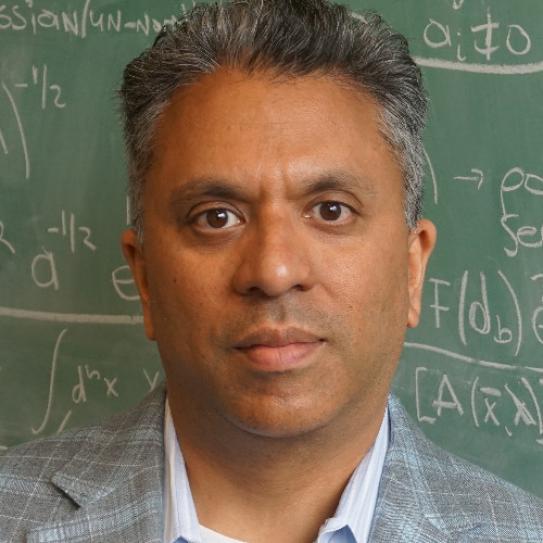
Rupak Chatterjee

Rupak Chatterjee

· ProfessorVerified

New York University · Applied Physics

Active 1995–2026

h-index10
Citations525
Papers6926 last 5y
Funding
See your match with Rupak Chatterjee — sign in to PhdFit.Sign in

About

Rupak Chatterjee is an Industry Associate Professor at NYU Tandon School of Engineering with a focus on Quantum Information and Computation, including quantum systems for machine learning algorithms and quantum optimization. His research interests also encompass Mathematical Physics, specifically C∗ and von Neumann Algebras, as well as supersymmetric and conformal quantum mechanics. Dr. Chatterjee has an extensive academic background, having completed his B.Sc. in Physics at the University of Calgary, an M.Math. in Mathematics at the University of Waterloo, and a Ph.D. in Physics from Stony Brook University. He further pursued postdoctoral research at the University of Chicago's Department of Physics, James Franck Institute. His scholarly contributions include numerous publications in the fields of quantum mechanics, quantum information, and mathematical physics, reflecting a deep engagement with the theoretical foundations and applications of quantum systems.

Research topics

  • Computer Science
  • Artificial Intelligence
  • Machine Learning
  • Biochemistry
  • Organic chemistry
  • Chemistry
  • Chromatography
  • Physics
  • Nuclear chemistry
  • Algorithm
  • Combinatorial chemistry
  • Theoretical computer science

Selected publications

  • Modular Self-Duality, Symmetrized Relative Entropy, and Bogoliubov--Kubo--Mori Susceptibility in Quantum Field Theory

    arXiv (Cornell University) · 2026-05-18

    preprintOpen access1st authorCorresponding

    We develop an operator-algebraic framework for modular self-duality, symmetrized relative entropy, and Bogoliubov--Kubo--Mori susceptibility of local states in quantum field theory. In finite dimensions, modular self-duality singles out fixed points at which a state coincides with its modularly reflected partner. At such points, the natural comparison functional is the symmetrized Umegaki relative entropy. It vanishes at coincidence, and its Hessian is governed by the Bogoliubov--Kubo--Mori quantum Fisher information along the reflected tangent direction. We then extend this fixed-point construction to the local type~III von Neumann algebras that arise in quantum field theory. Here, a local state is compared with the modular pullback of its commutant restriction, and the intrinsic comparison functional is the symmetrized Araki relative entropy. For sufficiently regular state deformations, the fixed-localization Hessian at the self-dual point defines a type~III Bogoliubov--Kubo--Mori susceptibility. This coefficient is obtained by evaluating the BKM bilinear form on the tangent selected by the modular pairing. Exact coherent-state realizations are obtained for the free scalar field on wedge algebras and for the chiral \(U(1)\) current on half-line algebras. In both examples, the comparison functional is exactly quadratic in the deformation parameter, and the susceptibility coefficients admit explicit boost-energy, stress-tensor, or half-line integral representations.

  • Modular Self-Duality, Symmetrized Relative Entropy, and Bogoliubov--Kubo--Mori Susceptibility in Quantum Field Theory

    ArXiv.org · 2026-05-18

    articleOpen access1st authorCorresponding

    We develop an operator-algebraic framework for modular self-duality, symmetrized relative entropy, and Bogoliubov--Kubo--Mori susceptibility of local states in quantum field theory. In finite dimensions, modular self-duality singles out fixed points at which a state coincides with its modularly reflected partner. At such points, the natural comparison functional is the symmetrized Umegaki relative entropy. It vanishes at coincidence, and its Hessian is governed by the Bogoliubov--Kubo--Mori quantum Fisher information along the reflected tangent direction. We then extend this fixed-point construction to the local type~III von Neumann algebras that arise in quantum field theory. Here, a local state is compared with the modular pullback of its commutant restriction, and the intrinsic comparison functional is the symmetrized Araki relative entropy. For sufficiently regular state deformations, the fixed-localization Hessian at the self-dual point defines a type~III Bogoliubov--Kubo--Mori susceptibility. This coefficient is obtained by evaluating the BKM bilinear form on the tangent selected by the modular pairing. Exact coherent-state realizations are obtained for the free scalar field on wedge algebras and for the chiral \(U(1)\) current on half-line algebras. In both examples, the comparison functional is exactly quadratic in the deformation parameter, and the susceptibility coefficients admit explicit boost-energy, stress-tensor, or half-line integral representations.

  • Entanglement harvesting and curvature of entanglement: A modular operator approach

    ArXiv.org · 2025-08-17

    preprintOpen access1st authorCorresponding

    An operator-algebraic framework based on Tomita-Takesaki modular theory is used to study aspects of quantum entanglement via the application of the modular conjugation operator $J$. The entanglement structure of quantum fields is studied through the protocol of entanglement harvesting whereby quantum correlations evolve through the time evolution of qubit detectors coupled to a Bosonic field. Modular conjugation operators are constructed for Unruh-Dewitt type qubits interacting with a scalar field such that initially unentangled qubits become entangled. The entanglement harvested in this process is directly quantified by an expectation value involving $J$ offering a physical application of this operator. The modular operator formalism is then extended to the Markovian open system dynamics of coupled qubits by expressing entanglement monotones as functionals of a state $ρ$ and its modular reflection $JρJ$. The second derivative of such functionals with respect to an external coupling parameter, termed the curvature of entanglement, provides a natural measure of entanglement sensitivity. At points of modular self-duality, the curvature of entanglement coincides with the quantum Fisher information measure. These results demonstrate that the modular conjugation operator $J$ captures both the harvesting of entanglement from quantum fields and the curvature of entanglement in coupled qubit dynamics providing parallel modular structures that connect these systems.

  • Solving the traveling salesman problem via different quantum computing architectures

    International Journal of Quantum Information · 2025-10-11 · 4 citations

    article

    In this paper, we study the application of emerging photonic and quantum computing architectures to solving the Traveling Salesman Problem (TSP), a well-known NP-hard optimization problem. We investigate several approaches: Simulated Annealing (SA), Quadratic Unconstrained Binary Optimization (QUBO-Ising) methods implemented on quantum annealers and Optical Coherent Ising Machines, as well as the Quantum Approximate Optimization Algorithm (QAOA) and the Quantum Phase Estimation (QPE) algorithm on gate-based quantum computers. QAOA and QPE were tested on the IBM Quantum platform. The QUBO-Ising method was explored using the D-wave quantum annealer, which operates on superconducting Josephson junctions, and the Quantum Computing Inc (QCi) Dirac-1 entropy quantum optimization machine. Gate-based quantum computers demonstrated accurate results for small TSP instances in simulation. However, real quantum devices are hindered by noise and limited scalability. Circuit complexity grows with problem size, restricting performance to TSP instances with a maximum of six nodes. In contrast, Ising-based architectures show improved scalability for larger problem sizes. SQUID-based Ising machines can handle TSP instances with up to 12 nodes, while entropy computing implemented in hybrid optoelectronic components extend this capability to 18 nodes. Nevertheless, the solutions tend to be suboptimal due to hardware limitations and challenges in achieving ground state convergence as the problem size increases. Despite these limitations, Ising machines demonstrate significant time advantages over classical methods, making them a promising candidate for solving larger-scale TSPs efficiently.

  • Solving the Traveling Salesman Problem via Different Quantum Computing Architectures

    ArXiv.org · 2025-02-24

    preprintOpen access

    We study the application of emerging photonic and quantum computing architectures to solving the Traveling Salesman Problem (TSP), a well-known NP-hard optimization problem. We investigate several approaches: Simulated Annealing (SA), Quadratic Unconstrained Binary Optimization (QUBO-Ising) methods implemented on quantum annealers and Optical Coherent Ising Machines, as well as the Quantum Approximate Optimization Algorithm (QAOA) and the Quantum Phase Estimation (QPE) algorithm on gate-based quantum computers. QAOA and QPE were tested on the IBM Quantum platform. The QUBO-Ising method was explored using the D-Wave quantum annealer, which operates on superconducting Josephson junctions, and the Quantum Computing Inc (QCi) Dirac-1 entropy quantum optimization machine. Gate-based quantum computers demonstrated accurate results for small TSP instances in simulation. However, real quantum devices are hindered by noise and limited scalability. Circuit complexity grows with problem size, restricting performance to TSP instances with a maximum of 6 nodes. In contrast, Ising-based architectures show improved scalability for larger problem sizes. SQUID-based Ising machines can handle TSP instances with up to 12 nodes, while entropy computing implemented in hybrid optoelectronic components extend this capability to 18 nodes. Nevertheless, the solutions tend to be suboptimal due to hardware limitations and challenges in achieving ground state convergence as the problem size increases. Despite these limitations, Ising machines demonstrate significant time advantages over classical methods, making them a promising candidate for solving larger-scale TSPs efficiently.

  • Entanglement harvesting and curvature of entanglement: A modular operator approach

    Physical review. D/Physical review. D. · 2025-10-16 · 3 citations

    articleOpen access1st authorCorresponding

    An operator-algebraic framework based on Tomita-Takesaki modular theory is used to study aspects of quantum entanglement via the application of the modular conjugation operator <a:math xmlns:a="http://www.w3.org/1998/Math/MathML" display="inline"> <a:mi>J</a:mi> </a:math> . The entanglement structure of quantum fields is studied through the protocol of entanglement harvesting whereby quantum correlations evolve through the time evolution of qubit detectors coupled to a Bosonic field. Modular conjugation operators are constructed for Unruh-Dewitt type qubits interacting with a scalar field such that initially unentangled qubits become entangled. The entanglement harvested in this process is directly quantified by an expectation value involving <c:math xmlns:c="http://www.w3.org/1998/Math/MathML" display="inline"> <c:mi>J</c:mi> </c:math> offering a physical application of this operator. The modular operator formalism is then extended to the Markovian open system dynamics of coupled qubits by expressing entanglement monotones as functionals of a state <e:math xmlns:e="http://www.w3.org/1998/Math/MathML" display="inline"> <e:mi>ρ</e:mi> </e:math> and its modular reflection <g:math xmlns:g="http://www.w3.org/1998/Math/MathML" display="inline"> <g:mi>J</g:mi> <g:mi>ρ</g:mi> <g:mi>J</g:mi> </g:math> . The second derivative of such functionals with respect to an external coupling parameter, termed the curvature of entanglement, provides a natural measure of entanglement sensitivity. At points of modular self-duality, the curvature of entanglement coincides with the quantum Fisher information measure. These results demonstrate that the modular conjugation operator <i:math xmlns:i="http://www.w3.org/1998/Math/MathML" display="inline"> <i:mi>J</i:mi> </i:math> captures both the harvesting of entanglement from quantum fields and the curvature of entanglement in coupled qubit dynamics providing parallel modular structures that connect these systems.

  • Tomita-Takesaki theory and quantum concurrence

    Physical review. D/Physical review. D. · 2024-09-16 · 3 citations

    article1st authorCorresponding

    The quantum entanglement measure of concurrence is shown to be directly calculable from a Tomita- Takesaki modular operator framework constructed from the local von Neumann algebras of observables for two quantum systems. Specifically, the Tomita-Takesaki modular conjugation operator $J$ that links two separate systems with respect to their von Neumann algebras is related to the quantum concurrence $C$ of a pure bivariate entangled state composed from these systems. This concurrence relation provides a direct physical meaning to $J$ as both a symmetry operator and a quantitative measure of entanglement. This procedure is then demonstrated for a supersymmetric quantum mechanical system and a real scalar field interacting with two entangled spin-$\frac{1}{2}$ Unruh-DeWitt qubit detectors. For the latter system, the concurrence result is shown to be consistent with some known results on the Bell-CHSH inequality for such a system.

  • Tomita-Takesaki theory and quantum concurrence

    arXiv (Cornell University) · 2024-06-22

    preprintOpen access1st authorCorresponding

    The quantum entanglement measure of concurrence is shown to be directly calculable from a Tomita- Takesaki modular operator framework constructed from the local von Neumann algebras of observables for two quantum systems. Specifically, the Tomita-Takesaki modular conjugation operator $J$ that links two separate systems with respect to their von Neumann algebras is related to the quantum concurrence $C$ of a pure bi-variate entangled state composed from these systems. This concurrence relation provides a direct physical meaning to $J$ as both a symmetry operator and a quantitative measure of entanglement. This procedure is then demonstrated for a supersymmetric quantum mechanical system and a real scalar field interacting with two entangled spin-$\frac{1}{2}$ Unruh-DeWitt qubit detectors. For the latter system, the concurrence result is shown to be consistent with some known results on the Bell-CHSH inequality for such a system.

  • Chaos in Optomechanical Systems Coupled to a Non-Markovian Environment

    Entropy · 2024-08-30 · 9 citations

    articleOpen access

    We study the chaotic motion of a semi-classical optomechanical system coupled to a non-Markovian environment with a finite correlation time. By studying the emergence of chaos using the Lyapunov exponent with the changing non-Markovian parameter, we show that the non-Markovian environment can significantly enhance chaos. It is observed that a non-Markovian environment characterized by the Ornstein-Uhlenbeck type noise can modify the generation of chaos with different environmental memory times. As a comparison, the crossover properties from Markov to non-Markovian regimes are also discussed. Our findings indicate that the quantum memory effects on the onset of chaos may become a useful property to be investigated in quantum manipulations and control.

  • Optimization on large interconnected graphs and networks using adiabatic quantum computation

    International Journal of Quantum Information · 2023-05-20

    preprintOpen accessSenior author

    In this paper, we demonstrate that it is possible to create an adiabatic quantum computing algorithm that solves the shortest path between any two vertices on an undirected graph with at most [Formula: see text] qubits, where [Formula: see text] is the number of vertices of the graph. We do so without relying on any classical algorithms, aside from creating an ([Formula: see text]) adjacency matrix. The objective of this paper is to demonstrate the fact that it is possible to model large graphs on an adiabatic quantum computer using the maximum number of qubits available and random graph generators such as the Barabási–Albert and the Erdős–Rényi methods which can scale based on a power law.

Frequent coauthors

  • A.D. Jackson

    12 shared
  • Anadijiban Das

    Simon Fraser University

    11 shared
  • Ting Yu

    Wuhan University

    8 shared
  • Ionuţ Florescu

    Stevens Institute of Technology

    8 shared
  • N. L. Balázs

    Stony Brook University

    8 shared
  • Sebastian F. Tudor

    Morgan Stanley (United States)

    6 shared
  • Thomas Lonon

    Stevens Institute of Technology

    5 shared
  • Honglei Zhao

    Stevens Institute of Technology

    5 shared
  • Resume-aware match score
  • Save to shortlist
  • AI-drafted outreach

See your match with Rupak Chatterjee

PhdFit ranks faculty by your research interests, methods, and publications — grounded in their actual work, not templates.

  • Free to start
  • No credit card
  • 30-second signup