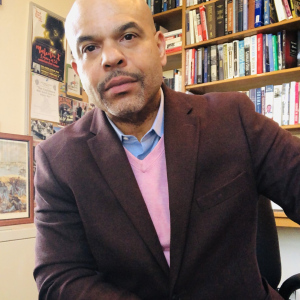
Saladin Ambar
· ProfessorRutgers University · Environmental Science and Policy
Active 2008–2025
About
Saladin Ambar is a Professor of Political Science and a Senior Scholar at the Center on the American Governor at the Eagleton Institute of Politics at Rutgers University-New Brunswick. His research focuses on the institutions of the American presidency and governorship, race and ethnic politics, American political thought, and American political development. He serves as the Director of the Democracy Committee for the New Jersey Reparations Council at the New Jersey Social Justice Institute. Additionally, Prof. Ambar is a scholarly advisor to the Lincoln Presidential Foundation and the Woodrow Wilson Presidential Library and Museum. Dr. Ambar is author of the forthcoming book, Murder on the Mississippi: The Shocking Crimes That Shaped Abraham Lincoln, which offers a narrative examination of racially motivated lynchings and murders beginning in 1835 that influenced Abraham Lincoln and highlighted the vulnerabilities of America to despotism. His work has been featured in various media outlets, and he has served as an expert commentator on CNN’s series Race for the White House, as well as a consultant for the Smithsonian Channel. He has also been a regular guest on PBS New Jersey and MetroFocus, providing political commentary.
Research topics
- Political Science
- History
- Sociology
- Archaeology
- Law
- Environmental ethics
- Philosophy
- Psychology
Selected publications
Presidential Studies Quarterly · 2025-11-18
article1st authorCorrespondingThe author declares no conflicts of interest. The author has nothing to report.
2022-08-31
book-chapter1st authorCorrespondingAbstract When Marlon Brando walked into a diner in New York’s Greenwich Village and sat between James Baldwin and Norman Mailer, it began a friendship that would play out on many stages, including in Paris, Istanbul, and Washington, D.C., during the March on Washington. As both men were conscious of their public standing as two of the most prominent artists of their time, they sought public venues for their interracial friendship, hoping to shatter white supremacy in their lives and in their respective works. Their love and respect for one another was profound and mutually rewarding, even as their sexual identities were subordinated in an era where male romantic love remained taboo. Chapter 6 highlights one of the more important relationships of the civil rights era involving two cultural icons seeking a path towards racial justice through their art.
2022-08-31
book-chapter1st authorCorrespondingAbstract Over many decades, the lives of America’s two most iconic radical women intersected—at times with equal parts irony and significance. As Gloria Steinem grew into perhaps the greatest symbol of post-war feminism, Angela Davis can likewise be said to have represented the radical left in America—and the rise of Black Power. As their friendship emerged over the years, their commitment to ending racial and gender-based discrimination intersected, bringing them together for a historic Women’s March after the inauguration of Donald Trump in 2016. Chapter 9 offers a window into their respective stories and their relationship as it demonstrates how the story of interracial friendship in America has many faces and demands new paradigms for understanding how the status of women in society is critical for thinking about racial injustice and white supremacy.
2022-08-31
other1st authorCorrespondingExtract We put out the camp fire at the cavern the first thing, and didn’t show a candle outside after that.I took the canoe out from shore a little piece and took a look, but if there was a boat around I couldn’t see it, for stars and shadows ain’t good to see by.—Mark Twain, The Adventures of Huckleberry Finn
2022-08-31
other1st authorCorrespondingExtract Oxford University Press is a department of the University of Oxford. It furthers the University’s objective of excellence in research, scholarship, and education by publishing worldwide. Oxford is a registered trade mark of Oxford University Press in the UK and certain other countries. Published in the United States of America by Oxford University Press 198 Madison Avenue, New York, NY 10016, United States of America. © Saladin Ambar 2022 All rights reserved. No part of this publication may be reproduced, stored in a retrieval system, or transmitted, in any form or by any means, without the prior permission in writing of Oxford University Press, or as expressly permitted by law, by license, or under terms agreed with the appropriate reproduction rights organization. Inquiries concerning reproduction outside the scope of the above should be sent to the Rights Department, Oxford University Press, at the address above. You must not circulate this work in any other form
2022-08-31
book-chapter1st authorCorresponding2022-08-31 · 1 citations
book-chapter1st authorCorrespondingAbstract Eleanor Roosevelt’s friendship with the Black activist and educator Mary McLeod Bethune was one of the most influential relationships forged in Franklin Roosevelt’s presidency. The pioneering Bethune and the daring First Lady helped orchestrate a number of important policy shifts and advances in matters of race, in an administration deeply averse to taking risks where race was concerned. Over time, their bond helped create new expectations about racial justice and its connection to presidential leadership, even as women in politics were forced to play a subordinate role. Chapter 4 introduces a politically strategic, and yet deeply personal friendship, one that helped broaden the horizons of a racially proscribed New Deal era.
2022-08-31
book-chapter1st authorCorrespondingAbstract Barack Obama and Joe Biden’s friendship may be the most covered interracial friendship in modern American history. And for good reason: both men have served as president and both have been shaped by crisis, loss, and a sense of destiny. Yet, below the surface bonhomie between the forty-fourth and forty-sixth presidents of the United States is a sense of how far multiracial democracy has come over the past two centuries. It is also a relationship that raises new questions about why the symbolic value of interracial friendship may remain with us for some time.
2022-08-31
book-chapter1st authorCorrespondingAbstract When Ralph Ellison reached out to the great but then unheralded critic Stanley Hyman to write for his Negro journal, one of the great tripartite intellectual connections and friendships in American history began. Ellison, Hyman, and the writer Shirley Jackson—still then very much known as “Stanley Hyman’s wife”—would collectively grapple with the great issues of the time in their works, as each explored the primal and the mythical in their writings. This was especially true of Jackson and Ellison, whose mid-century works would become synonymous for the ways in which race, sex, and class have shaped the nature of American democracy. Chapter 5 explores the subtleties of how this artistic triangle, rooted in friendship, blossomed into a social force for broadening American democracy.
2022-08-31
book-chapter1st authorCorrespondingAbstract One of the great Hollywood stories persists to this day: Marilyn Monroe and Ella Fitzgerald’s groundbreaking friendship and its role in desegregating American music venues. Yet, there remains a great deal of myth about this historic friendship, even as plays, internet memes, and children’s books have been written about it. The story of Monroe, Fitzgerald, and the club Mocambo is an object lesson in why the politics of interracial friendship cut many ways—even when our motivations are in the right place. Nevertheless, there is much more instructive about the Mocambo moment than myth; it also sheds light on the relationship between racism, sexism, and class in American society. Chapter 7 investigates one of the more lauded stories of interracial friendship from the civil rights era, and why the stories we tell about it matter.
Frequent coauthors
- 1 shared
Niambi M. Carter
- 1 shared
Heath Fogg Davis
- Resume-aware match score
- Save to shortlist
- AI-drafted outreach
See your match with Saladin Ambar
PhdFit ranks faculty by your research interests, methods, and publications — grounded in their actual work, not templates.
- Free to start
- No credit card
- 30-second signup