Resume-aware faculty matching

Find professors who actually fit you

Upload your resume. Four AI agents analyze your background, rank the faculty who fit, inspect their recent research, and help you draft outreach — grounded in their actual work, not templates.

Free to startNo credit cardCancel anytime
Top matches Balanced preset
Dr. Sarah Chen
Stanford · Interpretability · NLP
91
Dr. Marcus Holloway
MIT · Robotics · RL
84
Dr. Aisha Okonkwo
CMU · Fairness · HCI
82
Nova · Professor Researcher · re-ranking top 20…
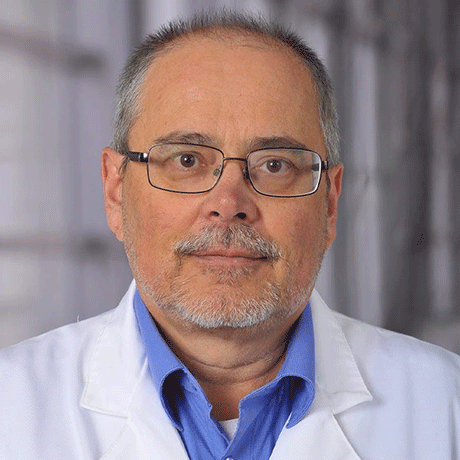
Sandor Gyorke

Sandor Gyorke

· ProfessorVerified

Ohio State University · Molecular, Cellular, and Integrative Physiology

Active 1987–2026

h-index74
Citations16.4k
Papers34871 last 5y
Funding$23.4M2 active
See your match with Sandor Gyorke — sign in to PhdFit.Sign in

About

Sandor Gyorke, PhD, is a Professor of Physiology and Cell Biology at The Ohio State University College of Medicine. His research group focuses on the study of processes that regulate the contraction of the heart under both normal conditions and during cardiac disease. His work is concerned with the mechanisms that govern the gating activity of the cardiac ryanodine receptor (RyR2) channels and control the release of calcium from the sarcoplasmic reticulum. Additionally, his research is devoted to understanding alterations of intracellular calcium handling in disease conditions, particularly those related to cardiac rhythm disorders (arrhythmia) and pump function (heart failure), which are leading causes of morbidity and mortality worldwide. His goal is to gain fundamental insights into these mechanisms to develop novel treatments.

Research topics

  • Chemistry
  • Cell biology
  • Internal medicine
  • Biology
  • Medicine
  • Biochemistry
  • Cardiology
  • Endocrinology
  • Biophysics
  • Immunology
  • Molecular biology

Selected publications

  • BPS2026 – Sub-sarcomeric spatial multiomics reveals distinct organization of excitation-contraction coupling mRNA translation

    Biophysical Journal · 2026-02-01

    articleSenior author
  • Dynamic-Structure Redesign of Calmodulin Reveals Mechanistic Constraints on Ryr2 Regulation

    bioRxiv (Cold Spring Harbor Laboratory) · 2026-04-17

    articleOpen access

    2. ABSTRACT Calmodulin (CaM) is a highly conserved Ca 2+ sensor that regulates hundreds of cellular targets through Ca 2+ -dependent conformational dynamics. Despite its central role in Ca 2+ signaling and disease, its evolutionary conservation and structural flexibility have suggested that CaM is resistant to rational redesign. Here, using the cardiac Ca 2+ release channel Ryanodine receptor 2 (RyR2) as a model system, we tested whether incorporating conformational dynamics into computational protein design enables functional reengineering of CaM. We first applied a static structure–based redesign to increase CaM–RyR2 affinity. Although the resulting variant bound more tightly to both the RyR2 peptide and the intact channel in vitro, it distorted peptide geometry and worsened Ca 2+ leak in cardiomyocytes ex vivo. Guided by molecular dynamics simulations, we then developed a dynamic-structure redesign strategy that preserves conformational integrity while strengthening binding. The resulting CaM variant exhibited increased RyR2 affinity and reduced pathological Ca 2+ leak in a disease-relevant model. These findings show that improved binding affinity alone is insufficient to enhance physiological regulation and that successful CaM redesign requires preservation of conformational dynamics. More broadly, they demonstrate that integrating conformational dynamics into protein redesign can enable functionally predictive engineering of flexible regulatory protein–protein interactions.

  • BPS2026 – Dynamic-structure redesign of calmodulin reduces Ca2+ leak and reveals mechanistic insights into RyR2 regulation

    Biophysical Journal · 2026-02-01

    article
  • BPS2026 – The D73N troponin C mouse: A translational model of dilated cardiomyopathy with mitochondrial ROS and novel atrial myxomas

    Biophysical Journal · 2026-02-01

    article
  • Disruption of Localized Protein Synthesis in the Sarcoplasmic Reticulum Impairs Cardiac Excitation-Contraction Coupling in Heart Failure

    Journal of Molecular and Cellular Cardiology Plus · 2026-03-01

    articleOpen accessSenior author
  • Restoration of mitochondrial Ca2+ and redox homeostasis by enhancement of SK channels rescues Ca2+ cycling in HFpEF cardiomyocytes

    Journal of Molecular and Cellular Cardiology · 2026-05-12

    article
  • BPS2025 - Mechanisms underlying distinct cardiac arrhythmia phenotypes caused by calmodulin mutation D132E in Calm2 and Calm3 genes

    Biophysical Journal · 2025-02-01

    article
  • Distinct intracellular spatiotemporal expression of Calmodulin genes underlies functional diversity of Calmodulin-dependent signalling in cardiac myocytes

    Cardiovascular Research · 2025-04-22 · 6 citations

    articleSenior author

    AIMS: This study aims to resolve the mechanisms underlying Calmodulin (CaM)'s signalling diversity by investigating whether the three CaM genes-Calm1, Calm2, and Calm3-play distinct or redundant roles in cardiac myocytes, focusing on their spatial mRNA localization and interactions with key targets. METHODS AND RESULTS: We utilized single-molecule mRNA detection and three-dimensional imaging to map the spatial distribution of Calm1, Calm2, and Calm3 mRNAs within ventricular myocytes. These mRNAs were found to be consistently positioned within specific cellular zones, overlapping with their target mRNAs and forming region-specific transcript conjunctions. This spatial organization aligns with two distinct protein synthesis pathways: centralized synthesis near the nucleus for proteins such as Cx43 and localized synthesis in more peripheral cytosolic areas for proteins like RyR2. Ablation of Calm1 triggered compensatory increases in Calm2 and Calm3; however, this compensation was insufficient to restore normal CaM transcript distribution, leading to disrupted Ca²⁺ handling. In the context of hypertrophic heart failure (HF), the distribution and spatial interactions of CaM transcripts, while potentially adaptive to support myocyte growth, become disrupted, leading to disorganized CaM signalling. CONCLUSION: Our findings reveal that Calm1, Calm2, and Calm3 fulfil distinct, non-redundant roles in cardiac myocytes through their spatially regulated mRNA localization (spatiotemporal coding). This precise spatial control of mRNA localization is critical for region-specific CaM signalling and is disrupted in hypertrophic HF, contributing to pathological remodelling.

  • Pharmacological Enhancement of Small Conductance Ca <sup>2+</sup> -Activated K <sup>+</sup> Channels Suppresses Cardiac Arrhythmias in a Mouse Model of Catecholaminergic Polymorphic Ventricular Tachycardia

    Circulation Research · 2025-05-29 · 6 citations

    article

    BACKGROUND: Sarcolemmal small conductance Ca 2+ -activated K + channels have the unique capacity to translate intracellular Ca 2+ signal into repolarization, while mitochondrial SK channels can link Ca 2+ cycling to mitochondrial function. We hypothesize that pharmacological enhancement of SK channels can be protective against malignant cardiac arrhythmias associated with disturbances in Ca 2+ handling machinery. METHODS: A mouse CASQ2 KO (calsequestrin type 2 knockout) model of catecholaminergic polymorphic ventricular tachycardia (CPVT) was used for in vivo ECG recordings and for cell electrophysiology, Ca 2+ , and reactive oxygen species imaging in isolated ventricular myocytes (VMs). RESULTS: Bidirectional and polymorphic ventricular tachycardias in CASQ2 KO mice induced by stress challenge (epinephrine+caffeine cocktail) were attenuated by injection of NS309, a specific SK channel enhancer. Voltage-clamp experiments in isolated VMs treated with β-adrenergic agonist isoproterenol showed a reduction of sarcolemmal SK channel current (I SK ) density in CPVT VMs. Application of NS309 to CPVT VMs increased I SK . Current-clamp experiments demonstrated a significant reduction of arrhythmogenic delayed afterdepolarizations and spontaneous Ca 2+ waves in isoproterenol-challenged CPVT VMs pretreated with NS309. Importantly, subsequent application of membrane-impermeable SK channel inhibitor apamin did not reverse the protective effects of NS309, suggesting important roles of mitochondrial SK channels in intracellular Ca 2+ handling rescue. SK channel enhancement reversed the increased rate of reactive oxygen species production by mitochondria in CPVT VMs. It also reversed increased cardiac RyR2 (ryanodine receptor 2) oxidation measured in samples from CPVT hearts of the animals after the stress challenge. Electron microscopy studies showed a significant widening of mitochondria cristae in the ventricular tissue from CPVT mice, which led to a decrease in quaternary supercomplexes of electron transport chain, resulting in impairment of ATP production in VMs under β-adrenergic stimulation. Application of NS309 facilitated cristae flattening in CPVT ventricular tissue and restored supercomplexes and ATP production in VMs from diseased animals. CONCLUSIONS: Sarcolemmal SK channel enhancement reduces arrhythmic potential by restoring repolarization force in CPVT VMs. Activation of mitochondrial SK channels attenuates mitochondria structural changes in CPVT, restoring more efficient electron transport chain assembly into supercomplexes and reducing mito-reactive oxygen species production. This decreases RyR2 oxidation and thus channel activity, reducing spontaneous Ca 2+ waves underlying arrhythmogenic delayed afterdepolarizations.

  • BPS2025 - Spatial compartmentalization of the expression of CaM genes supports versatile Ca2+-CaM signaling in cardiac myocytes

    Biophysical Journal · 2025-02-01

    articleSenior author

Recent grants

Frequent coauthors

  • Dmitry Terentyev

    The Ohio State University

    267 shared
  • Radmila Terentyeva

    The Ohio State University

    187 shared
  • Serge Viatchenko‐Karpinski

    Cyprotex (United States)

    171 shared
  • Inna Györke

    The Ohio State University

    157 shared
  • Andriy E. Belevych

    The Ohio State University

    147 shared
  • Pompeo Volpe

    University of Padua

    131 shared
  • Silvia G. Priori

    University of Pavia

    117 shared
  • Simon C. Williams

    Wellcome / EPSRC Centre for Interventional and Surgical Sciences

    114 shared
  • Resume-aware match score
  • Save to shortlist
  • AI-drafted outreach

See your match with Sandor Gyorke

PhdFit ranks faculty by your research interests, methods, and publications — grounded in their actual work, not templates.

  • Free to start
  • No credit card
  • 30-second signup