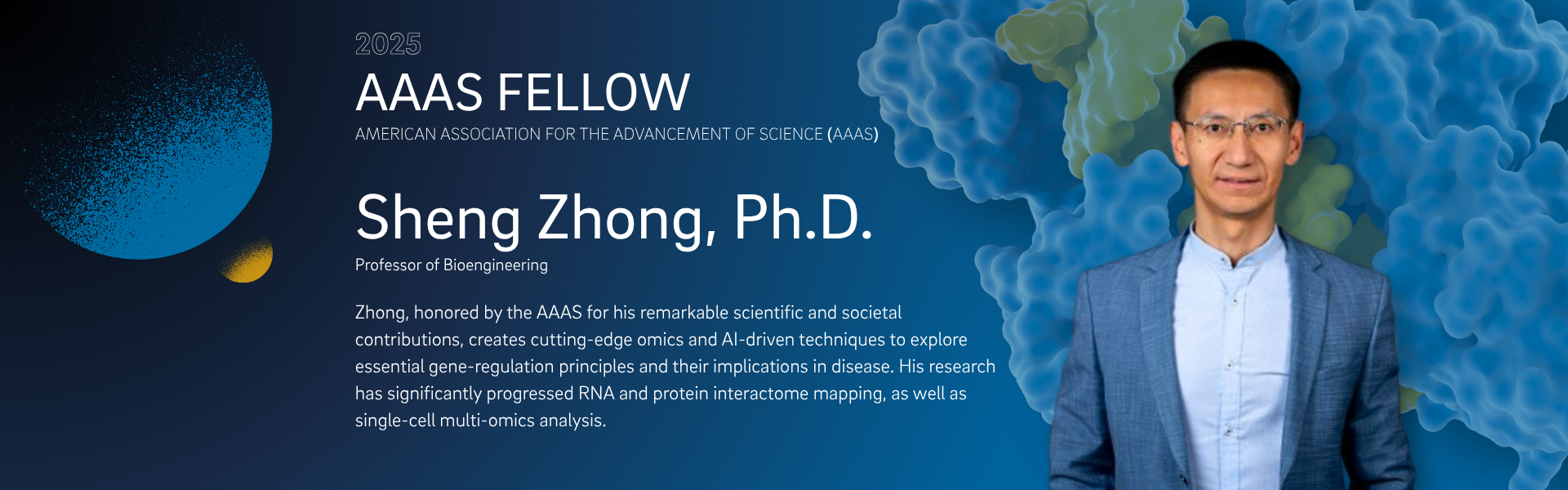
Sheng Zhong
· ProfessorVerifiedUniversity of California, San Diego · Bioengineering
Active 1995–2025
About
Sheng Zhong is a professor in the Shu Chien-Gene Lay Department of Bioengineering and co-director of the Center for AI in Biomedicine at UC San Diego. His research develops innovative omics technologies and AI-driven methods to uncover fundamental principles of gene regulation and their roles in disease. His work has advanced RNA and protein interactome mapping and single-cell multi-omics, driving biological discoveries including the regulatory functions of chromatin-associated RNA and the presence of cell-surface RNA. Zhong has also pioneered AI-enabled approaches for protein function discovery and small-molecule design. Building on these advances, his group has identified a molecular driver of Alzheimer’s disease and is exploring new strategies for therapeutic intervention and prevention. He has served as director of the organizational hub of the NIH Common Fund 4D Nucleome program and is a Fellow of the International Academy of Medical and Biological Engineering (IAMBE) and the American Institute for Medical and Biological Engineering (AIMBE).
Research topics
- Biology
- Cell biology
- Endocrinology
- Genetics
- Computational biology
- Medicine
- Internal medicine
- Chemistry
- Anatomy
Selected publications
Chordless Structure: A Pathway to Simple and Expressive GNNs
ArXiv.org · 2025-05-25
preprintOpen accessSenior authorResearchers have proposed various methods of incorporating more structured information into the design of Graph Neural Networks (GNNs) to enhance their expressiveness. However, these methods are either computationally expensive or lacking in provable expressiveness. In this paper, we observe that the chords increase the complexity of the graph structure while contributing little useful information in many cases. In contrast, chordless structures are more efficient and effective for representing the graph. Therefore, when leveraging the information of cycles, we choose to omit the chords. Accordingly, we propose a Chordless Structure-based Graph Neural Network (CSGNN) and prove that its expressiveness is strictly more powerful than the k-hop GNN (KPGNN) with polynomial complexity. Experimental results on real-world datasets demonstrate that CSGNN outperforms existing GNNs across various graph tasks while incurring lower computational costs and achieving better performance than the GNNs of 3-WL expressiveness.
bioRxiv (Cold Spring Harbor Laboratory) · 2025-03-23
preprintOpen accessAbstract N 6 -methyladenosine (m6A) is the most prevalent internal RNA modification that can impact mRNA expression post-transcriptionally. Recent progress indicates that m6A also acts on nuclear or chromatin-associated RNAs to impact transcriptional and epigenetic processes. However, the landscapes and functional roles of m6A in human brains and neurodegenerative diseases, including Alzheimer’s disease (AD), have been under-explored. Here, we examined RNA m6A methylome using total RNA-seq and meRIP-seq in middle frontal cortex tissues of post-mortem human brains from individuals with AD and age-matched counterparts. Our results revealed AD-associated alteration of m6A methylation on both mRNAs and various noncoding RNAs. Notably, a series of p romoter a ntisense RNAs (paRNAs) displayed cell-type-specific expression and changes in AD, including one produced adjacent to the MAPT locus that encodes the Tau protein. We found that MAPT-paRNA is enriched in neurons, and m6A positively controls its expression. In iPSC-derived human excitatory neurons, MAPT-paRNA promotes expression of hundreds of genes related to neuronal and synaptic functions, including a key AD resilience gene MEF2C , and plays a neuroprotective role against excitotoxicity. By examining RNA-DNA interactome in the three-dimensional (3D) nuclei of human brains, we demonstrated that brain paRNAs can interact with both cis - and trans -chromosomal target genes to impact their transcription. These data together reveal previously unexplored landscapes and functions of noncoding RNAs and m6A methylome in brain gene regulation, neuronal survival and AD pathogenesis.
Nature Communications · 2025-06-06 · 8 citations
articleOpen access-methyladenosine (m6A) is an abundant internal RNA modification that can impact gene expression at both post-transcriptional and transcriptional levels. However, the landscapes and functions of m6A in human brains and neurodegenerative diseases, including Alzheimer's disease (AD), are under-explored. Here, we examined RNA m6A methylome using total RNA-seq and meRIP-seq in middle frontal cortex of post-mortem brains from individuals with or without AD, which revealed m6A alteration on both mRNAs and various noncoding RNAs. Notably, many promoter-antisense RNAs (paRNAs) displayed cell-type-specific expression and changes in AD, including one produced adjacent to MAPT that encodes the Tau protein. MAPT-paRNA is highly expressed in neurons, and m6A positively controls its expression. In iPSC-derived human excitatory neurons, MAPT-paRNA does not impact the nearby MAPT mRNA, but instead promotes expression of hundreds of neuronal and synaptic genes, and is protective against excitotoxicity. Analysis of single nuclei RNA-DNA interactome in human brains supports that brain paRNAs interact with both cis- and trans-chromosomal target genes to impact their transcription. These data reveal landscapes and functions of noncoding RNAs and m6A in brain gene regulation and AD pathogenesis.
Supervisory Feedback for Low-Textured Multi-View Stereo In High-Resolution Large-Scale Scenes
SSRN Electronic Journal · 2025-01-01
preprintOpen accessAn integrated view of the structure and function of the human 4D nucleome
Nature · 2025-12-17 · 19 citations
articleOpen accessto map and analyse the 4D nucleome in widely used H1 human embryonic stem cells and immortalized fibroblasts (HFFc6). We produced and integrated diverse genomic datasets of the 4D nucleome, each contributing unique observations, which enabled us to assemble extensive catalogues of more than 140,000 looping interactions per cell type, to generate detailed classifications and annotations of chromosomal domain types and their subnuclear positions, and to obtain single-cell 3D models of the nuclear environment of all genes including their long-range interactions with distal elements. Through extensive benchmarking, we describe the unique strengths of different genomic assays for studying the 4D nucleome, providing guidelines for future studies. Three-dimensional models of population-based and individual cell-to-cell variation in genome structure showed connections between chromosome folding, nuclear organization, chromatin looping, gene transcription and DNA replication. Finally, we demonstrate the use of computational methods to predict genome folding from DNA sequence, which will facilitate the discovery of potential effects of genetic variants, including variants associated with disease, on genome structure and function.
Genome-wide mapping of RNA-protein associations through sequencing
Nature Biotechnology · 2025-09-09 · 5 citations
articleOpen accessSenior authorTranscriptional regulation by PHGDH drives amyloid pathology in Alzheimer’s disease
Cell · 2025-04-23 · 9 citations
articleOpen accessSenior authorSeparation and Purification Technology · 2025-05-16 · 3 citations
articleCell Death and Disease · 2025-12-26
articleOpen accessAbstract Interferon-stimulated genes (ISGs) serve as evolutionarily conserved mediators of antiviral defense and tumor surveillance. Emerging evidence underscores the non-oncogenic addiction of high-risk human papillomavirus (hrHPV) E6/E7 oncoproteins in maintaining malignant phenotypes and cervical carcinogenesis. Here, we leveraged CRISPR/Cas9-engineered YTHDF3-knockout (YTHDF3 −/− ) SiHa cells and Ythdf3 −/ − mice to dissect the molecular arbiters governing m 6 A-dependent RNA regulation in HPV-driven carcinogenesis. To further elucidate the role of YTHDF3 in HPV-induced immunosuppressive tumor microenvironment (ITME) formation, we demonstrated that YTHDF3, an m 6 A RNA reader, suppresses type I ISGs responses. Notably, elevated m 6 A modification and YTHDF3 protein levels were observed in HPV + CCa tissues. Mechanistically, YTHDF3 bound to the m 6 A methylation site of STAT3 mRNA, enhancing its stability and transcription efficiency. This YTHDF3-STAT3 axis repressed ISG (e.g., IRF7) transcription and IFN-α production, thereby compromising antiviral immunity and facilitating HPV E6/E7 persistence. Correspondingly, Ythdf3 − mice bearing TC-1 xenografts exhibited a significant reduction in immunosuppressive immune cell infiltration, including Tregs, M2 macrophages, and MDSCs, accompanied by enhanced CD8 + T cell activation. Collectively, our findings unveiled that YTHDF3-mediated upregulation of STAT3 suppresses the type I ISG expression, thus promoting HPV carcinogenesis and establishing an ITME. Taken together, our results suggest that targeting the YTHDF3/STAT3/IRF7 axis could be a promising therapeutic strategy against HPV-associated malignancies.
Separation and Purification Technology · 2025-01-25 · 5 citations
article
Recent grants
Modeling the Evolution of Gene Regulatory Modules for Complex Traits
NSF · $651k · 2010–2013
Mapping RNA interactomes by sequencing
NIH · $3.9M · 2015–2020
Non-coding Variants Predisposing to Age-related Macular Degeneration
NIH · $2.3M · 2015–2019
Single Cell Tracking of 3D Epigenetic Landscape Evolution During Embryonic Development
NIH · $3.2M · 2022–2027
CAREER: Computational Identification of Gene Regulatory Networks in Multicellular Eukaryotes
NSF · $709k · 2009–2014
Frequent coauthors
- 39 shared
Riccardo Calandrelli
La Jolla Bioengineering Institute
- 39 shared
Zhangming Yan
La Jolla Bioengineering Institute
- 38 shared
Xiaoyi Cao
University of California, San Diego
- 33 shared
Zhen Chen
Weifang Medical University
- 28 shared
Qiuyang Wu
- 27 shared
Xingzhao Wen
University of California, San Diego
- 25 shared
Tri C. Nguyen
- 20 shared
Weixin Wu
Illumina (United States)
Labs
Sheng Zhong LabPI
Awards & honors
- Allen Distinguished Investigator
- Fellow of the IEEE
- Fellow of the ACM
- Fellow of the National Academy of Inventors (NAI)
- Fellow of the American Institute for Medical and Biological…
- Resume-aware match score
- Save to shortlist
- AI-drafted outreach
See your match with Sheng Zhong
PhdFit ranks faculty by your research interests, methods, and publications — grounded in their actual work, not templates.
- Free to start
- No credit card
- 30-second signup