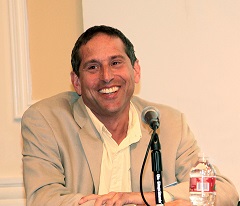
Stephen Aron
University of California, Los Angeles · History
Active 1962–2023
About
Stephen Aron is a Professor Emeritus at UCLA and serves as the President and CEO of the Autry Museum of the American West. He has been on the UCLA faculty since 1996 and has held a concurrent appointment at the Autry Museum, where he was the founding executive director and later chair of the Institute for the Study of the American West. His scholarly expertise focuses on the history of frontiers, borderlands, and the American West. Aron has dedicated his career to bridging the divide between academic and public history, actively engaging in discussions and panels on history museums and public history initiatives. His work includes a notable publication, 'The American West: A Very Short Introduction,' and ongoing projects such as 'Can We All Get Along: An Alternative History of the American Frontier.' In July 2021, he retired from UCLA to assume his role at the Autry Museum, emphasizing his commitment to connecting scholarly research with public history and cultural institutions.
Research topics
- Computer Science
- Sociology
- Archaeology
- Political Science
- Social Science
- Geography
- History
- Ethnology
- Genealogy
Selected publications
Review: <i>Continental Reckoning: The American West in the Age of Expansion</i>, by Elliott West
California History · 2023-01-01
article1st authorCorrespondingAs a former president of the Western History Association, I know that presidential addresses to that organization don’t usually create much of a trail. Not so, Elliott West’s 2002 oration in which he introduced the construct “Greater Reconstruction.” Challenging the long-held wisdom that confined Reconstruction to a twelve-year period from the end of the Civil War until 1877 and to the territory of the Confederate states, West argued for an extended chronology and an expanded geography. Greater Reconstruction, he maintained, began with the acquisition of territories after the Mexican-American War and continued to the end of the nineteenth century. In West’s telling, it played out across the nation, with the West being central to the era’s remaking of race relations and to the consolidations of national authority and industrial capitalist supremacy. West’s speech and its published version reset the research agendas of western historians and sparked vigorous debates about Reconstruction’s boundaries.With Continental Reckoning: The American West in the Age of Expansion, West offers a sweeping survey that fleshes out the themes of his presidential address. The latest entry in the “History of the American West” series published by the University of Nebraska Press, Continental Reckoning follows Colin Calloway’s One Vast Winter Count: The Native American West before Lewis and Clark and Anne Hyde’s Empires, Nations, and Families: A New History of the North American West, 1800–1860. Like those volumes, West’s synthesizes recent scholarship while weaving a fresh interpretation of the region’s history.Unlike the preceding volumes in the series, Continental Reckoning does not spell out its time period in its title. The age of expansion for West’s West begins with what he calls “the great coincidence,” the fluke of John Marshall’s discovery of gold in California occurring simultaneously with the territorial cessions from Mexico that brought California into the United States. Its ending is less clear. At points, West refers to the three decades after 1848. The book, however, also explores developments into the 1880s and devotes several pages to the Ghost Dance and Wounded Knee Massacre in 1890. Absent from West’s text are mentions of Frederick Jackson Turner or of the Census Department’s reported closing of the frontier in that year, which in older western histories often served as a finale.Turner’s absence stamps Continental Reckoning as a new western history, but West is not concerned with countering “the frontier thesis.” The book’s focus is on putting developments in what became the western half of the United States into a national and international conversation. “The American West,” he writes, “was both the child and the midwife of the new United States” (453). Shifting the familial metaphor to consider revolutions in transportation and communication that underwrote the era’s expansions, West describes the West and the eastern spaces to which it was newly connected as “historical twins, and like many twins, neither can be truly understood without the other” (173). The same could be said of the West’s relation with the new world order that emerged in the second half of the nineteenth century. At times, what happened in the West entwined with developments to the east and around the globe. At other points, the West led the way.That was especially true of California, which assumes a particular prominence in Elliott West’s account of the American West. From “the great coincidence” forward, California prefigured, often in exaggerated form, the transformations that remade the lands from the Missouri River to the Pacific into an American West.That California anticipated continental reckonings elsewhere was not to the Golden State’s historical credit. Take its record in the devastation of Indians and in interpersonal violence more generally. It was in California in the 1850s that Americans first deployed the tactics that the United States used to dispossess Native peoples from the Great Plains in the 1860s and ’70s, the difference being that the genocidal destruction was more pronounced in California. So, too, was the broader ledger of racialized violence. American history textbooks, notes West, typically identify Kanas in the 1850s as the place where Americans first organized to kill one another over issues of race. But the scale of killing that bled Kansas paled next to what transpired in “bloodier California” (50) during the same decade. Putting a different, and definitely not a positive, spin on homicides in California in the first six years after the great coincidence, West suggests that “a man living through that time had survived odds just slightly better than those of a Union soldier fighting at Antietam,” the bloodiest battle of the Civil War.There is nothing funny about these grim reckonings, but West’s history of the American West in the age of expansion is filled with passages that made me laugh. Sometimes, employing a comic’s eye for quotes that kill, West mines humor from his primary sources. As often, the zingers are of West’s devising. Always the punch lines and clever turns of phrase serve to drive home larger points, puncturing myths, deflating outsized reputations, exposing foibles. “If expansion and gold were in fact a divine assurance of America’s command of the West, the good Lord was indeed working in ways mysterious, and not especially impressive” (66) is how West summarizes the gap between American pronouncements of manifest destiny and the reality of the American government’s impotence across much of its West in the initial years after the Treaty of Guadalupe Hidalgo. Of John Wesley Powell’s expedition down the Colorado River: “They flirted with disaster, which sometimes flirted back” (218). The “rotting carcasses” of bison bones left behind by hunters “were eggs broken for the national omelet” (375). Richard Henry Pratt proclaimed that a boarding school education would kill the Indian to save the man. In fact, educating Native children from different communities together “did not so much kill as create ‘the Indian’” (426).The discussion of Indian boarding schools appears in the book’s penultimate chapter. The final chapter recaps developments in the decades after the great coincidence and carries matters forward into the twentieth century. That may explain why West’s “age of expansion” has no definitive end date. Its implications are with us still.
The Meetings of Peoples and Empires at the Confluence of the Missouri, Ohio, and Mississippi Rivers
University of Arizona Press eBooks · 2023 · 12 citations
1st authorCorresponding- Computer Science
- Geography
- Archaeology
What’s in a Name and Why I Use the Terms I Do
2022-08-31
other1st authorCorrespondingExtract In the Introduction that follows this Note on Terms, I devote a number of paragraphs to defining and distinguishing between “alternative history,” “alternate history,” and “wishtory.” As the reader will discover, I maintain that the first two of these are improperly conflated, while the third I claim as my invention. Because “Alternative History” appears in the subtitle of the book and “alternate history” and “wishtory” play out through the chapters, it seemed appropriate to explain my usages within the “Introduction.” But there are many more terms and names that figure prominently in the pages that follow, including some of the most familiar ones, which turn out to be problematic for a variety of reasons and deserve explanations for why I choose to use them. For starters, consider the mistaken conflation of bison and buffalo, so common in my sources and perpetuated in this book. More controversial, I suspect, will be my frequent references to the “frontier.” Not that long ago, a reference to the American frontier would be conventional in a book such as this one. Not so anymore. Back in the 1980s and 1990s, Patricia Nelson Limerick made “frontier” a controversial designation for that era’s “new Western historians.” The “f-word,” she maintained, carried too much baggage, linked as it was to Frederick Jackson Turner’s “frontier thesis” that had too long ruled the study of the American West. “Frontier,” in her influential view, trapped Western history in a nostalgic and racist mythology and so needed to be banished from the lexicon of Western historians. Against Limerick’s indictment, an assortment of historians, including me, sought to salvage at least some of Turner’s insights and to save the frontier, which we claimed was too deeply embedded in the public’s consciousness to be jettisoned. Rather than a drastic amputation, a more surgical revision could remove the racist taint of a “meeting point between savagery and civilization” and leave the frontier more simply as a “meeting point,” a cultural contact zone in which no single polity had established political hegemony. It is in that sense and spirit that I employ “frontier” here.
2022-08-31
book-chapter1st authorCorrespondingAbstract This chapter focuses on Chillicothe, a Shawnee Indian village in what is now the state of Ohio, where Daniel Boone was taken as a captive in 1778 and where his adoption by Blackfish, a Shawnee leader, opened a road to reconciliation between Indians and Americans in the Ohio Valley. The chapter hinges on the dilemmas faced by Boone and Blackfish, for the adoption occurred at time in which conflict between Kentucky pioneers and Ohio Indians was escalating. It was also a moment when the American Revolution and the path to an American West hung in the balance. Here, the critical questions are why Boone opted to return to Boonseborough, the settlement in Kentucky that bore his name, and what that meant for him and for the chances of a common future for American pioneers and Ohio Indians.
2022-08-31
book-chapter1st authorCorrespondingExtract It rained through the night and into the morning of December 12, 1805. That soaked the members of the Corps of Discovery, the exploring enterprise co-captained by Meriwether Lewis and William Clark, who were still building cabins for their winter quarters. Located near the mouth of the Columbia River, Lewis and Clark designated this encampment Fort Clatsop, naming it for the nearest neighboring Indians. On the evening of the twelfth, those neighbors paid their first visit to the construction site. The Clatsop party brought a sweet black root and a small sea otter skin, which the Americans purchased "for a few fishing hooks & some Snake Indian Tobacco." Deciding the Indians "appear well disposed," Lewis and Clark "made a chief of one" of the Indians. In his journal entry for that day, Clark, never much of a speller, recorded the leader's name as "Conyear" or "Con-ny-au" or "Com mo-wol." Historians more commonly refer to him as "Coboway." And to Coboway, Lewis and Clark presented a small medal.1Close
Oxford University Press eBooks · 2022 · 1 citations
1st authorCorresponding- Political Science
- Political Science
Extract In 2010, a new Western, Red Dead Redemption, generated rave reviews and record sales. According to the aggregator Megacritic.com, Red Dead Redemption scored a 95 (out of 100) rating. Normally staid reviewers rolled out seldom-used superlatives. The New York Times hailed it as a "tour de force," a gush the essayist had never previously employed in more than a thousand articles for the newspaper. Numerous critics reached for cinematic, literary, and artistic comparisons. Likening it to "the po-mo Westerns of Clint Eastwood and Cormac McCarthy," the reviewer for Rolling Stone marveled at how the production "brings the myth of the American West to life just to deconstruct it and does the same for the whole concept of redemption itself." The New Yorker critic raved about "the finest dawns and dusks in all of moving pictures," adding that painter "Albert Bierstadt couldn't make morning light look this good." It was not just critics who loved Red Dead Redemption; it also defied conventional wisdom about the declining commercial prospects of Westerns. "Everyone assured us the Wild West was dead and of no interest to people anymore," admitted one of Red Dead Redemption's creators. Yet in the first three days after its release, Red Dead Redemption grossed $725 million ($85 million more than the year's biggest blockbuster, Avengers: Infinity War, took in at the box office during its opening weekend).1Close
2022-08-31
book-chapter1st authorCorrespondingAbstract No spot is more closely associated with the West at its wildest than Dodge City, Kansas, the subject of this chapter. From its origins in the 1860s as a military post and a hub for buffalo hunters to its brief heyday in the 1870s and early 1880s as a “cattle town” to which cowboys from Texas drove their herds, Dodge City was infamous for its reportedly rampant lawlessness and frequent shootouts. Yet, the chapter argues that compared with other parts of the United States in the decades after the Civil War, the multiethnic assemblage that made up most teams of drovers got along relatively well and African American visitors and residents fared better in Dodge than they did elsewhere. And contrary to the Dodge of legend, its heyday featured few gunfights and fewer homicides than other boom towns in that era, with lessons for us about gun control and law enforcement.
Oxford University Press eBooks · 2022
1st authorCorresponding- Sociology
- Social Science
- History
Abstract The chapter probes how people who had been locked in a death struggle for control of the Ohio Valley then lived in peace and friendship as neighbors and explains the factors that contributed to this reconciliation. For that is what happened when, in the aftermath of the American Revolution, Indians and Americans from the Ohio Valley relocated to the vicinity of Apple Creek in what is today Missouri but what was then part of the Spanish colony of Louisiana. There and elsewhere under nominally Spanish rule, they found the common ground that had eluded Boone and his Shawnee adopters in Chillicothe. In an astonishing rapprochement, Shawnee and American refugees, including Boone and his family, now settled harmoniously alongside one another during the 1790s.
2022-08-31
book-chapter1st authorCorrespondingAbstract This chapter journeys across the continent with Meriwether Lewis and William Clark to fix on Fort Clatsop at the edge of the Pacific Ocean and examine how peace between Indians and explorers was maintained. Especially during the two hundredth anniversary commemorations of the exhibition, the retellings of the Lewis and Clark saga acclaimed the pacific relations between explorers and Indians, especially during the Corps’ sojourn on the West Coast of North America. In reality, as the chapter details, interactions at Fort Clatsop did not live up to these bicentennial “wishtories.” But if not exactly the “peace and friendship” stamped on the medals that Lewis and Clark gifted to Indian leaders, the explorers did manage to avoid violent conflicts and to get what they needed from Indians during their months at Fort Clatsop.
2022-08-31
book-chapter1st authorCorrespondingAbstract This chapter takes as its vantage point Chimney Rock, one of the signature landmarks along what became the principal overland trail across the Great Plains and to the Pacific Slope during the 1840s and 1850s. Although circled covered wagons, surrounded by marauding Indians on horseback, became a staple scene in nineteenth-century paintings and twentieth-century motion pictures, those images mislead about relations between American emigrants and Plains Indians. Through the 1840s, peace generally prevailed on the trail, and trade, if not friendship, linked Americans heading west and the Indians through whose countries they traveled. The onset of the California Gold Rush multiplied the number of Americans on the trail and brought an increased presence of the United States military to the Great Plains, which put pressure on that peace. Still, it was the conflicts between “Mormons” and those they called “Gentiles” that most threatened to erupt into a full-scale war.
Frequent coauthors
- 17 shared
Bernard W. Janicki
- 7 shared
Jeremy Adelman
- 7 shared
Michael J. Rose
The University of Texas at Austin
- 4 shared
Jeremy Adelman
Princeton University
- 2 shared
Elizabeth A. R. Brown
University of Oxford
- 2 shared
Michael A. Robinson
University of Georgia
- 2 shared
Alan S. Berson
- 2 shared
Glyndwr Williams
- Resume-aware match score
- Save to shortlist
- AI-drafted outreach
See your match with Stephen Aron
PhdFit ranks faculty by your research interests, methods, and publications — grounded in their actual work, not templates.
- Free to start
- No credit card
- 30-second signup