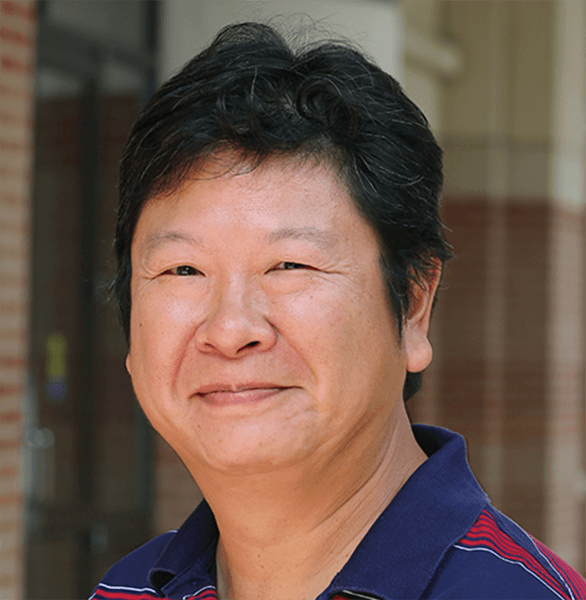
Stephen Wong
· Assistant Professor of Computer ScienceVerifiedRice University · Computer Science
Active 1974–2026
About
Stephen Wong is an experienced computer scientist, physicist, and educator specializing in object-oriented programming, software engineering, and computer science pedagogy. His current research includes the use of design patterns in redesigning traditional algorithms, serious gaming systems, cloud-based enterprise information management systems, large-scale high-fidelity simulation systems, and technologies for massive open online courses. He holds a PhD in Physics from MIT, obtained in 1989, and a BA in Physics with minors in Digital Electronics and Physical Chemistry from Swarthmore College, earned in 1981.
Research topics
- Genetics
- Biology
- Cancer research
- Computational biology
- Mathematics
- Evolutionary biology
- Combinatorics
Selected publications
2026-03-16
articleOpen access<p>Tumor NOS2 and COX2 expression induced by IFNg and TNFa</p>
2026-03-16
articleOpen access<p>Modulation of EpCAM and CD44v6+.</p>
2026-03-16
articleOpen access<p>Supplementary Table II summarizes �8+ T cells in designated regions of the tumors.</p>
2026-03-16
articleOpen access<p>Tumor analysis of NOS2 and COX2.</p>
2026-03-16
articleOpen access<p>Supplementary Fig. 4. Supplementary Fig. 4. Spatial UMAP analysis of CD8+/-NOS2+/-COX2+/- phenotypes in Deceased vs Alive patient tumors. Single cell neighborhood profile summary.</p>
2026-03-16
articleOpen access<p>Supplementary Table I summarizes pathological features of tumor immune microenvironment where NOS2+ inflamed regions are significantly higher in tumors from Deceased patients.</p>
iS2C2: a cointelligent platform for mechanistic discovery of disease cellular crosstalk
Signal Transduction and Targeted Therapy · 2026-05-11
articleOpen accessSenior authorLarge language models (LLMs) have demonstrated impressive capabilities in summarization, reasoning, and content generation, yet their inability to directly interpret large-scale omics data has limited their utility in data-driven hypothesis generation-particularly in mechanism discovery that demands the integration and interpretation of multimodal datasets, heterogeneous models, and deep domain expertise. Conversely, traditional computational algorithms excel at quantitative analysis of omics data but often rely heavily on labor-intensive, expert-driven interpretation to extract biologically meaningful insights. Here, we introduce (cointelligent single-cell spatial cell‒cell communication: iS2C2), a novel cointelligent platform that synergizes mathematically rigorous computational algorithms with the contextual reasoning capabilities of LLMs to automatically generate biologically interpretable hypotheses from single-cell RNA-seq and spatial transcriptomics data. The iS2C2 platform incorporates a transparent and reproducible cell-cell communication analysis pipeline built upon mathematically rigorous algorithms designed to enhance interpretability for integration with LLMs that contextualize algorithmic outputs or predictions using domain-specific knowledge and literature-derived evidence. When applied to Alzheimer's disease and cancer datasets, iS2C2 generated accurate, reproducible, and expert-validated hypotheses, unveiling previously unrecognized signaling pathways and mechanistic insights in disease microenvironments. This cointelligent approach bridges the gap between structured computational analysis and generative reasoning, heralding a paradigm shift toward fully automated, interpretable biological discovery and advancing the frontiers of next-generation precision medicine and systems biology.
2026-03-16
articleOpen access<p>Spatial dot plot of CD8+/-NOS2+/-COX2+/- phenotypes in tumor from deceased patient.</p>
Tumor-derived cystatin C enables amyloid clearance
Trends in Immunology · 2026-03-11
articleSenior author2026-03-16
articleOpen access<p>Immune and tumor quantification</p>
Recent grants
NIH · $3.5M · 2018–2024
NIH · $1.0M · 2009
Systematic identification of astrocyte-tumor crosstalk regulating brain metastatic tumors
NIH · $2.6M · 2020–2025
NIH · $1.3M · 2012
NIH · $1.3M · 2013
Frequent coauthors
- 369 shared
Xiaobo Zhou
- 323 shared
Hong Zhao
Children's Hospital of Zhejiang University
- 297 shared
Kelvin Wong
Houston Methodist
- 252 shared
Jianting Sheng
Weill Cornell Medicine
- 239 shared
Fuhai Li
Washington University in St. Louis
- 225 shared
Zheng Yin
Houston Methodist
- 200 shared
Zhong Xue
- 180 shared
Kemi Cui
Albany Medical Center Hospital
- Resume-aware match score
- Save to shortlist
- AI-drafted outreach
See your match with Stephen Wong
PhdFit ranks faculty by your research interests, methods, and publications — grounded in their actual work, not templates.
- Free to start
- No credit card
- 30-second signup