Resume-aware faculty matching

Find professors who actually fit you

Upload your resume. Four AI agents analyze your background, rank the faculty who fit, inspect their recent research, and help you draft outreach — grounded in their actual work, not templates.

Free to startNo credit cardCancel anytime
Top matches Balanced preset
Dr. Sarah Chen
Stanford · Interpretability · NLP
91
Dr. Marcus Holloway
MIT · Robotics · RL
84
Dr. Aisha Okonkwo
CMU · Fairness · HCI
82
Nova · Professor Researcher · re-ranking top 20…
Verity Platt

Verity Platt

· Professor

Cornell University · Classics

Active 1989–2025

h-index17
Citations1.4k
Papers566 last 5y
Funding
See your match with Verity Platt — sign in to PhdFit.Sign in

About

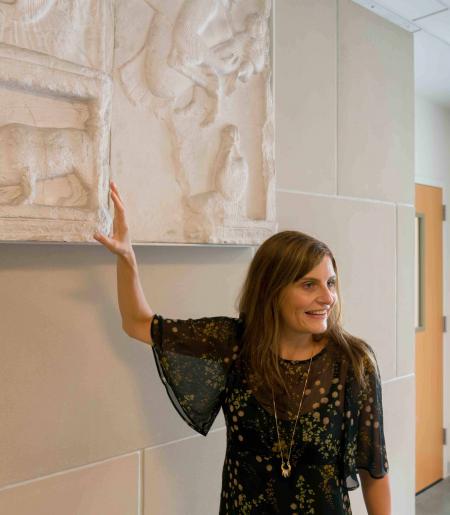
Verity Platt is a Professor in the Department of Classics at Cornell University, holding a DPhil in Classics from Oxford University and a Masters in Classical Art History from the Courtauld Institute of Art, London. She joined Cornell in 2010 after teaching at the University of Chicago and completing a post-doctoral research fellowship at University College, Oxford. Her research specializes in Greek and Roman art history, with a focus on the relationship between ancient literary and visual cultures, particularly during the Hellenistic and Roman periods. Her scholarly interests include ancient theories of the image, media and intermediality, the historiography of ancient art, and classical reception studies. She has a keen interest in the materiality of artifacts, the intersection of art and religion, and the cultural transmission of images and texts. Platt has held fellowships at prestigious institutions such as the Institute of Advanced Study at Princeton, the Franke Institute for the Humanities at the University of Chicago, Trinity College and the Cambridge Centre for Greek Studies, as well as at Cornell's Society for the Humanities and Atkinson Center for a Sustainable Future. She is currently the director of Cornell's Humanities Scholars Program for undergraduates, fostering interdisciplinary research in the humanities. Her recent work includes a monograph titled 'Epistemic Impressions: Making and Mediating Classical Art and Text,' which explores how Greek authors engaged with ancient models of sense-perception, and she is working on projects related to Pliny the Elder's Natural History, eco-critical approaches to classical art, and ancient sculpture focused on the concept of the fold. Platt is also an editor of the Classical Receptions Journal and curator of the Cornell Cast Collection, actively engaging in contemporary art reception and classical material culture.

Research topics

  • Computer Science
  • Political Science
  • Sociology
  • Social Science
  • Aesthetics
  • Literature
  • History
  • Epistemology
  • Pedagogy
  • Visual arts
  • Art
  • Linguistics
  • Engineering
  • Public relations
  • Archaeology
  • Philosophy
  • Engineering ethics

Selected publications

  • List of Figures

    2025-10-22

    paratext1st authorCorresponding
  • Epilogue

    2025-10-22

    book-chapter1st authorCorresponding

    Abstract The book concludes with an Epilogue which gestures to the afterlife of the Greek typos as it was appropriated and transformed within the contexts of late antique Platonism and early Christianity, especially in relation to the Hebrew Bible (through the concept of ‘typology’), baptism, and the Incarnation. Like Christian angels, seals are media ‘messengers’ that facilitate all manner of relationships across time, space, and ontological categories. Looking to the combination of antiquarianism and theology that informs the use of sealing metaphors in sixth-century ce epigrams in the Palatine Anthology, the chapter presents Epistemic Impressions as a prehistory of the rich uses of indexicality that emerge in the sealing cultures of Byzantium, not to mention the longer media history of ‘types’ and impressions that takes us through the development of printing in early modern Europe to the invention of analogue recording and photographic technologies in the nineteenth century.

  • Introduction

    2025-10-22

    book-chapter1st authorCorresponding

    Abstract This chapter sets out the conceptual framework of the book, starting with a genealogy of the impression (typos). A contemporary photograph alluding to Pliny the Elder’s anecdote about the Corinthian Maid (who traced the outline of her lover’s shadow as the first ‘painting’) offers a historiography of the image as index or ‘type’. An overview of art-historical approaches to indexically produced images such as stamps, death-masks, and relics leads to a discussion of the role played by seals and their impressions in ancient art, philosophy, and epigrammatic poetry, where they functioned as ‘epistemic objects’ (following Hans-Jörg Rheinberger’s concept of ‘epistemic things’). The introduction concludes with an outline of the book.

  • The <i>Greek Anthology</i>

    2025-10-22

    book-chapter1st authorCorresponding

    Abstract This chapter explores how the epigrammatic language of impressing and moulding shifted as Greek culture was absorbed into Roman systems of production, representation, and dissemination in the first centuries bce/ce. For late Hellenistic poets, the selection, processing, and circulation of art-historical knowledge focused on earlier Greek art was made possible by the transmission of epigram in anthologies and the replication of Greek art as ‘copies’. In line with this recursive approach to Classical Greek models, the chapter charts two important shifts in the use of typos and its cognates across sequences in the Greek Anthology related to fourth-century bce marble sculptures by Praxiteles and paintings by Apelles and Nicias. First, typos is applied to a broader range of media, taking on the more general meaning of ‘image’ and effectively dematerializing technological processes of facture and transmission. Second, epigrams on Greek art feature our earliest secure usages of the term archetypon, alongside its use in contemporary treatises on rhetoric and poetics seeking to define emerging concepts of classical style. In its conceptualization of a ‘first impression’, the archetypon offered language through which late Hellenistic epigram could conceptualize its own operations, as it recursively reprocessed earlier poetic and visual ‘archetypes’. In prioritizing the archē (or ‘origin’), the archetypon suggests an ontological hierarchy in which celebrated models look more like Platonic Forms, whilst the productions they inspire are treated as forms of ‘imitation’. The final section examines how late Hellenistic lithika rework earlier tropes, problematizing the relationship between stones and their figural engravings in contrast with Posidippus.

  • The Stones of Posidippus I

    2025-10-22

    book-chapter1st authorCorresponding

    Abstract Chapter 2 explores the intermedial operations of Posidippus’ Lithika in more detail, in light of epigram’s own intermedial shift from epigraphic inscription to the literary vehicle of the papyrus roll during the fourth and third centuries bce and the question of how inscribed artefacts that had once been directly encountered by readers might be conjured into virtual presence by words alone. The Lithika exemplify an experimental phase in the emergence of what we now call ‘ekphrastic epigram’; as such, they are both intensely object-oriented and highly aware of processes of transmission, whilst exploring the full potential of epigram’s liberation from stone. On the one hand, gems share their lithic vehicle with epigram’s epigraphic origins, suggesting a medial continuity between text and object; on the other hand, they are too tiny to have supported verse inscriptions themselves. Gems thus necessitate a medial split between the ekphrastic object and its accompanying text, now mediated by the papyrus scroll. The chapter argues that Posidippus’ focus on stones—and in particular, precious gems incised in intaglio so that they can function as seals—is a very particular choice in the history of text-object relations, drawing directly upon the aesthetic, material, technological, and conceptual roles played by seals within archaic and Classical Greek culture. This chapter focuses on Lithika AB 6–12, exploring how Posidippus’ intense preoccupations with materials, technologies of making, and transmission are closely tied to both artistic practices of carving and stamping and philosophical models of perception. These themes can also be read as a comment on the composition, aesthetic effects, and literary transmission of object-oriented epigram.

  • List of Abbreviations

    2025-10-22

    other1st authorCorresponding
  • Epistemic Impressions

    2025-10-22

    book1st authorCorresponding

    Abstract This book advances a new history of image-making and art-text relations in antiquity. Moving away from imitation (mimēsis), it looks to the concept of the seal-impression (typos), which played a vital role in ancient philosophies of mind: seals were ‘epistemic objects’ that informed complex thinking about form, matter, and medium. As an indexically produced image, the typos offered a model of perception and knowledge transmission grounded in material processes of engraving and stamping, which were closely related to sculptural moulding and casting (plastikē). These had a profound influence on concepts of truth, representation, and replication, offering a materially embedded ontology of the image that had far-reaching implications for Graeco-Roman aesthetics. Drawing on theories of media, the book explores how impressing (typōsis) was especially significant for literary engagements with artworks, informing Greek models of intermediality from archaic poetry to imperial Greek prose and early Christian exegesis. Advancing an ‘object-oriented’ approach that dislodges the trope of ekphrasis in favour of embodied processes of making, it focuses on Hellenistic epigrams, especially those ascribed to the third-century bce poet Posidippus, who drew on practices of engraving, stamping, and casting in his Lithika and Andriantopoiika. These are set within the longer history of intermedial relations in the Greek Anthology under the Roman Empire and in early Byzantium. As a prehistory of analogue modes of reproduction (and thus the concept of ‘type’), Epistemic Impressions demonstrates how, just as many ancient concerns with the visual may seem surprisingly modern, so many modern preoccupations are more ancient than we might presume.

  • Classics in Theory

    2025-10-22

    other1st authorCorresponding
  • Bold Hand! Posidippus and the Moulds of Lysippus

    2025-10-22

    book-chapter1st authorCorresponding

    Abstract This chapter explores how in Posidippus’ Andriantopoiika (‘On the Making of Statues’) bronze-casting technology informs the language through which he addresses questions of style, representation, and aesthetic effect. In a broader discussion of bronzes in the Greek Anthology (including Myron’s Cow), it explores how poetic language was shaped by the same technologies of production that gave rise to bronzes themselves, especially the modelling of clay, with its associated concept of plasticity (and thus sculpture as plastikē). While this has been understood in terms of the ‘fictility’ of mimetic illusionism, a closer look at the language of plasmata (‘moulded objects’) suggests that they played a malleable role within Platonic ontology: as ‘epistemic objects’ employed in processes of mental modelling, they both mediated between and challenged the binaries of dualism. This has important implications for the intermedial operations of object-oriented epigram, where the role of the plastēs in the production of bronze sculpture parallels that of the poet as a ‘maker’ whose verbal plasmata mediate between mind and matter. Material encounters grounded in specific technologies of production thus inform the models of creation, transmission, and reception that shape the relationship between both texts and objects, and texts and readers. The chapter concludes with an account of the embodied relationship between ‘hand and mind’, relating Posidippus’ ‘handicraftsmen’ to the handiwork of Cheirisophos, the ‘wise-handed’ artist who signed the first-century bce/ce Hoby Cups, which feature remarkably sensitive depictions of the role of the intelligent hand in mythological scenes of healing and diplomacy.

  • Classics in Theory

    2025-10-22

    other1st authorCorresponding

Frequent coauthors

Awards & honors

  • Stephen H. Weiss Presidential Fellow Award
  • Resume-aware match score
  • Save to shortlist
  • AI-drafted outreach

See your match with Verity Platt

PhdFit ranks faculty by your research interests, methods, and publications — grounded in their actual work, not templates.

  • Free to start
  • No credit card
  • 30-second signup