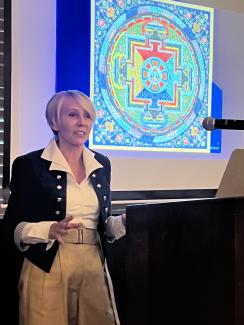
Vesna A. Wallace
· Distinguished University ProfessorUniversity of California, Santa Barbara · Religious Studies
Active 1992–2025
About
Vesna A. Wallace is a Distinguished University Professor in the Department of Religious Studies at the University of California, Santa Barbara. Her main methodological approach involves philological and textual study, as well as philosophical, historical, critical, and comparative analyses of Buddhist traditions. Her research focuses on the Buddhist traditions of South Asia, Tibet, and Mongolia. She holds a Ph.D. from UC Berkeley and is engaged in scholarly work that explores the rich religious and philosophical landscapes of these regions.
Research topics
- Computer Science
- Sociology
- Data science
- Social Science
- Epistemology
- Data Mining
- History
- Geology
- Paleontology
- Geography
- Philosophy
- Archaeology
Selected publications
Flyer Promoting "Art and Imagination: Mongolian Buddhist Texts and Ritual Practices"
IUScholarWorks (Indiana University) · 2025-12-30
articleSenior authorArt and Imagination sheds light on this unique tradition and on the Buddhist past of Inner Asia in general. It explores the relationships among texts, artistic images, structured imagination practices, and visual aesthetics, examining the roles of meditation and ritual in visualizing images and producing the artifacts of visual culture. Contemplative practices of imagination and visualization in ritual contexts are invariably prescriptive, whereas the depiction of Buddhist deities in works of art allows for creative freedom, and Wallace and Tsultemin investigate how the mental imagery that is invoked in contemplative and ritual practices, which requires the activation of memory and at times verbal and physical partici- pation, are manipulated in visual art. Using the methods of religious studies and art history to analyze texts, visualization and imaginative practices, and artworks, they demonstrate that the adaptation of Tibetan Buddhism and its imagery to the Mongolian context resulted in unique textual, ritual, and artistic innovations that emerged in different social and political conditions, thus contributing to our understanding of the effects of cultural encounters through different geographi- cal areas and historical periods.
Buddhist Literature as Philosophy and Buddhist Philosophy as Literature ed. by Rafael K. Stepien
Philosophy East and West · 2023-01-01
article1st authorCorrespondingReviewed by: Buddhist Literature as Philosophy and Buddhist Philosophy as Literature ed. by Rafael K. Stepien Vesna A. Wallace (bio) Buddhist Literature as Philosophy and Buddhist Philosophy as Literature. Edited by Rafael K. Stepien. Albany, NY: State University of New York Press, 2020. Pp. xi + 381. Paperback $26.95, isbn 978-1-4383-8070-1. The editor of the Buddhist Literature as Philosophy and Buddhist Philosophy as Literature should be commended for bringing together an excellent collection of essays and producing the first comprehensive volume that offers a coherent study of the relationship between Buddhist literature and philosophy. This book is an ambitious and praiseworthy project, which covers a wide range of Buddhist literary genres produced in India, Tibet, and East Asia over two millennia. As a whole, the volume invites the reader to reexamine a centuries-long binary division between the categories of literature and philosophy, which have been often approached in academic studies as mutually exclusive. It does so by demonstrating that in the context of Buddhism, philosophy and literature continuously converge, diminishing the overarching binary and broadening their scopes. Most contributions to this volume demonstrate that Buddhist philosophy as presented and enacted in Buddhist literature is not limited to what some would consider a "pure philosophy." The volume is divided into the two, mutually mirroring sections, with each section containing six chapters. Chapters forming the section one, "Buddhist Literature as Philosophy," aim at broadening our perspective about literary forms, such as tales, novels, hymns, and court poetry, which have not been usually explored as the means of articulating Buddhist philosophical views. Chapters grouped in the section "Buddhist Philosophy as Literature" focus on Buddhist literary theories as philosophy of language and introduce the Buddhist biographical and autobiographical genres characterized by practical philosophy to further challenge our preconceptions of what it is that constitutes literature and philosophy. While some contributors endeavor to demonstrate the presence of rational, analytical reasoning in unexpected literary forms, other contributors problematize a strict distinction between literature and philosophy as inapplicable to Buddhism, which is undeniably cross-disciplinary. The first two chapters in section one, authored by Amber Carpenter and Sarah Shaw respectively, draw examples from jātaka stories to show us how Buddhist ethical lessons work in the narrative tales of the Buddha's former births. These two chapters also draw our attention to an accessible and engaging, [End Page 1] narrative manner that presents the Bodhisattva's philosophical exercises to the audience, a manner that stands in contrast to the a priori reasoning characteristic of philosophical treatises. In the first chapter, titled "Transformative Vision: Coming to See the Buddha's Reality," Carpenter analyzes two jātaka stories--"Bodhi the Wandering Ascetic" and "The Man Without an Heir"--taken from Āryaśūra's Jātakamālā. In the first story, a renunciant Bodhi, while repudiating the king's ministers who are intent on disqualifying him as a king's advisor on morality, makes metaphysical claims regarding the nature of reality, causation, and the universe, and provides the reasons and arguments. According to Shaw, by offering an insight into the Buddhist worldview and morality, jātaka tales have a transformative power not only with regard to ethics but also in transforming the reader's vision of reality. In the chapter "Jātakas and the Abhidhamma: Practical Compassion and Kusala Citta," Shaw suggests that a reason why jātaka stories are rarely discussed seriously in the way that they were intended is their literary format based in narrative and mundane situations. Analyzing the concepts of momentariness and kusala citta ("virtuous consciousness") in these stories, Shaw shows that by communicating the technical and insight-based Buddhist doctrinal elements, jātaka tales significantly contribute to Buddhist practical ethics. The Pāli Javanahaṃsa-jātaka, a tale about the friendship between a goose and a king, introduces the reader to some of the most complex Buddhist ideas such as impermanence, momentariness, and mental states, expounded in the Abhidhamma in extraction. Through her analysis of the Kurudhamma-jātaka and Mahosaddha-jātaka, Shaw further shows the integration of narrative literature and Buddhist philosophical tenets, of Buddhist tales and the Abhidhamma, of the relationship between the intention and consciousness...
A Dharma Protector in a Transcultural Tantric Buddhist Context
Oxford University Press eBooks · 2023-03-22
book-chapter1st authorCorrespondingAbstract In the process of transmission of tantric Buddhism from one culture to another, tantric deities often undergo multivariant configurations as the lineages of their transmissions grow in numbers, and as legends of their origins, their religious and social roles, and ritual practices expand. One such deity is a fierce deity widely known in Mongolian and Tibetan Buddhist traditions under the names of Jamsran/Jamsrang (Tib. Lcam sring) and Begtse Brother-and Sister (Tib. Beg tse lcam dral; Mong. Begze Begze Egch Düü). Jamsran falls into two main categories of deities—the Buddhist war deities and Dharma Protectors—whose fierce nature and violent actions have been directed toward the mundane and religious pragmatic ends in Tibetan and Mongolian forms of Buddhism.
Kālacakra-Maṇḍala: Symbolism and Construction
Oxford Research Encyclopedia of Religion · 2022-06-17
reference-entry1st authorCorrespondingAbstract The kālacakra-maṇḍala, whether as a purely mental object created in meditation through visualization or as a material object produced by the hands of artists and tantric masters, has a significant instrumental function in the Kālacakra tantric tradition. It is a complex, virtual object abounding in visual signs pointing to the transcendent, or sublimated, aspects of the practitioner’s outer and inner worlds. The kālacakra-maṇḍala is believed to have the capacity to induce desirable mental states, to produce religious knowledge in a nondiscursive manner, and to exercise purificatory agency. The maṇḍala’s expressive power and transformative agency dwell in its prescribed shape, structure, dimensions, colors, deity forms, emblems, mantric symbols, and other constitutive elements. However, its agency becomes fully effective when combined with the creative skills and mental powers of those who bring the maṇḍala into view. In the Kālacakra tantric tradition, the material kālacakra-maṇḍala, created for the rite of initiation, also has a social function in that it brings together the community of Buddhist tantric practitioners with shared religious goals.
Big Gods and big science: further reflections on theory, data, and analysis
Religion Brain & Behavior · 2022 · 10 citations
- Sociology
- Computer Science
- Data science
Our target article empirically tested the Big Gods Hypothesis which proposes that beliefs in moralizing supernatural punishment (MSP) contributed to the evolution of socio-political complexity (SPC) in world history. We tested this hypothesis using a suite of measures of MSP, SPC, and other potential evolutionary drivers coded in Seshat: Global History Databank. Our analyses indicate that intensity of warfare and productivity of agriculture were major drivers in the evolution of both SPC and MSP. The correlation between social complexity and moralizing religion resulted from shared evolutionary drivers, rather than from direct causal relationships between these two variables. Most commentaries on the target article broadly accept our conclusions, but some argue that alternative measures might be used in future studies before the Big Gods Hypothesis can be conclusively rejected. In this response, we argue that while some of these alternative measures should be developed, they are closely related to the ones we have already adopted. Thus, it seems unlikely that further research will give rise to substantially different outcomes. A particularly fruitful aspect of the discussion is that it illustrates both the pitfalls and productive affordances of transdisciplinary research that seeks to bridge the “two cultures” of the humanities and sciences.
2022-06-22
book-chapter1st authorCorrespondingA buddha as an author of a Buddhist tantra takes a normative stance when he teaches the doctrinal tenets that express his ontological and epistemological views regarding his ultimate nature and the nature of the world that is pervaded by him and ultimately indivisible from him. He is repeatedly directing the attention of his audience to the fact that he is their true nature. He does so by resorting to the principles and conventions of a tantric tradition. A tantra as a text, whether oral or written, is understood by tradition as an authoritative discourse; it is a linguistic expression of a buddha’s mind, given with the intent to bring others to understand his truths and to convert them, as seen in the Wheel of Time Tantra, whereby he engages in the work of a philosopher and a doxographer. Thus, the act of listening or reading a tantra is meant to be an event of interacting with the buddha’s mind, through which one begins to know his mind and to transform one’s own mind.
Monastic Discipline and Local Practice
Oxford University Press eBooks · 2022-05-19
book-chapter1st authorCorrespondingAbstract Despite contradicting the Vinaya, traditional Mongolian cultural norms characteristic of pastoral life were integrated into Mongolian Buddhist practice. Consumption of substances that might be interpreted as counter to Vinaya regulations—such as fermented mare’s milk (airag) or vodka as “internal offering” mentally transformed into ambrosia—form an important part of monastic and tantric ritual practices. While monks’ recreational consumption of fermented mare’s milk has been traditionally acceptable, monks’ recreational drinking of vodka, being highly intoxicating, has been always regarded as problematic. Seeing Mongolian Buddhist practice through textual and ethnographic lenses offers a view of the significant cultural current that undergirds Mongolian monastic practice of the Vinaya, highlighting the primacy of the traditional customary law over the Vinaya. Although the prohibition of smoking tobacco is nowhere found in the Vinaya, the Buddhist cultural norms and regional laws in Mongolia dictated the avoidance of tobacco smoking. However, cultural silence on snuffing tobacco has given rise to acceptance and practice of tobacco powder snuffing.
Religion Brain & Behavior · 2022 · 39 citations
- Geology
- Paleontology
The causes, consequences, and timing of the rise of moralizing religions in world history have been the focus of intense debate. Progress has been limited by the availability of quantitative data to test competing theories, by divergent ideas regarding both predictor and outcomes variables, and by differences of opinion over methodology. To address all these problems, we utilize Seshat: Global History Databank, a large storehouse of information designed to test theories concerning the evolutionary drivers of social complexity. In addition to the Big Gods hypothesis, which proposes that moralizing religion contributed to the success of increasingly large-scale complex societies, we consider the role of warfare, animal husbandry, and agricultural productivity in the rise of moralizing religions. Using a broad range of new measures of belief in moralizing supernatural punishment, we find strong support for previous research showing that such beliefs did not drive the rise of social complexity. By contrast, our analyses indicate that intergroup warfare, supported by resource availability, played a major role in the evolution of both social complexity and moralizing religions. Thus, the correlation between social complexity and moralizing religion seems to result from shared evolutionary drivers, rather than from direct causal relationships between these two variables.
Journal of Cognitive Historiography · 2020 · 26 citations
- Social Science
- Sociology
- Computer Science
This article introduces the Seshat: Global History Databank, its potential, and its methodology. Seshat is a databank containing vast amounts of quantitative data buttressed by qualitative nuance for a large sample of historical and archaeological polities. The sample is global in scope and covers the period from the Neolithic Revolution to the Industrial Revolution. Seshat allows scholars to capture dynamic processes and to test theories about the co-evolution (or not) of social scale and complexity, agriculture, warfare, religion, and any number of such Big Questions. Seshat is rapidly becoming a massive resource for innovative cross-cultural and cross-disciplinary research. Seshat is part of a growing trend to use comparative historical data on a large scale and contributes as such to a growing consilience between the humanities and social sciences. Seshat is underpinned by a robust and transparent workflow to ensure the ever growing dataset is of high quality.
University of Hawaii Press eBooks · 2019-03-31
book-chapter1st authorCorresponding
Frequent coauthors
- 10 shared
Peter Turchin
- 7 shared
Jennifer Larson
Loma Linda University
- 6 shared
Gary M. Feinman
Field Museum of Natural History
- 6 shared
Pieter François
- 6 shared
Patrick E. Savage
University of Auckland
- 6 shared
Andrey Korotayev
National Research University Higher School of Economics
- 6 shared
Peter K. Bol
- 6 shared
Harvey Whitehouse
University of Oxford
- Resume-aware match score
- Save to shortlist
- AI-drafted outreach
See your match with Vesna A. Wallace
PhdFit ranks faculty by your research interests, methods, and publications — grounded in their actual work, not templates.
- Free to start
- No credit card
- 30-second signup