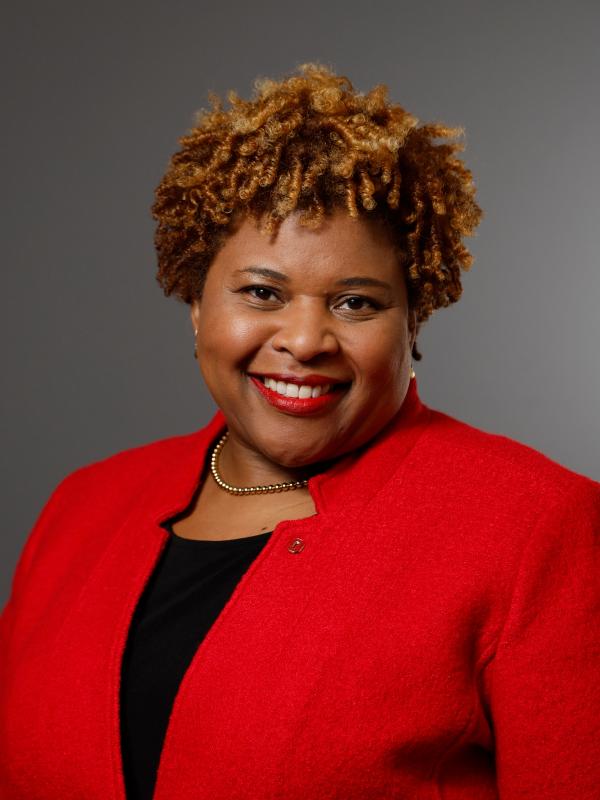
Wendy G. Smooth
· Wendy G. Smooth Professor (by courtesy) Professor of Women's, Gender, and Sexuality Studies; Professor by Courtesy John Glenn College of Public Affairs Asociate Dean for Workplace Culture and Student Success, College of Arts and SciencesOhio State University · Political Science
Active 1994–2023
About
Wendy G. Smooth is a Professor of Women’s, Gender, and Sexuality Studies and a Professor by Courtesy in the Department of Political Science at The Ohio State University. She also serves as the Associate Dean for Workplace Culture and Student Success in the College of Arts and Sciences. Her research and teaching focus on women’s experiences in political institutions and the impact of public policies on women’s lives. She is a noted scholar of intersectionality and American politics, with particular emphasis on the experiences of women of color as lawmakers and in public policy issues affecting women of color. Her work broadly centers on what she terms 'inclusionary politics.' Currently, she is engaged in projects examining the rise of women of color as voters and candidates for public office, including community-engaged research on Black women in Ohio aimed at understanding how to support Black women in transitioning from reliable voters to political candidates. She has been appointed as one of the 25 commissioners for the Columbus Commission on Black Girls, which assesses and monitors the quality of life for Black girls in Columbus. Additionally, she serves as a board member of Beautifully Flawed, a nonprofit organization supporting girls and LGBTQIA+ youth. Her scholarly contributions include publications in journals such as Politics and Gender, the Journal of Women, Politics and Policy, and the National Political Science Review, as well as edited volumes on intersectionality, gender, and politics. Her courses address public policies affecting women and girls, including work/family policies, workplace diversity, empowerment for women living with HIV/AIDS, violence against women and girls, and welfare reform. Her policy work is informed by experience working as a policy researcher in Washington, D.C.
Research topics
- Political Science
- Sociology
- Law
- Public administration
- Political economy
- Medicine
- Public relations
- Management
- Family medicine
- Engineering
Selected publications
National Review of Black Politics · 2023-01-01
articleSenior authorNational Review of Black Politics · 2023-01-01
articleSenior authorDr. Mae Coates King was born in Lee County, Arkansas, to a farmer and preacher father and a housewife mother. It was her grandfather, Robert, who piqued her interest in Africa that would shape her career. In March 1960, Mae C. King went to jail. As a twenty-one-year-old student at Bishop College, an HBCU, and Chairman of the local chapter of the National Student Young Women’s Christian Association (YWCA), she was at the forefront of student challenges to racial discrimination in local community of Marshall, Texas. There, she helped to lead sit-ins and other forms of direct action after being trained in nonviolent tactics by the Southern Christian Leadership Conference. This commitment to justice and equality was met with violent repression from law enforcement and she, along with hundreds of other student protestors, were arrested, jailed, and put on trial. Undeterred, King continued to struggle against structural racism and to speak out about her experience of confinement. These acts of courage and commitment garnered the respect and praise of her peers.While at Bishop College, she developed an interest in international relations through the mentorship of Dr. Jenkins, the Dean of Women at the College, and through her work with students from several countries in the YWCA. King went on to earn her BA (1960) in social study with a minor in history. She went directly to graduate school on a National Defense Education Fellowship, choosing Political Science as her area of study at the University Idaho. After writing a thesis on contemporary nationalism in Ghana, she earned her MA in 1962. She went on to obtain a PhD in 1968, concentrating her dissertation research on the United Nations and the Congo crisis. In between these degrees, she took time off in 1963 to teach Political Science at Texas Southern University; there she met a few Black political scientists, including Mack Jones.From 1975–1989, she taught and conducted research at the University of Benin in Nigeria. She was hired at American Political Science Association (APSA), as the first Black and first woman to work on its professional staff, leading what came to be known as the Committee on the Status of Blacks in the Profession and the Committee on the Status of Women. Though the situation was often tense, she was able to persist because she had Jewel Limar Prestage—the first Black person to earn a PhD in political science—as a model and mentor. When NCOBPS was founded, King was a key figure in APSA. In 1970, these two trailblazing women worked together to organize the pivotal, now infamous, conference in Baton Rouge, LA, that birthed NCOBPS. King ultimately understood NCOBPS as an organization committed to the work that APSA had long neglected, namely the engagement of Black political scientists. After the founding of NCOBPS, she served as membership secretary and secretary-treasurer of the Graduate Assistantship Program, where she was in direct contact with Black political scientists and helped to cultivate a strong and enduring network among them.Her dedication to Black freedom and the flourishing of African people did not abate with the end of de jure segregation; indeed, it is her persistent scholar-activism on behalf of the continent and its descendants in the Diaspora that makes her one of the most important Black political scientists of our time. Along with co-founding NCOBPS, Dr. King has been instrumental in building, leading, and representing other organizations germane to African descendants, including the National Council of Negro Women and the African Studies Association. When the latter continued to undermine the work of Black scholars on Africa, Dr. King helped to form the African Heritage Studies Association, of which she is a lifetime member and a former Director.In recognition of her significant work, the Association for the Study of Black Women in Politics created the “Mae C. King Distinguished Paper Award on Women, Gender, and Politics” in her honor. Given her seminal text on Nigerian politics, Basic Currents of Nigerian Foreign Policy (1996), critical work on U.S. foreign policy toward Africa, entitled “Race and U.S. Foreign Policy: Reflections on West Africa” and groundbreaking interventions on Black women in politics, including, “The Politics of Sexual Stereotypes” (1973) and “Oppression and Power: The Unique Status of the Black Woman in the American Political System” (1975), it is fitting that an award in her name is bestowed each year upon the best paper presented in political science on women, gender, and Black Politics at a national or regional political science conference.Following in the footsteps of her mentor, Jewel Prestage, King has paved the way for a generation of Black political scientists generally, and Black female political scientists particularly, to engage in activist-scholarship across the discipline, including in international relations, comparative politics, and Black politics. She has made a significant contribution to the modern Black Liberation Movement, and to other fields of study, including African studies, Black studies, and Black women’s studies. In this way, she serves as a model for leaving our disciplines, institutions, and communities in a better condition than we found it.
Journal of Women Politics & Policy · 2022 · 32 citations
Senior authorCorresponding- Sociology
- Political Science
- Sociology
Pundits and scholars alike point to recent elections as evidence of a changing American electorate with women of color (WOC) at the center of creating a more diverse electorate. Similarly, we are also witnessing an increase in WOC seeking political office at all levels. We focus on the apparatuses driving increased participation of WOC in these aspects of electoral politics. We argue that much of the growth in WOC voting and running as candidates for public office stem from strategic networks of WOC-centered mobilizations working to extend democratic inclusion. We build a framework to theorize the interconnected relationships of these groups and depict the complex ecosystem of WOC formations in operation as they cultivate a more diverse electorate and candidate base simultaneously. Specifically, we focus on WOC-centered groups during the 2020 election cycle, providing a typology of political activism based upon the types of labor they contribute to the democratic process.
2022-05-27 · 1 citations
book-chapterSenior authorPundits and scholars alike point to recent elections as evidence of a changing American electorate with women of color (WOC) at the center of creating a more diverse electorate. Similarly, we are also witnessing an increase in WOC seeking political office at all levels. We focus on the apparatuses driving increased participation of WOC in these aspects of electoral politics. We argue that much of the growth in WOC voting and running as candidates for public office stem from strategic networks of WOC-centered mobilizations working to extend democratic inclusion. We build a framework to theorize the interconnected relationships of these groups and depict the complex ecosystem of WOC formations in operation as they cultivate a more diverse electorate and candidate base simultaneously. Specifically, we focus on WOC-centered groups during the 2020 election cycle, providing a typology of political activism based upon the types of labor they contribute to the democratic process.
New York University Press eBooks · 2022-08-20 · 2 citations
book-chapter1st authorCorrespondingElevating African American Women’s Political Leadership amid Pandemic Politics
Cambridge University Press eBooks · 2021-12-09 · 1 citations
book-chapter1st authorCorrespondingThe fifth edition of Gender and Elections offers a lively, multi-faceted account of the role of gender in the electoral process through the 2020 elections. This timely yet enduring volume strikes a balance between highlighting the most important developments for women as voters and candidates in the 2020 elections and providing an in-depth analysis of the ways that gender has helped shape the contours and outcomes of electoral politics in the United States. Individual chapters demonstrate the importance of gender in understanding presidential, congressional, and state elections; voter participation, turnout, and choices; participation of African American women and Latinas; support of political parties and women's organizations; and candidate communication. New chapters explore the role of social movements in elections and introduce concepts of gendered and raced institutions, intersectionality, and identity politics applied to presidential elections from past to present. The resulting volume is the most comprehensive and reliable resource on the role of gender in electoral politics.
5. Obama, African American Women, and the Limitations of the Politics of Recognition
New York University Press eBooks · 2021-02-16 · 1 citations
book-chapter1st authorCorrespondingIn this chapter, I examine if African American women benefitted from their support of the Obama presidency by using traditional markers of group interests, especially as a key constituency group supporting candidate Obama. I explore the Obama presidency, asking beyond the politics of recognition, Did American women receive the attention from the president that their numbers as voters and early supporters of his presidential run might suggest? If not, why? I explore these questions from four different perspectives. First, I center African American women as the key constituency group that accounted for Obama’s electoral successes and situate what traditionally emerges when groups bear that designation in electoral politics. Second, I examine a range of policy interventions the administration pursued that might have addressed the specific needs of African American women as a distinct group. Third, I explore African American women’s descriptive representation under the Obama administration and whether the Obama administration created unique opportunities for African American women as decision makers in the administration. Finally, I argue that Obama’s failures to adequately address African American women as a critical constituency is explained by critical disconnections in his relationship to Black women.
Access to single-visit IUD insertion at obstetrician-gynecology practices in Ohio: An audit study
Contraception · 2020 · 7 citations
- Medicine
- Family medicine
Chronicling Our Legacy of Leadership
National Review of Black Politics · 2020 · 2 citations
Senior authorCorresponding- Political Science
- Sociology
- Political Science
This paper is a culmination of research by the task force established to commemorate the fiftieth anniversary of the founding of the National Conference of Black Political Scientists (NCOBPS). It presents a capsule history of the founding of NCOBPS and then profiles of the founders of the organization. The profiles focus on the founders’ educational backgrounds, careers, and contributions to NCOBPS leadership, to the profession in terms of scholarship and service, and to the Black community and the nation with respect to their work in civil rights and community organizations, the bureaucracy, and as elected and appointed officials. The purpose is to provide not only a distilled and concise record, but also a framework from which to develop future research.
African American Women and Electoral Politics
Cambridge University Press eBooks · 2018-01-20 · 5 citations
book-chapterOpen access1st authorCorrespondingA summary is not available for this content. As you have access to this content, full HTML content is provided on this page. A PDF of this content is also available in through the 'Save PDF' action button.
Frequent coauthors
- 25 shared
Christine Garza
- 25 shared
George E. Mason
- 25 shared
Kendra King
- 25 shared
Sekou Mace'o-Mustafa
Harvard University Press
- 25 shared
José Villarreal Camacho
Universidad Libre de Colombia
- 25 shared
Lynn Alva- Rez
Princeton University
- 25 shared
Diego Vacano
Princeton University
- 25 shared
Anya Bond
Princeton University
- Resume-aware match score
- Save to shortlist
- AI-drafted outreach
See your match with Wendy G. Smooth
PhdFit ranks faculty by your research interests, methods, and publications — grounded in their actual work, not templates.
- Free to start
- No credit card
- 30-second signup