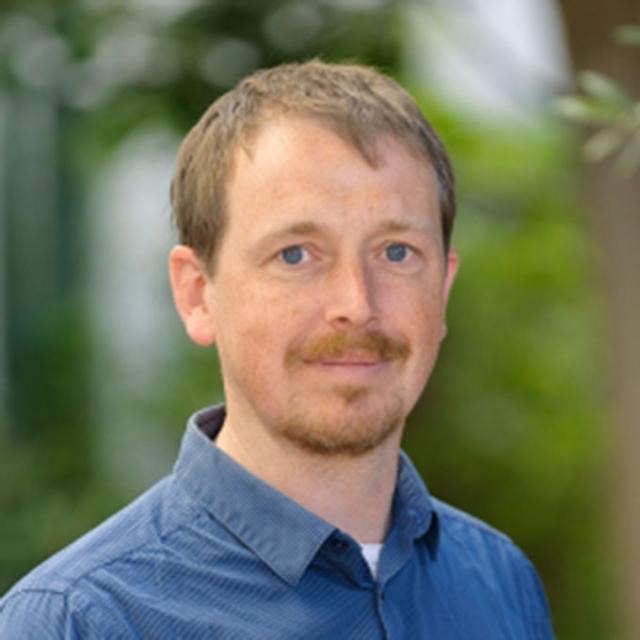
Wim van Dam
· Assistant ProfessorVerifiedUniversity of California, Santa Barbara · Art
Active 1978–2024
About
Wim van Dam is an associate professor at the departments of computer science and physics at the University of California, Santa Barbara, since June 2009. He joined UCSB's College of Creative Studies in July 2004, initially as an assistant professor in the Computer Science Department, and in July 2005, he also became an assistant professor in the Physics Department. Prior to his tenure at UCSB, Wim van Dam was a postdoctoral researcher at UC Berkeley, HP Labs Palo Alto, the Mathematical Sciences Research Institute, and MIT. His academic background and professional experience reflect a strong foundation in computer science and physics, with a focus on foundational aspects of computer science.
Research topics
- Computer Science
- Quantum mechanics
- Algorithm
- Physics
- Statistics
- Mathematical optimization
- Applied mathematics
- Finance
- Theoretical computer science
- Parallel computing
- Mathematics
- Discrete mathematics
- Statistical physics
Selected publications
Fault-tolerant quantum computation with a neutral atom processor
arXiv (Cornell University) · 2024-11-18 · 5 citations
preprintOpen accessQuantum computing experiments are transitioning from running on physical qubits to using encoded, logical qubits. Fault-tolerant computation can identify and correct errors, and has the potential to enable the dramatically reduced logical error rates required for valuable algorithms. However, it requires flexible control of high-fidelity operations performed on large numbers of qubits. We demonstrate fault-tolerant quantum computation on a quantum processor with 256 qubits, each an individual neutral Ytterbium atom. The operations are designed so that key error sources convert to atom loss, which can be detected by imaging. Full connectivity is enabled by atom movement. We demonstrate the entanglement of 24 logical qubits encoded into 48 atoms, at once catching errors and correcting for, on average 1.8, lost atoms. We also implement the Bernstein-Vazirani algorithm with up to 28 logical qubits encoded into 112 atoms, showing better-than-physical error rates. In both cases, "erasure conversion," changing errors into a form that can be detected independently from qubit state, improves circuit performance. These results begin to clear a path for achieving scientific quantum advantage with a programmable neutral atom quantum processor.
End-to-End Quantum Simulation of a Chemical System
arXiv (Cornell University) · 2024-09-09 · 1 citations
preprintOpen access1st authorCorrespondingWe demonstrate the first end-to-end integration of high-performance computing (HPC), reliable quantum computing, and AI in a case study on catalytic reactions producing chiral molecules. We present a hybrid computation workflow to determine the strongly correlated reaction configurations and estimate, for one such configuration, its active site's ground state energy. We combine 1) the use of HPC tools like AutoRXN and AutoCAS to systematically identify the strongly correlated chemistry within a large chemical space with 2) the use of logical qubits in the quantum computing stage to prepare the quantum ground state of the strongly correlated active site, demonstrating the advantage of logical qubits compared to physical qubits, and 3) the use of optimized quantum measurements of the logical qubits with so-called classical shadows to accurately predict various properties of the ground state including energies. The combination of HPC, reliable quantum computing, and AI in this demonstration serves as a proof of principle of how future hybrid chemistry applications will require integration of large-scale quantum computers with classical computing to be able to provide a measurable quantum advantage.
Demonstration of quantum computation and error correction with a tesseract code
arXiv (Cornell University) · 2024-09-06 · 7 citations
preprintOpen accessA critical milestone for quantum computers is to demonstrate fault-tolerant computation that outperforms computation on physical qubits. The tesseract subsystem color code protects four logical qubits in 16 physical qubits, to distance four. Using the tesseract code on Quantinuum's trapped-ion quantum computers, we prepare high-fidelity encoded graph states on up to 12 logical qubits, beneficially combining for the first time fault-tolerant error correction and computation. We also protect encoded states through up to five rounds of error correction. Using performant quantum software and hardware together allows moderate-depth logical quantum circuits to have an order of magnitude less error than the equivalent unencoded circuits.
arXiv (Cornell University) · 2023-11-10
preprintOpen access1st authorCorrespondingThe resource estimation tools provided by Azure Quantum and Azure Quantum Development Kit are described. Using these tools one can automatically evaluate the logical and physical resources required to run algorithms on fault-tolerant quantum computers. An example is given of obtaining resource estimates for quantum fault-tolerant implementations of three different multiplication algorithms.
2023-11-10 · 16 citations
article1st authorCorrespondingThe automatic resource estimation tools provided by Azure Quantum and Microsoft Quantum Development Kit are described, which enable the evaluation of the resources required to run algorithms on fault-tolerant quantum computers. An example is given of obtaining resource estimates for quantum fault-tolerant implementations of several multiplication algorithms.
Quantum Science and Technology · 2022 · 41 citations
- Computer Science
- Mathematics
- Computer Science
Abstract We report on the energy-expectation-value landscapes produced by the single-layer ( p = 1) quantum approximate optimization algorithm ( QAOA ) when being used to solve Ising problems. The landscapes are obtained using an analytical formula that we derive. The formula allows us to predict the landscape for any given Ising problem instance and consequently predict the optimal QAOA parameters for heuristically solving that instance using the single-layer QAOA . We have validated our analytical formula by showing that it accurately reproduces the landscapes published in recent experimental reports. We then applied our methods to address the question: how well is the single-layer QAOA able to solve large benchmark problem instances? We used our analytical formula to calculate the optimal energy-expectation values for benchmark M AX -C UT problems containing up to 7000 vertices and 41 459 edges. We also calculated the optimal energy expectations for general Ising problems with up to 100 000 vertices and 150 000 edges. Our results provide an estimate for how well the single-layer QAOA may work when run on a quantum computer with thousands of qubits. In addition to providing performance estimates when optimal angles are used, we are able to use our analytical results to investigate the difficulties one may encounter when running the QAOA in practice for different classes of Ising instances. We find that depending on the parameters of the Ising Hamiltonian, the expectation-value landscapes can be rather complex, with sharp features that necessitate highly accurate rotation gates in order for the QAOA to be run optimally on quantum hardware. We also present analytical results that explain some of the qualitative landscape features that are observed numerically.
Zenodo (CERN European Organization for Nuclear Research) · 2021-08-23
datasetOpen accessThis data repository contains the I-set instances of the paper "Expectation Values from the Single-Layer Quantum Approximate Optimization Algorithm on Ising Problems".
Quantum Optimization Heuristics with an Application to Knapsack Problems
2021-10-01 · 4 citations
preprintOpen access1st authorCorrespondingThis paper introduces two techniques that make the standard Quantum Approximate Optimization Algorithm (QAOA) more suitable for constrained optimization problems. The first technique describes how to use the outcome of a prior greedy classical algorithm to define an initial quantum state and mixing operation to adjust the quantum optimization algorithm to explore the possible answers around this initial greedy solution. The second technique is used to nudge the quantum exploration to avoid the local minima around the greedy solutions. To analyze the benefits of these two techniques we run the quantum algorithm on known hard instances of the Knapsack Problem using unit depth quantum circuits. The results show that the adjusted quantum optimization heuristics typically perform better than various classical heuristics.
Zenodo (CERN European Organization for Nuclear Research) · 2021-08-23
datasetOpen accessThis data repository contains the I-set instances of the paper "Expectation Values from the Single-Layer Quantum Approximate Optimization Algorithm on Ising Problems".
Prospects and challenges of quantum finance
HAL (Le Centre pour la Communication Scientifique Directe) · 2020-12-08
preprint49 pages, 4 figures
Recent grants
Quantum Algorithms for Data Streams
NSF · $69k · 2007–2009
Complexity of Simulating Quantum Adiabatic Optimization by Quantum Monte Carlo Methods
NSF · $250k · 2013–2016
CAREER: Algebraic and Semiclassical Methods for Quantum Computing
NSF · $400k · 2008–2015
Strengths and Weaknesses of Simulated Quantum Annealing
NSF · $200k · 2016–2019
Small:CIF:Exact Thresholds for Quantum Information Processing
NSF · $444k · 2009–2013
Frequent coauthors
- 17 shared
Andrew M. Childs
Joint Center for Quantum Information and Computer Science
- 15 shared
Michele Mosca
- 12 shared
Dave Bacon
- 9 shared
Harry Buhrman
- 8 shared
Miklós Sántha
- 8 shared
Matthias Steffen
- 7 shared
Richard Cleve
University of Waterloo
- 7 shared
Julia Kempe
Education
Ph.D.
Unknown
M.S.
Unknown
B.S.
Unknown
M.D.
Unknown
B.A.
Unknown
M.A.
Unknown
Other
UC Berkeley, HP Labs Palo Alto, the Mathematical Sciences Research Institute, and MIT
- Resume-aware match score
- Save to shortlist
- AI-drafted outreach
See your match with Wim van Dam
PhdFit ranks faculty by your research interests, methods, and publications — grounded in their actual work, not templates.
- Free to start
- No credit card
- 30-second signup