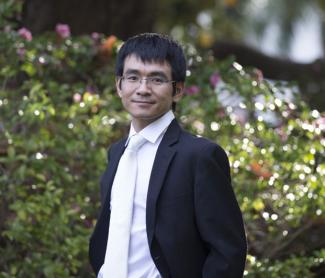
Xu Yang
· FacultyVerifiedUniversity of California, Santa Barbara · Mathematics
Active 2001–2025
About
The provided page text does not contain specific information about Professor Xu Yang's research focus, background, or key contributions. It primarily describes the structure and activities of the UCSB Directed Reading Program (DRP), including mentoring details, event schedules, and award winners. Therefore, there is no detailed professional biography available for Professor Xu Yang in the given content.
Research topics
- Biology
- Classical mechanics
- Physics
- Optoelectronics
- Medicine
- Chemistry
- Engineering
- Microbiology
- Materials science
- Condensed matter physics
- Electrical engineering
- Quantum mechanics
- Mathematics
- Geometry
- Mechanics
Selected publications
Spontaneous Macroscopic Quantum Synchronization in an Ensemble of Two-level Systems
ArXiv.org · 2025-11-14
preprintOpen access1st authorCorrespondingSpontaneous macroscopic quantum synchronization is an emergent phenomenon where an ensemble of quantum oscillators achieves global phase coherence through the interplay of interaction and dissipation. To illuminate this phenomenon, we study an ensemble of two-level systems (TLS) and establish its associated nonlinear quantum master equation, for which self-consistent analytical solutions of quantum synchronization can be obtained. The trajectories on the Bloch sphere vividly illustrate how dissipation and interaction drive the system toward a synchronized state. We present a phase diagram for macroscopic synchronization as a function of interaction strength and the gain-to-damping ratio. Furthermore, we demonstrate full synchronization and partial synchronization between two groups of TLS with different natural frequencies. This work establishes ensemble of TLS as a remarkable system for understanding spontaneous quantum synchronization.
Physics of Fluids · 2025-07-01 · 3 citations
article1st authorCorrespondingRoughness coefficients significantly influence flow resistance and are critical for accurate one-dimensional (1-D) river flow simulations. However, obtaining reliable roughness data in natural rivers is challenging due to spatial variability and measurement difficulties, leading to substantial uncertainty in hydraulic modeling. To address this, we propose a novel Physics-Informed Neural Network Roughness Estimation (PINN-RE) framework, which augments traditional PINNs by incorporating a dedicated neural network for predicting spatially distributed roughness. By coupling the roughness and the hydrodynamic field via the loss function governed by the Saint-Venant Equations, PINN-RE enables the simultaneous learning of spatially distributed roughness coefficients and hydrodynamics. The framework is evaluated using four scenario groups with varying roughness distributions. Results show that PINN-RE markedly improves hydrodynamic prediction accuracy compared to the conventional PINN, reducing the water depth error from 8.24% to 1.75% in a linear roughness case. Sensitivity analysis reveals a U-shaped error trend with sampling frequency, minimized at 300 points per station and the model is more sensitive to sampling frequency than to station count. Moreover, we analyze the relative importance of different physical quantities in the partial differential equation loss and find that the contribution of roughness is 10–50 times greater than that of water depth or discharge. These findings show the dominant role of roughness in 1-D flow modeling and demonstrate that PINN-RE not only offers a physically consistent and data-efficient solution to roughness identification, but also enhances the understanding of physical parameter interactions in river channels.
Journal of Physics A Mathematical and Theoretical · 2025-02-07 · 1 citations
articleOpen accessSenior authorCorrespondingAbstract The semi-classical regime of static Dirac matter is derived from the Dirac equation in curved space-time. The leading- and next-to-leading-order contributions to the semi-classical approximation are evaluated. While the leading-order yields classical equations of motion with relativistic Lorentz and a geometric forces related to space curvature, the next-to-leading-order gives a transport-like equation with source terms. We apply the proposed strategy to the simulation of electron propagation on strained graphene surfaces, as well as to the dynamics of edge states in photonic graphene.
Marine Energy Research · 2025-01-01
articleOpen access1st authorCorrespondingThe research focuses on the flow-induced motion (FIM) and energy harness of “Cir-Tri-Att” oscillators (CTAO). The wake was photographed by particle image velocimetry (PIV) to explore wake structures. With the increase of the aspect ratios: the ability of oscillators to galloping under self-excitation or external excitation is enhanced. When ζ = 0.033, Ur = 12.5, the maximum amplitude ratio A* = 2.408 for oscillators with α = 1:1. Moreover, oscillators with higher aspect ratios can bear larger loads, which is conducive to energy utilization and conversion. The maximum power output Pharn = 16.588 W and the optimal efficiency ηharn = 24.706% appear in oscillators with α = 1.5:1. Additionally, In the soft galloping (SG), the wake mode is 4P or 3P. The wake vortex is more broken and its scale increases, but the force effect of the oscillators is better and the oscillation is more stable. The pressure difference makes for a longer oscillation period. This paper summarizes the FIM, energy harness and wake structures of the CTAO under different working conditions, which provides theoretical and data support for the optimization oscillators of flow-induced motion tidal energy conversion system.
SSRN Electronic Journal · 2025-01-01
preprintOpen accessSIAM Journal on Financial Mathematics · 2025-06-16
articleUnfitted Spectral Element Method for Interfacial Models
Communications in Computational Physics · 2025-09-05
articleSenior authorIn this paper, we propose an unfitted spectral element method for solving elliptic interface and corresponding eigenvalue problems. The novelty of the proposed method lies in its combination of the spectral accuracy of the spectral element method and the flexibility of the unfitted Nitsche’s method. We also use tailored ghost penalty terms to enhance its robustness. We establish optimal $hp$ convergence rates for both elliptic interface problems and interface eigenvalue problems. Additionally, we demonstrate spectral accuracy for model problems in terms of polynomial degree.
Ocean Engineering · 2025-12-13 · 1 citations
article2025-06-13
preprintOpen accessAccurate earthquake location is of fundamental importance for understanding seismogenic process, revealing the Earth’s interior structure, and mitigating seismic hazard. However, precisely determining the depth of an earthquake is often challenging due to the severe trade-off between focal depth and origin time, especially in the absence of nearby seismic stations. To address this challenge, we have developed an integrative procedure for reliably and efficiently identifying the sP depth phase in local and regional seismic records. After preparing the traveltimes of first-arriving P, S waves and sP depth phases, we sequentially refine the earthquake hypocenter (longitude, latitude and depth) and origin time within a Bayesian inversion framework. The efficacy of the proposed depth phase identification procedure and earthquake location method is validated through the analysis of small-to-moderate aftershocks that occurred within two months of the 2019 Mw 7.1 Ridgecrest earthquake. Our study shows that including depth phases can significantly reduce location uncertainty in the depth direction, i.e., by a factor of five. Moreover, the results achieved by jointly using first arrivals and depth phases are less dependent on the background velocity model, enabling more accurate location estimates for 86.6% of the examined earthquakes after successfully identifying the sP waves. In regions northwest of the mainshock nucleation area, the base of the seismogenic zone is located generally below 10 km, likely sandwiching a much shallower brittle-to-ductile transition zone (< 4 km) beneath the Coso geothermal site. This locally abrupt change in rock rheology may inhibit the occurrence of M8+ earthquakes.
Journal of Materials Chemistry C · 2025-01-01 · 5 citations
articleThe high-pressure phase structures of CaYH 2 n ( n = 3–6) ternary hydrides were systematically explored employing a combination of particle swarm optimization and first principles calculations.
Recent grants
Kinetic Approaches for Multi-Scale Problems in Quantum Chemistry and Seismology
NSF · $293k · 2014–2018
Parallel Semiclassical Methods for Seismic Wave Propagation, Inversion, and Data Analysis
NSF · $200k · 2018–2022
Frequent coauthors
- 28 shared
Santa Bárbara
- 28 shared
Warsaw Antonio Elz ̇bieta Jarze ̨bowska
University of California, Santa Barbara
- 28 shared
J Machado
University of California, Santa Barbara
- 28 shared
Madrid Carpio
University of California, Santa Barbara
- 28 shared
Na Łódzá
University of California, Santa Barbara
- 28 shared
Yuri York
Walter de Gruyter (Germany)
- 28 shared
Brasília Sobral
Walter de Gruyter (Germany)
- 28 shared
Jan Awrejcewicz
Labs
UCSB DRPPI
Education
- 2008
Ph.D., Mathematics
University of Wisconsin Madison
- Resume-aware match score
- Save to shortlist
- AI-drafted outreach
See your match with Xu Yang
PhdFit ranks faculty by your research interests, methods, and publications — grounded in their actual work, not templates.
- Free to start
- No credit card
- 30-second signup